Highlights
- The UK plots retaliatory tariffs
- Trump and Vance say the economy is “healing”
- The eurozone is now facing a recession
Get bank-beating rates — zero hidden fees
Join 10,000+ clients transferring salary, property deposits and business payments globally.


Labour has kicked off its election campaign
The Prime Minister continued the theme that his Party used at the General Election by highlighting the changes that Labour has brought in over the past nine months and telling the assembled Party candidates that he believes that change is as applicable to local elections as it is to Parliamentary ones.
Starmer followed that by meeting business leaders to brief them on the Government’s intentions towards the imposition of tariffs on UK exports to the U.S. He told them that he would approach the suggestion of retaliatory measures calmly and considered.
He said that he has not yet decided if imposing tariffs on U.S. imports into the UK would be the most productive reaction. He told the group of company CEOs and Finance Directors that it was clear that the measures announced by President Trump this week would affect UK growth, but he was intentionally vague about how serious he felt the “hit to growth” would be.
The Ministry of Trade published a list of over four hundred items that the UK imports from the U.S., which would form the basis of retaliatory tariffs should he decide to go down that route.
His audience believes that since Trump is trying to divide and conquer, Labour should try to solidify its relationship with Brussels and present a united front.
Sterling broke the 1.30 barrier, which has limited its progress this year and reached a high of 1.3195 before drifting back to close at 1.3085.
The most severe blow to the UK economy from the imposition of tariffs will be felt in the auto sector. The 25% tariff imposed on the import of vehicles into the U.S will be felt strongly by luxury marques like Jaguar, Bentley and Range Rover, but smaller niche manufacturers like Morgan could see their business face a crippling blow.
Trump told company representatives recently that the solution to their dilemma is simple; establish a manufacturing operation in the U.S., for which it would receive support from Federal and State sources.
The company does not want to go down that path and is facing an uncertain future.
Next week will see the publication of GDP data for March, which will allow the market to estimate if the economy managed to grow at all in the first quarter. If the economy contracts between January and March, it may be a signal that the tariffs will push the economy into recession. This would be a major blow to the Chancellor since the measures she announced that came into effect this week will also cause uncertainty.
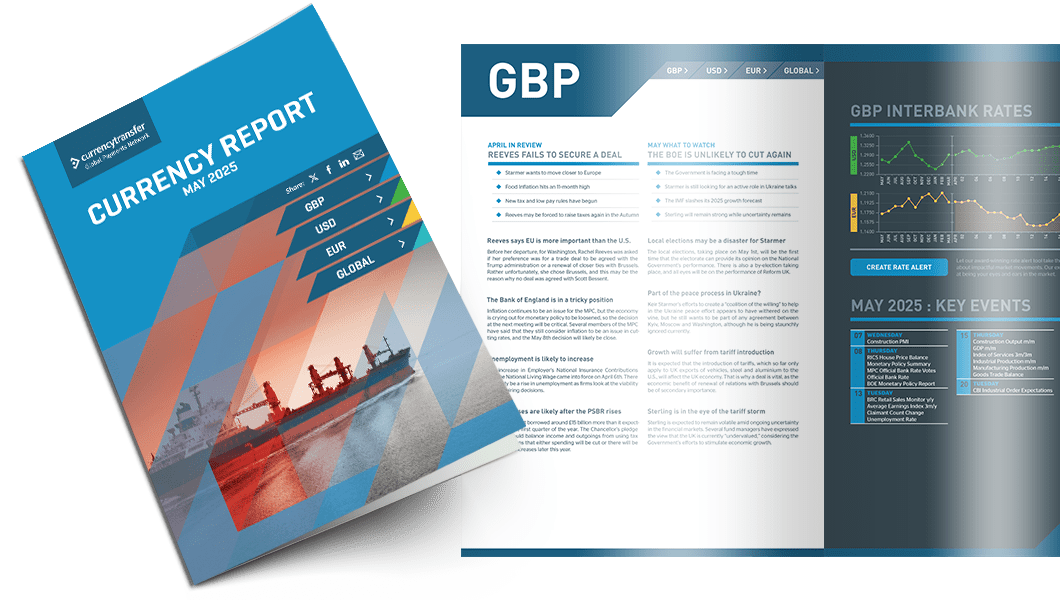
Read our latest currency report
Most impactful events planned this month and how they could impact your business
Powell is under the microscope
Asset markets were stunned by the announcement of tariffs this week, despite President Trump flagging his intentions.
Several major brands like Nike and Apple have seen their established business models shredded by the proposals, even as Trump highlighted their intentions to build facilities in the U.S.
Nike, for example, manufactures in Vietnam and Indonesia, two countries that face some of the highest tariffs. It will be impossible for those tariffs to be passed on to consumers in their entirety, which will bring a major reevaluation of their business strategy. Trump told his audience on Wednesday afternoon that Apple already had plans in place to invest five hundred billion dollars in new plants and factories in the U.S.
It is unclear how advanced those plans are, or even if they are a figment of the President’s overactive imagination.
Several stock market indices saw their worst day in years as the market pronounced its concerns over what Trump’s measures will mean in the short to medium term.
Trump shrugged off their concerns, firm in his belief that he has begun the country on a path towards greater prosperity.
The Federal Reserve has remained tight-lipped so far as it tries to consider the effect of the imposition of tariffs that are sure to cause major disruption to consumers.
How much of those tariffs will be able to be passed on to the public remains to be seen, but inflation is unlikely to reach the Central Bank’s 2% target this year.
Today’s publication of the March Employment report has arrived almost unnoticed.
Estimates put today's headline figure at 135k, down from 151k in February. Should the figure be close to that level, the FOMC will likely be able to leave rates unchanged while it tries to figure out the effect on inflation that the measures in Trump’s announcement will have.
The dollar index fell through support at 103.20 yesterday and reached a low of 101.30. The market hasn't taken too much notice of the effect of a possible trade war on the dollar, and yesterday’s moves were more of a knee-jerk reaction. Over the next few days and weeks, investors will study the likely effect, and the dollar could see a positive reaction as inflation may rise in the U.S. while other G7 nations see growth affected, meaning they will be more inclined to loosen monetary policy.
HSBC sees tariffs hitting the economy hard
The most significant losers will be Germany, France and Italy, which have industries which see a significant amount of the products exported to the U.S.
The eurozone economy has never been far from recession over the three years since Russia’s invasion of Ukraine sent energy prices surging. It may finally be tipped over the edge by a fresh blow from another direction, as the Trump administration targets its exports.
While its consumers were tightening their belts, businesses in Europe could at least sell into areas that were less affected by the war. This included the U.S. but that avenue has been effectively closed now. For some, that may prove to be one blow too many.
“The direct impact of lower exports will drag growth down, but even more damaging could be the broader shock to confidence,” according to Moody's. “If negotiations fail to yield concessions and these tariffs remain in place, the eurozone will slip into recession this year.”
The European Central Bank could lower borrowing costs further if the current economic trajectory is maintained, Governing Council member Martins Kazaks told Bloomberg News in an interview on Thursday.
Kazaks, who is also the Latvian Central Bank Governor, told Bloomberg News that tariffs are another source of uncertainty.
The ECB is expected to announce its seventh rate cut two weeks from today, but the Governing Council may hold off to see what impact the tariffs have on the eurozone economy, leaving the decision on a knife edge.
ECB president Christine Lagarde, speaking in Dublin yesterday, said that inflation in the eurozone was now close to the ECB’s target.
But there was huge uncertainty around how the tariffs would affect eurozone economic growth, said Ms Lagarde, who was in Dublin to receive an award.
She gave no direct hints about rate cutting but did reference the benefits of low rates and emphasized the need for Europe to take actions to strengthen the eurozone economy.
Economists listening to her remarks felt that Lagarde appeared less worried about inflation than she had in recent months, concentrating on the prospects for economic growth.
The euro benefitted from the turmoil in global markets yesterday, but its show of strength may be short-lived, as tariffs could drive the region closer to a recession.
The single current rose to a high of 1.1130, easily breaking through resistance at 1.10 and closed at 1.1110
Have a great day!

Exchange rate movements:
03 Apr - 04 Apr 2025
Click on a currency pair to set up a rate alert
Alan Hill
Alan has been involved in the FX market for more than 25 years and brings a wealth of experience to his content. His knowledge has been gained while trading through some of the most volatile periods of recent history. His commentary relies on an understanding of past events and how they will affect future market performance.