Highlights
- The economic deal with the U.S. may save thousands of jobs for British carmakers and the steel industry
- Will the economy drift into recession unless the Fed acts?
- Foreign workers are boosting Eurozone growth
Get bank-beating rates — zero hidden fees
Join 10,000+ clients transferring salary, property deposits and business payments globally.


Bailey believes that there is still uncertainty
He would certainly like us to believe it is so, but the trade deal between the UK and the U.S. may not be all it seems.
When announcing the agreement at the Jaguar Land Rover Plant in Solihull yesterday, he wasted no opportunity to tell the workers how it has potentially saved the jobs of thousands of employees there and in the steel and aluminium industries.
However, when reminded that following the deal, there will still be tariffs on JLR’s exports to the U.S., 10% on the first one hundred thousand vehicles per year, with the size of tariff on exports above that number not yet being revealed, he told reporters to compare it to the previous day, when tariffs were at 27% and not consider six months ago when the tariff was just 3%.
The Trade deal is “typical Trump”; he has managed to get the Prime Minister to accept 10% rather than 27%, which may or may not have been imposed in July, and not consider that it will be 7% more than before.
Furthermore, the PM has also given the U.S. greater access to the UK’s agricultural market, particularly in beef and other grains and cereals. He managed to avoid having genetically modified meat forced upon him, since that remains illegal in the UK.
The leaders of the Westminster Opposition Parties were united in their criticism. Both Kemi Danenoch and Ed Davey agreed that the deal heavily favours the U.S. agenda, while Nigel Farage agreed with them but accepted that it is a start, although there is still a long way to go.
As expected, the Bank of England cut the base rate of interest yesterday, from 4.50% to 4.25%. When making the announcement, the Bank’s Governor told reporters that the U.K. was heading for more economic uncertainty, despite the country being the first to strike a trade agreement with the U.S. under President Donald Trump’s controversial tariff regime.
“The tariff and trade situation has injected more uncertainty into the situation... There’s more uncertainty now than there was in the past,” Bailey told CNBC in an interview.
“A U.K.-U.S. trade agreement is very welcome in that sense, very welcome. But the U.K. is a very open economy,” he continued.
That means that the impact from tariffs on the U.K. economy comes not just from its trade relationship with Washington, but also from those of the U.S. and the rest of the world, he said.
“I hope that what we’re seeing on the U.K.-U.S. trade side will be the first of many, and it will be repeated by a whole series of trade agreements, but we have to see that happen, of course, and where it actually ends up.”
He also made the point that “we are looking at tariff levels that are probably higher than they were beforehand.”
There was an unusual “mix” in the MPC voting, with five members voting for the twenty-five point cut, two, Huw Pill and Catherine Mann, voting for no change and two, Swati Dhingra and Alan Taylor, for fifty points.
That voting pattern sums up the uncertainty around creating a level of monetary policy that works for the economy currently.
The pound was trading at 1.1335 as the announcement was made, but gradually lost ground during the afternoon to close at 1.3244.
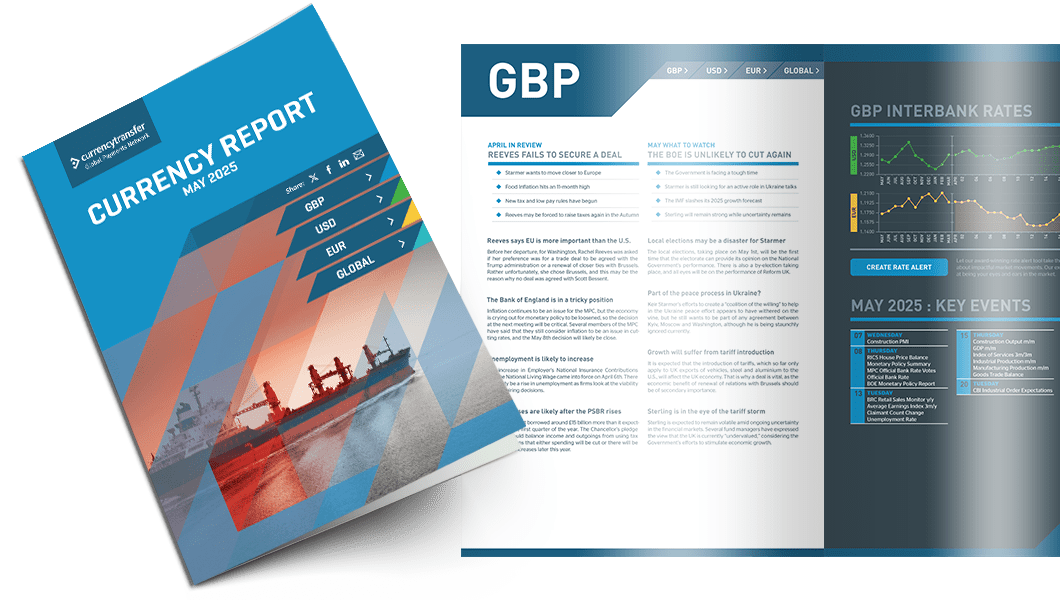
Read our latest currency report
Most impactful events planned this month and how they could impact your business
Rates may be cut in June or July, depending on the data
The decision, made unanimously by the Federal Open Market Committee, follows three rate cuts in 2024 that lowered the federal funds rate from 5.5%.
Federal Reserve Chair Jerome Powell cited the tariffs as the reason the FOMC decided not to lower interest rates further.
“The tariff increases announced so far have been significantly larger than anticipated,” he told reporters following the FOMC’s two-day meeting. “If the large increases in tariffs that have been announced are sustained, they are likely to generate a rise in inflation, a slowdown in economic growth, and an increase in unemployment.”
However, it is unknown whether the tariffs could trigger a short-lived inflation spike or something more persistent, how long they will remain in place, and what effect they will have on the economy.
What looks likely, given the scope and scale of the tariffs, is that we will see, certainly, the risks to higher inflation and unemployment have increased,” Powell continued. “And if that’s what we do see and if the tariffs are ultimately put in place at those levels, which we don’t know, then we won’t see further progress toward our goals.”
Powell declined to commit to any rate cuts soon, preferring to take a wait-and-see approach.
“It’s going to depend. We’re going to need to see how this evolves,” he said.
For now, though, the economy appears to be healthy.
“Although swings in net exports have affected the data, recent indicators suggest that economic activity has continued to expand at a solid pace,” the Federal Reserve Bank said.
He believes that, in his view, marginal contraction in GDP in the first quarter of the year is solely due to the overstocking by importers concerned by the imposition of tariffs.
We will get the thoughts of several members of the FOMC later today, when several of them will make speeches in various areas of the country.
Yesterday’s publication of jobless claims numbers backed Powell’s comments. Having risen to a high of 241k in the previous reporting period, claims fell back to close to their four-week average at 228k.
The dollar index finally broke through the 100 level yesterday, driven by the fact that the Trump administration is open to agreeing to trade deals. It rose to a high of 100.71 and has rallied further in early Asian trading.
The growth outlook is bleak
While inflation figures for April disappointed, falling energy prices are still likely to push headline inflation to 2% before the end of the year, allowing the ECB to cut rates twice more.
Eurozone growth surprised in the first quarter with a 0.4% quarter-on-quarter expansion. Interestingly, a 0.4% increase in the eurozone has been lauded as significant, while a 0.3% fall in the U.S. GDP is considered marginal.
The details of the GDP component have not been published yet, but stronger exports ahead of the US import tariffs were the likely key driver. However, this unusual boost in the first quarter may lead to weaker performance in the subsequent ones. This is already evident in the European Commission’s business and consumer survey, where production expectations in manufacturing fell significantly in April after three consecutive months of increases.
Additionally, as long as uncertainty regarding tariffs persists, companies might delay investment and hiring decisions. Households are also likely to postpone spending on big-ticket items due to increased geopolitical uncertainty. The sharp drop in consumer confidence in April supports this view.
On the positive side, the drop in energy prices provides welcome relief for both businesses and households, offsetting some of the negative impact of the trade war. While the impact of increased defence spending on GDP growth due to high import leakage and offsetting expenditure cuts has been downplayed, this view has strengthened as some countries attempt to reclassify existing public spending as defence spending.
The German infrastructure package will provide a tailwind, though its impact will only be felt from 2026 onwards.
Overall, economic stagnation is likely in the coming quarters, though a full-blown recession seems unlikely.
The region’s largest economy is likely to contribute more to GDP in the coming quarters.
Germany must pursue trade deals as part of wider European Union efforts to diversify its markets, new Economy Minister Katherina Reiche said on Wednesday, adding the United States would remain the country's main trade partner.
She spoke about the importance of diversifying the European Union's trading partners with free trade agreements with countries such as Australia, Chile, India and Mexico, as well as Latin America's Mercosur bloc, but added the United States would remain Germany's main trading partner.
The European Commission is coordinating the 27-nation bloc's response to import tariffs announced by U.S. President Donald Trump, including a 25% levy on its steel, aluminium and cars and an additional 10% on almost all other goods.
"Trade wars have disadvantages for both sides, and that is why we must reach a free trade agreement with the U.S", Reiche said.
"We cannot hope that the trading opportunities for German companies will automatically improve in the coming years. We have to take action ourselves," Reiche said after the handover ceremony with former economy minister Robert Habeck.
The Euro took something of a backseat as traders concentrated on the trade deal between the UK and the U.S. and the interest rate cut in the UK.
The single currency rallied to a high of 1.1308 during the morning, but gradually lost ground from then on, closing at 1.1213.
As the U.S. makes further trade agreements, the Euro may have seen its highest level for the year.
Have a great day!

Exchange rate movements:
08 May - 09 May 2025
Click on a currency pair to set up a rate alert
Alan Hill
Alan has been involved in the FX market for more than 25 years and brings a wealth of experience to his content. His knowledge has been gained while trading through some of the most volatile periods of recent history. His commentary relies on an understanding of past events and how they will affect future market performance.