
Highlights
- Starmer shuffles his pack
- The Supreme Court blocking Trump could ‘end’ the economy
- Lagarde talks of the ‘worrying risk’ if France ‘collapses’
Get bank-beating rates — zero hidden fees
Join 10,000+ clients transferring salary, property deposits and business payments globally.


Starmer’s shake-up may unsettle the Treasury
Sir Keir Starmer acknowledged that it has taken longer than he either hoped or expected to set the country on the right path, and he is as frustrated by this as many voters, but then he went on to make more promises that things will get better.
He marked the return of Parliament from its summer recess by reshuffling his Downing Street team, while leaving his Cabinet unscathed. If this was to provide confidence that things are going in the right direction, he failed.
Amongst the changes, there was a promotion for Treasury minister Darren Jones, who will become Chief Secretary to the Prime Minister, a new position with a seat at the Cabinet table. But the shake-up risks undermining Chancellor Rachel Reeves, already braced for a bruising autumn Budget and the likelihood of major tax rises.
Not surprisingly, the opposition has been quick to seize on the switch as a serious snub to the chancellor, weakening and undermining her and her department.
There is, though, another way of viewing Jones’s arrival. Starmer is not comfortable with economics. Give him the law, and he is a fluent expert, as good as anyone in the Inns of Court. He speaks the language, can see both sides, and to present a reasoned, coherent argument. It’s his background; he did it for decades at the highest level. But in matters financial, he struggles to understand the finer points. He prefers to let others do the talking for him, notably Reeves herself, who never ceases to remind people that she once worked as a Bank of England economist and at a clearing bank.
Just how proficient and senior she really was has been the subject of debate, but one aspect is clear: her communication and delivery have been poor. So much so that support for Labour has plummeted, and the government’s ability to win a second term must already be in doubt. This, don’t forget, is from a position of overwhelming strength, with a substantial majority.
The move smacks of panic. It is not the traditional Cabinet reshuffle, rewarding the hard work of backbench Labour MPs. It may be considered as Starmer punishing his junior colleagues for their revolt over benefit reform.
Millions of people could be hit with a shock new penalty on their retirement savings under Labour's latest tax plans. Rachel Reeves is facing a backlash from landlords, who have branded the proposed levy on rental income unjust.
Treasury proposals to impose National Insurance contributions on rental income would impact millions who rely on property investments for their retirement funds, according to industry representatives.
Reeves suddenly finds herself under pressure to deliver on her promises. Her position may become untenable if she is unable to fulfil the pledges she has made. It will no longer do to say that “it will take a long time, but it will be worth the wait and hardships.
The pound rose to the top of its recent range yesterday as the U.S. celebrated Labor Day. It reached a high of 1.3550 and closed at 1.3544. The market lacks the momentum to drive Sterling to a new high, and it is likely to continue to drift until the Bank of England’s September meeting in a couple of weeks.
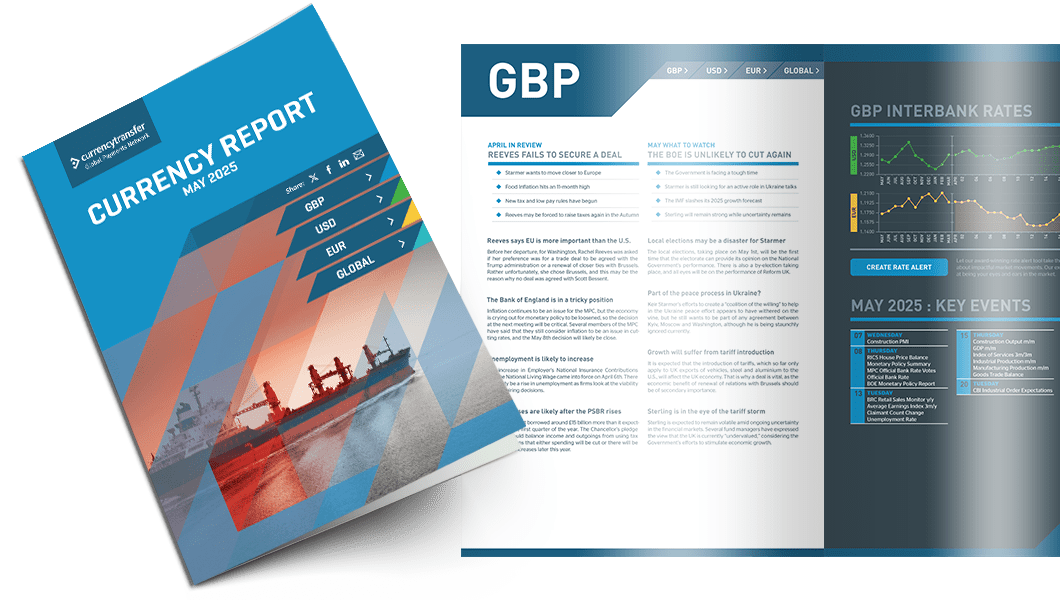
Read our latest currency report
Most impactful events planned this month and how they could impact your business
Lagarde enters the war over Fed independence
President Trump would inflict “very serious” damage on the US and global economy if he were to sack Federal Reserve chairman Jerome Powell or governor Lisa Cook, ECB President Christine Lagarde told reporters yesterday. There would be “very worrying” consequences for economic stability if Trump succeeded in his attempts to encroach on the Federal Reserve’s independence by removing either Jerome Powell or Lisa Cook from their current positions.
“If US monetary policy were no longer independent and instead dependent on the dictates of this or that person, then I believe that the effect on the balance of the American economy could, as a result of the effects this would have around the world, be very worrying, because it is the largest economy in the world,” she said.
The comments reflect efforts among the central banking community outside the United States to rally behind Powell, who has been repeatedly attacked by Trump, and other Fed officials and promote the benefits of keeping monetary policy separate from the political sphere.
The opposite view was put forward by Peter Navarro, a senior adviser to Trump and a member of the current Administration.
Navarro said that it would be “the end of the United States” if President Trump’s sweeping global tariffs are ultimately struck down by the Supreme Court. In May, the U.S. Court of International Trade ruled that President Trump had exceeded his authority by using the International Emergency Economic Powers Act to impose his tariffs.
The court held that tariffs are a power reserved for Congress and that the President cannot use IEEPA to unilaterally impose sweeping import duties. This ruling permanently blocked enforcement of the tariffs, deeming them unconstitutional, although the court’s decision was temporarily stayed, allowing the tariffs to remain in effect while appeals continued.
The administration is reportedly putting maximum pressure on the high court and public opinion, in an attempt to frame the future of Trump’s trade regime in more pragmatic terms.
“The core Congressional power to impose taxes such as tariffs is vested exclusively in the legislative branch by the Constitution,” the court said. “Tariffs are a core Congressional power.”
“If these Tariffs ever went away, it would be a total disaster for the Country,” Trump wrote in a Social post. “If allowed to stand, this Decision would literally destroy the United States of America.” Trump’s talent for overstating issues to make his point is becoming more understood by the public the longer his second term lasts.
The dollar index was in the doldrums yesterday, trading between 97.77 and 97.54 and closing at 97.68. The rest of the week is likely to be more volatile as the market returns from its summer vacation.
Italy is close to exiting the EU's excess deficit procedure
Revisions to Eurozone unemployment data have created a true Groundhog Day feeling, as unemployment has dropped once again to the historic low of 6.2% seen every month, without ever appearing to tick up.
The most recent data shows declines in the unemployment rate in June and July from 6.4 to 6.2%. As a reminder, last month’s release also showed unemployment at 6.2% in April, May and June.
In the past, there has been speculation over the data, as the “outlying states” have occasionally been accused of being “lazy” when conducting the relevant surveys. To be honest, is it truly conceivable that in a dynamic and fast-developing economy like the Eurozone, employment can barely move for an entire quarter despite a significant softening of monetary policy?
French and German leaders rolled out a catalogue of joint projects on Friday in Toulon, vowing to prove their partnership still drives EU policy.
Trumpets sounded and smiles flashed as Emmanuel Macron and Friedrich Merz opened the 25th Franco-German Council of Ministers, which the French president hailed as a “turning point” in bilateral ties.
“Together, France and Germany want to give Europe new momentum: more competitive, more productive and more sovereign,” Macron summed up.
Merz echoed the sentiment, stressing that Paris and Berlin “share the same clear-eyed view of the major domestic and external challenges” they face.
The two leaders set out eight strategy papers and some 20 flagship projects, spanning energy, trade, industry, advanced tech, competitiveness and the single market.
Among them was a pledge to boost Franco-German cooperation on trade-related issues, which have been a major point of disagreement between Paris and Berlin in recent years.
This was clearly not the time for matters on which the two leaders disagree to be aired, so issues like the EU’s free trade agreement with Mercosur, backed by Berlin but opposed in Paris over fears it would harm French farmers, were shelved for another time.
Italy is expected to leave the EU’s excessive deficit procedure as it is close to achieving a budget deficit of below 3% of GDP, Christine Lagarde remarked yesterday.
Being under the “excessive debt procedure reduces a country’s room for manoeuvre on public spending and taxation, since they are obliged to concentrate heavily on fiscal deficits. This is a testament to the measures put in place by Giorgia Meloni’s right-wing Government, as it continues to drive the economy forward.
The euro also took a breather yesterday, although it briefly rallied to a high of 1.1736. It quickly ran into selling pressure, which drove it lower to close at 1.1686.
Have a great day!

Exchange rate movements:
01 Sep - 02 Sep 2025
Click on a currency pair to set up a rate alert
Alan Hill
Alan has been involved in the FX market for more than 25 years and brings a wealth of experience to his content. His knowledge has been gained while trading through some of the most volatile periods of recent history. His commentary relies on an understanding of past events and how they will affect future market performance.