
Highlights
- The Inflation target provides a clear benchmark, says Pill
- Goolsbee is a 'little wary' of front-loading too many rate cuts
- Should France “benchmark its “social charter” against G7 Eurozone states?
Get bank-beating rates — zero hidden fees
Join 10,000+ clients transferring salary, property deposits and business payments globally.


A deflation of the AI bubble could cause a market crash - Bailey
Pill, who voted against the BoE’s most recent rate cut to 4% in August, said his speech at the University of Birmingham was not intended to be a comment on the current stance of monetary policy or the economic outlook.
However, he said that central bankers should make clear their commitment to prioritising price stability above broader goals for growth and employment, over which they could exert little long-term influence.
"We should be cautious in assigning monetary policy responsibility for real economic outcomes because, over the longer term at least, all monetary policy can do is determine the nominal dynamics of the economy," he said.
The BoE estimates that British consumer price inflation reached 4% in September and forecasts that it will not return to its 2% target until mid-2027.
Pill also said there was now too much uncertainty in the economy, both from unpredictable geopolitical events and difficulties in estimating underlying economic variables, to focus on especially sophisticated approaches to setting rates.
Noisy, frequently revised official economic data and potential shifts in labour market behaviour since the pandemic made it hard to calculate reasonable estimates of how much spare capacity there was in the economy or the neutral level of unemployment, in a timely enough way for policymakers, he said.
British authorities should adopt a "pragmatic and open-minded approach" to the applications of artificial intelligence and seek to mitigate the risks it poses, rather than merely highlighting them, Bank of England Governor Andrew Bailey has said.
"We must understand what it can and cannot deliver, and where it can create broader issues that will need to be tackled. But I would say to the alarmists that it is all of our responsibility to solve such issues rather than just broadcast them," he said.
Bailey said there was a need for a supportive domestic environment to facilitate investment in AI and other projects that require time to yield returns, and stated that he supported government efforts to encourage pension funds to invest more in British businesses.
UK housing and business sentiment weakened further in September as budget concerns weighed on confidence. The RICS house price balance improved slightly to -15, but demand stayed weak, while business confidence hit a three-year low amid expectations of higher taxes in November’s budget.
Confidence in the Chancellor has reached a new low as analysts have begun to criticise the measures she is expected to introduce, even before she has a chance to deliver them.
Reports suggest Reeves may seek new housing-related tax measures to meet fiscal targets. Economists also linked the recent drop in the Halifax house price index to pre-budget jitters.
In the rental market, landlord listings have dropped to their lowest level since 2020, while tenant demand remains strong, suggesting that rents are expected to rise by around 3% over the next year.
A separate Institute of Chartered Accountants business survey found corporate sentiment had deteriorated sharply, with 60% of firms citing the tax burden as a growing challenge.
The financial markets lack new factors to set a clear direction for Sterling over the next quarter. Huw Pill’s intervention yesterday showed that there is clear uncertainty over Bank of England Monetary Policy, with the Chief Economist unlikely to have made hawkish comments unless he agrees with the Bank’s Governor.
The data, coupled with these comments, suggest a period of mild stagflation as the economy continues to experience anaemic growth while inflation, to use the Fed’s expression, becomes “sticky.” Sterling lost a marginal amount of ground yesterday, falling to a low of 1.3371 and closing at 1.3403
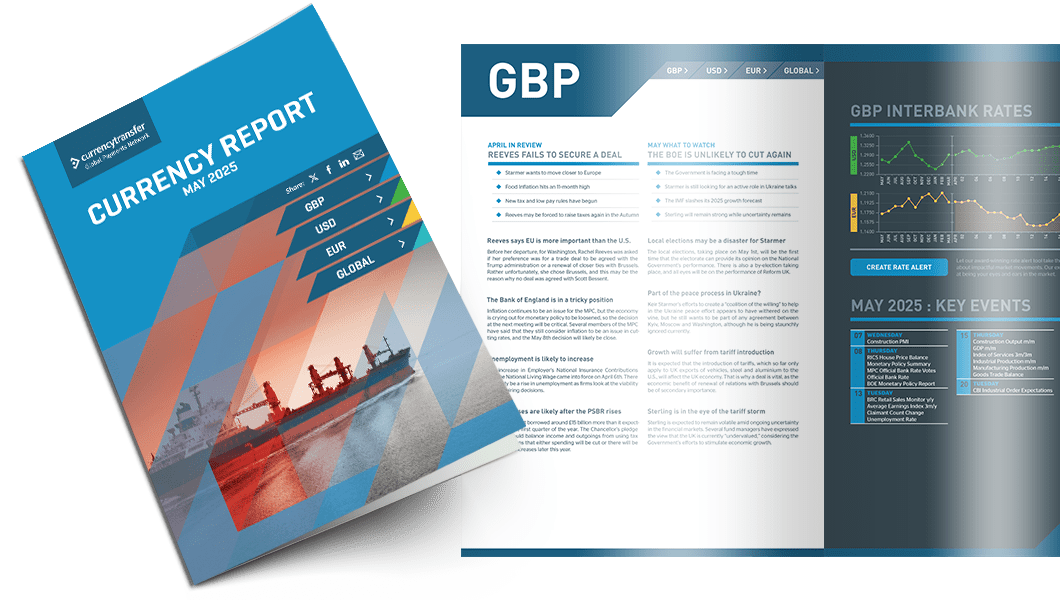
Read our latest currency report
Most impactful events planned this month and how they could impact your business
FOMC members are “hunting in packs”
The funding lapse has forced offices, national parks and other federal government operations to close or curtail operations, while employees have been furloughed. Signs of strain have mounted in recent days in the parts of the federal government that remained operational, with staffing shortages reported at airports across the US as well as at air traffic control centres.
Further disruptions may come next week, when US military personnel and other federal workers who remain on the job will not receive salaries, unless the government reopens.
When the Senate met yesterday, it became clear that sentiment had not shifted in the eight days since the shutdown began. For the sixth time, Democratic and Republican proposals to restart funding both failed to receive enough support to advance, and no senators changed their votes from recent days.
Democrats are demanding that any bill to fund the government be paired with an array of healthcare-centred provisions, including an extension of premium tax credits for Affordable Care Act (ACA) plans. Those expire at the end of the year, and costs are set to rise for the plans’ roughly 20 million enrollees if they are not renewed.
However, these demands are not the central point of the argument, which is now fast becoming a battle of wills between a President who feels he should have ultimate power and a Congress which is determined to keep hold of the checks and balances put in place to prevent any such power grab.
President Trump’s overall attitude toward naysayers has hardened since it was revealed that he had no entitlement to interfere in central bank policy. However, he has set about replacing several Federal Reserve governors with people loyal to him.
Federal Reserve officials showed a willingness to lower interest rates further this year, but many expressed caution driven by concerns over inflation at their policy gathering last month.
“Most judged that it likely would be appropriate to ease policy further over the remainder of this year,” according to minutes of the FOMC’s September meeting. The record of the meeting also showed “a majority of participants emphasised upside risks to their outlooks for inflation.”
“In considering the outlook for monetary policy, almost all participants noted that, with the reduction in the target range for the federal funds rate at this meeting, the Committee was well positioned to respond in a timely way to potential economic developments,” the minutes stated.
“Participants expressed a range of views about the degree to which the current stance of monetary policy was restrictive and about the likely future path of policy,” the document added. “Most judged that it likely would be appropriate to ease policy further over the remainder of this year.”
This week has seen the “usual suspects” making comments to support the overall view that the Fed will not be entering into preemptive rate cuts, despite the pressure that the administration continues to exert.
Goolsbee, Kashkari, Williams, Logan and Barr have all spoken and have said more or less the same thing.
The dollar continues to rally, with political events in France and Japan weighing on the two most significant components of the index. Yesterday’s deadline to form a new government in France carries downside risks for the EUR, but the dollar run looks overdone, and dovish-leaning Fed minutes could trigger a correction.
The dollar index rose to its highest level since August 1st. Still, with the unpredictability created by the shutdown showing no signs of ending, it is unlikely to continue forging new highs. It reached a high of 99/06 and closed at 98.84.
Lagarde is “concerned” about the situation in France
There is a growing rift between the hawkish sentiments displayed by Nagel, Escriva and Elderson, among others, and the views of the markets.
While the ECB continues to show caution about further rate cuts, option traders in the FX market are adding to positions that would benefit from a significant rate reduction throughout the first half of next year.
Three rate cuts are the prediction of the market before the end of June, even as Bundesbank President Joachim Nagel was commenting that the ECB’s monetary policy stance is appropriate.”
“Eurozone inflation is close to the medium-term target of 2%, seen remaining there in the coming years,” he added.
The market and the Central Bank are viewing the same thing through different lenses. Traders and investors are trying to determine what current policies will create in terms of growth, while the ECB is evaluating the measures it has taken so far to combat inflation, regardless of their impact on growth.
Central Banks have become more cautious over the past twenty-five years, a period that has included the creation of the ECB. Gone are the days when the likes of Greenspan and Bernanke made bold, preemptive decisions and carried the legislature with them, as markets did not question them or their motives.
The creation of a Central Bank that decides every policy move by committee has slowed down its ability to be quick and nimble on its feet, and to react to unexpected situations, often before the effect has been fully realised.
The situation in France continues to deteriorate. Political turmoil over the budget exposes contrasts in work culture and employee productivity between Europe, China and the US.
There have been questions raised in the French press about whether France can continue to be overly generous in its pursuit of an economy that can provide a high level of social care while remaining within the confines of the European Union.
This week’s collapse of the French government – featuring the resignation of a prime minister after only 27 days in office – marks the latest twist in a protracted political crisis threatening to bring the robust European economy to a halt as it grapples with unpopular budget measures, a deepening debt burden and stiff competition from the US and China.
Former Prime Minister Sébastien Lecornu, now acting in a caretaker capacity after his resignation on Monday, has set a modern record for the briefness of his tenure. He had until the close of business yesterday to salvage a budget that would bring drastic cuts to public benefits.
The deadline expired with no fresh proposal that would be acceptable to both sides.
A proposal from Lecornu’s predecessor, the similarly short-lived François Bayrou, included the removal of two public holidays, prompting a wave of discontent that helped seal his fate.
The option traders backing a fall in the value of the Euro over the next three to six months appear to have backed the right horse, but possibly for the wrong reasons. It may be fiscal policy rather than monetary policy that leads to a return to the days of Euro weakness.
The common currency fell to a low of 1.1598 yesterday and closed at 1.1628.
Have a great day!

Exchange rate movements:
08 Oct - 09 Oct 2025
Click on a currency pair to set up a rate alert
Alan Hill
Alan has been involved in the FX market for more than 25 years and brings a wealth of experience to his content. His knowledge has been gained while trading through some of the most volatile periods of recent history. His commentary relies on an understanding of past events and how they will affect future market performance.