Highlights
- The UK faces a triple whammy of economic gloom
- How will the “invasion” in Venezuela affect the economy?
- What to expect from December’s CPI Data
Get bank-beating rates — zero hidden fees
Join 10,000+ clients transferring salary, property deposits and business payments globally.


Will UK interest rates fall in 2026?
His allies concede he starts 2026 in a vulnerable position. There is frustration within Downing Street at the slow pace of passing legislation through Parliament, yet Ministers believe new laws due to kick in this year will start to deliver tangible change.
Other centre-left parties inspire Labour’s plan to turn things around. In Norway, Australia and the Netherlands, they managed to hold off threats from insurgent right-wing opponents by focusing on bread-and-butter issues like the cost of living.
Starmer has tried to highlight a freeze in some rail fares, energy bill subsidies, and childcare support that he hopes voters will feel the benefits of this year, but the growth that he and his Chancellor crave continues to elude them.
Those close to him believe the next election, which they insist will be in 2029, will be decided by whether voters feel better off, whether public services have improved, and whether people feel safer in their communities.
Britain faces an apocalyptic situation as high interest rates, energy prices, and rises in the minimum wage combine to kill off struggling firms.
Analysis by the Left-leaning Resolution Foundation think-tank suggested this “triple whammy” will prove the final nail in the coffin for some, driving unemployment higher.
It comes as figures from the British Chambers of Commerce show business confidence at its lowest in three years.
The Resolution Foundation examined a trend over recent years in which older, less productive, and so-called 'zombie' firms have been able to stagger on for longer than in past decades.
The triple whammy of a slow decline in interest rates, high energy prices and the minimum wage is finally beginning to finish off some of the low-productivity ‘zombie’ firms that managed to stay afloat in the 2010s,” the report said.
It added that this may also be connected to the rise of artificial intelligence, which some businesses are using to try to cut employment costs or operate more efficiently.
Labour faces a tight choice: although AI will provide a path to economic growth, it will also lead to the possible end of Labour’s traditional support base, similar to the end of the coal industry in the 70s and 80s.
The Bank of England can play a part in the Labour Leadership’s view of the future by cutting interest rates, but it may take some time for the MPC to have the confidence that inflation is permanently falling.
The pound has begun the year on the front foot as the dollar struggles with the fallout from America’s “adventure” in Venezuela.
It reached 1.3546 yesterday and closed at its highest level since mid-September at 1.3543.
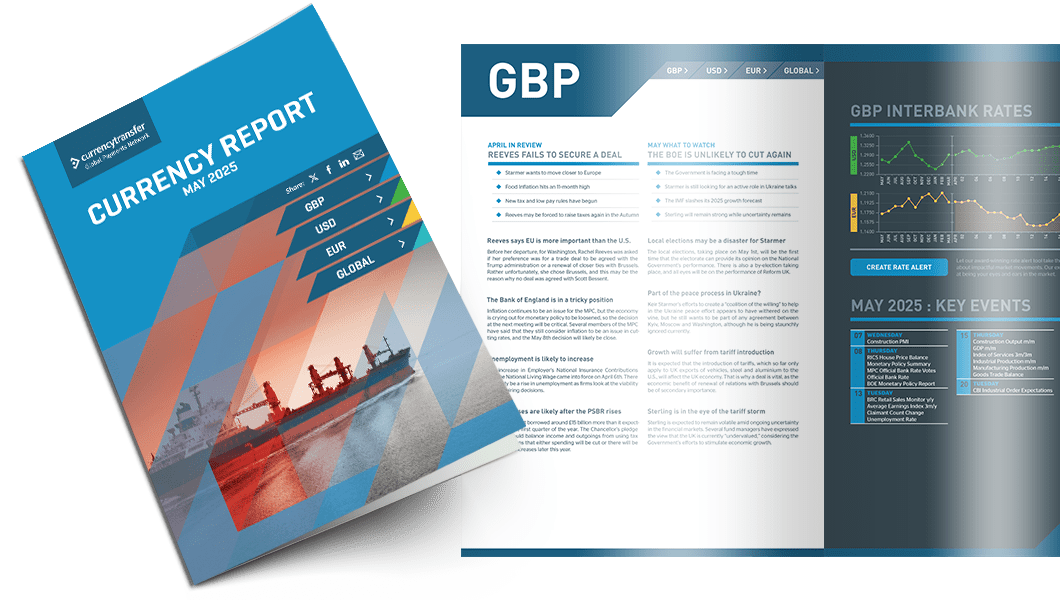
Read our latest currency report
Most impactful events planned this month and how they could impact your business
The Dollar firms as Venezuela raids hang over sentiment
Financial markets have shown only modest reactions to the surprise development. U.S. light sweet crude oil prices rose approximately 1% on Monday but remained close to the five-year lows reached in December.
Donald Trump told reporters on Sunday he could order another strike if Venezuela did not cooperate with U.S. efforts to open up its oil industry and stop drug trafficking. He also threatened military action in Colombia and Mexico.
Such a move towards Mexico would have a more significant effect on the U.S. in general and, in particular, its economy.
The U.S. monthly employment report, due on Friday, will be key in shaping expectations for monetary policy, an arguably weightier factor for the dollar.
Kashkari’s appearance on CNBC marked his return as a voting member of the FOMC. He went on to say that he would love to see Powell remain as a colleague for as long as he likes, but he has no idea if Powell will stay on after the Chairman's term ends.
While he notes "low hiring but low firing," he explicitly flagged a risk that the unemployment rate could "pop" from here. He sees the market as "clearly cooling" with wage growth trending down.
He also waded into an interesting debate on Powell, who has the option to stay on as a Fed Governor after his term ends. He floated some soft support, though said he has 'no idea' if that's the plan. If that were to happen, the byplay between Powell and whichever Kevin gets the top job will create intrigue in the market.
Fed funds pricing is just over 50% for a cut at the March 18 meeting, while a pause in January is largely priced in. A total of 58 bps of easing is priced in for the year ahead. There's been no market reaction to these headlines, and flows will largely drive trading as the new year really kicks off.
Trump has said he expects to announce his pick for Powell’s replacement this month, but much will depend on how the situation in Latin America unfolds. The President does not like to have multiple “balls in the air” at one time, as was seen last year, when he kept his Gaza and Ukraine involvements separate.
The dollar index initially rallied to a high of 98.86 yesterday as traders gave a thumbs up to Trump's incursion, but it fell away rapidly as the oil market failed to respond. It eventually closed lower on the day, at 98.33.
France ended the year without a budget as lawmakers failed to strike a deal
The Eurozone’s manufacturing sector moved deeper into contraction at the end of 2025, with the HCOB Eurozone Manufacturing headline PMI falling to 48.8 in December from 49.6 in November, slipping further below the 50 no-change threshold. The reading marked the lowest level since March 2025, signalling a sharper, though still mild, deterioration in factory operating conditions.
Manufacturing conditions worsened across several major euro area economies. Germany recorded the weakest performance among the eight monitored countries, posting its steepest deterioration since February. Italy and Spain also slipped back into contraction, pointing to renewed weakness in Southern Europe. In contrast, France bucked the broader trend, with its PMI jumping to a 42-month high, marking its strongest expansion since June 2022. Greece and Ireland continued to lead the rankings, while the Netherlands remained in modest growth territory.
After nine consecutive months of expansion, Eurozone factory output declined in December, driven by a sharp drop in new orders. New business contracted for a second successive month, with the pace of decline the sharpest since early 2025. Export demand was a key drag, as international orders fell at the fastest pace in nearly a year.
Manufacturers responded by cutting purchasing activity, while inventories of raw materials and intermediate goods declined notably. Finished goods stocks also fell, though at the slowest rate since September 2024.
Supply-chain pressures showed signs of re-emerging. Average supplier delivery times lengthened by the most since October 2022, while input cost inflation rose for a second month in a row to a 16-month high. Despite firmer cost pressures, manufacturers continued to discount output prices, with selling prices falling for the seventh time in the past eight months.
Inflation is expected to remain close to target for the final month of 2025, confirming that the ECB is unlikely to change interest rates any time soon. In preliminary data to be released tomorrow, Eurozone consumer prices are forecast to be 2.0%, according to FactSet consensus estimates. That is slightly down from November’s inflation reading of 2.1%. Core inflation, which excludes volatile components such as energy and food costs, is expected to be 2.4% year over year, in line with November’s figure.
French lawmakers tasked with finding a compromise on the 2026 state budget failed to strike a deal, ensuring France will enter the new year without finalising its fiscal plans for the next 12 months.
Seven lawmakers from each of France’s two legislative chambers had sat down on Friday in a joint committee in search of consensus, but it quickly became clear there was no pact to be had.
Prime Minister Sébastien Lecornu, in a statement, confirmed France would now end the year without a proper state budget and met with lawmakers yesterday to forge a path forward. There has been no news of that meeting yet, so it is assumed that there has been no agreement.
The Euro mirrored the dollar index yesterday, initially falling to a low of 1.1659, before recovering to end virtually unchanged at 1.1724.
Have a great day!

Exchange rate movements:
05 Jan - 06 Jan 2026
Click on a currency pair to set up a rate alert
Alan Hill
Alan has been involved in the FX market for more than 25 years and brings a wealth of experience to his content. His knowledge has been gained while trading through some of the most volatile periods of recent history. His commentary relies on an understanding of past events and how they will affect future market performance.