
Highlights
- Burnham pressured to end pension ‘triple lock’
- Rise in US factory orders beats expectations in July
- Schnabel says rates must rise more on strong economy
Get bank-beating rates — zero hidden fees
Join 10,000+ clients transferring salary, property deposits and business payments globally.


Healey is ‘trawling’ for Budget suggestions
Kemi Badenoch reacted, as many of her predecessors have, accusing Burnham of living in the past.
Burnham will need to tread carefully as his Chancellor prepares a Budget to be delivered to MPs next month, while adhering to the fiscal rules that the previous Chancellor, Rachel Reeves, introduced: day-to-day government spending must be fully covered by tax revenues by 2029/30, and more borrowing for capital investment (housing, transport, defence) without breaching debt limits.
John Healey is going to struggle to fulfil many of the government’s spending commitments, particularly spending 3% of GDP on defence by 2030, without either compromising in other areas or raising taxes, both of which would be outside his Party’s 2024 election manifesto.
It is rumoured that Burnham is under pressure to do away with the triple lock on the state pension. Were he to do so, it would surely spell defeat in the next General Election.
BofA Securities has lowered its 2027 growth forecast for the United Kingdom to 1.2%, a 10-basis-point cut, citing higher energy prices and uncertainty ahead of the government’s Autumn Budget.
Its economists raised their 2026 growth forecast by 10 basis points to 1.2%, reflecting stronger-than-expected growth in the first half of the year. They kept the 2028 growth forecast unchanged at 1.5%.
The investment arm of the U.S. commercial bank said growth is likely to slow in the coming months by more than previously expected, due to higher energy prices and Budget uncertainty. Risks to its forecasts are tilted to the upside, as sentiment data has proved resilient, with Purchasing Managers’ Index readings surprising higher in August, buoyed by services.
Potential fiscal loosening in the Budget could also pose upside risks to growth, BofA said, provided it does not trigger a significant tightening in financial conditions from a large or unexpected fiscal slippage.
The broker does not expect a large package of fiscal loosening in the Autumn Budget, given the previously mentioned commitment to its fiscal rules. However, it said some flexibility could be used within the debt rule to increase borrowing for investment in a limited manner.
BofA raised its UK inflation forecast for the fourth quarter of 2026 to 3.4%, up 20 basis points, reflecting higher oil and gas prices than assumed under its post-peace-deal outlook.
As he prepares to deliver his first Budget, the Chancellor is thought to be trawling through every department in Whitehall, seeking ideas from officials at all levels.
John Healey has asked junior staff, including IT workers and apprentices, to send him ideas for his October Budget, saying he will listen to all suggestions regardless of grade or profession.
The Chancellor’s unorthodox approach comes as he faces a tricky autumn, with expected inflation rises, sluggish growth and potential cuts from other departments to fund extra defence spending.
Healey, who was Andy Burnham’s surprise choice for Chancellor, is understood to have written to staff at the Treasury campuses in London, Norwich, Leeds and Darlington, asking them to send him ideas.
He said he wanted to hear not only from economists but also from staff not traditionally involved in policymaking. Those with the most interesting ideas will be invited to pitch to Healey in person.
The pound weakened yesterday, mainly on a stronger US dollar, higher oil prices, and risk-averse market sentiment.
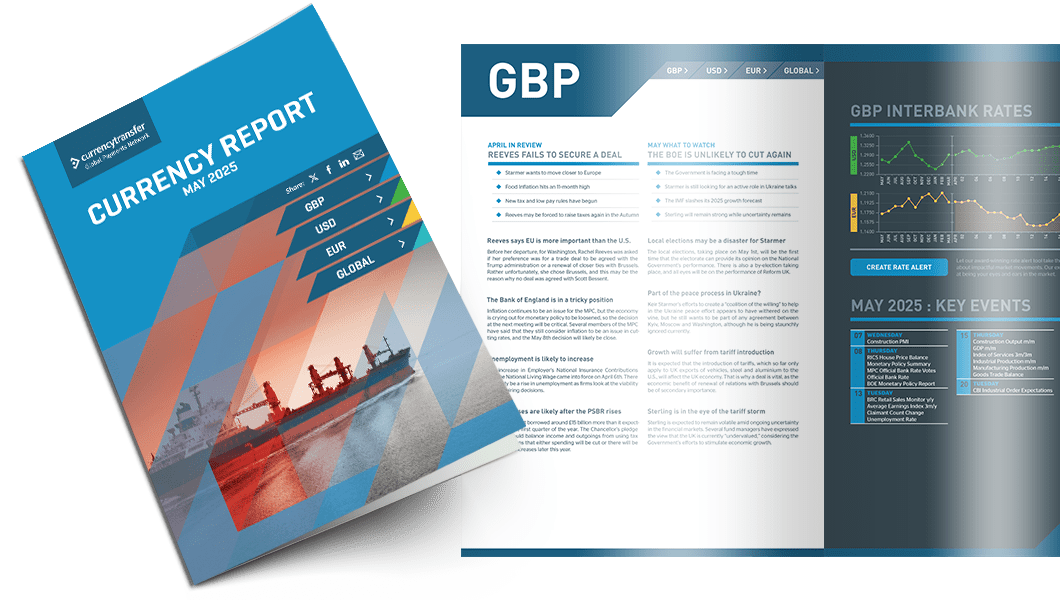
Read our latest currency report
Most impactful events planned this month and how they could impact your business
Private sector employment rises by less than forecast
In a CNBC interview, Williams said the climb in long-term yields is driven largely by a “strong U.S. economy and a strong economic outlook fuelled by big investments,” pointing to artificial intelligence, data centres, and broader technology spending.
Major tech companies are borrowing so heavily that they are competing with national governments, which is also pushing prices higher.
Williams told CNBC that the recent move is occurring mainly through higher real interest rates rather than inflation compensation.
"I see this as more of a reflection of the strength of the economy," Williams said.
Real rates measure the return investors receive after accounting for expected inflation. Their rise suggests investors are demanding higher compensation to finance an economy with increasing investment demand.
That is particularly relevant to the artificial intelligence boom.
Companies are spending enormous amounts on data centres, chips and other infrastructure. The stronger that investment cycle becomes, the greater the demand for financing.
“I think it’s not really about financial conditions affecting the economy. It’s more about the economy affecting financial conditions,” he said.
If higher yields are a symptom of investment demand rather than a brake on it, they do not tighten conditions on the Central Bank’s behalf. This removes the strongest argument against a rate increase this month.
While this may be true of the U.S., it does not explain higher bond yields in the UK, France and Japan.
Private-sector hiring slowed in August. According to the latest ADP report, businesses added just 38,000 jobs.
This was the weakest monthly gain in seven months and fell short of economists' expectations.
In July, the U.S. economy lost 23,000 jobs. June job gains were also modest, with the economy adding just 20,000 jobs, below previous estimates.
"Pay can tell us a lot about today's choppy hiring," said Dr Nela Richardson, Chief Economist at ADP. "To understand hiring patterns, you have to look deeply into where pay growth is accelerating, where it's slowing, and for whom. Once-predictable wage growth has been overtaken by the complexities of demographic change, persistent inflation, and AI's effects on jobs."
The biggest hiring gains came in health care, education, construction and hospitality. Meanwhile, retail, manufacturing, tech and other white-collar sectors lost jobs.
Pay growth also cooled, with wages rising 3.2% from a year ago.
The August employment report is due to be published tomorrow.
The Federal Reserve said price pressures in the United States have risen sharply, citing higher energy costs stemming from conflict in the Middle East and tariffs imposed by the Trump administration.
In its August Beige Book, released yesterday evening, the Fed said input cost pressures in manufacturing and construction rose noticeably in several districts. Prices rose at a moderate pace in 8 of the 12 Federal Reserve districts and modestly in two, the report said. Prices increased slightly in one district, while another reported strong gains.
Reports of higher energy, transport and raw material prices were widespread across industries, the Fed said. Price increases were especially pronounced for metals and petrochemical products. Retail and manufacturing contacts across multiple districts reported that the effects of tariffs were continuing to show. Businesses also reported significant cost pressure from rising medical and insurance expenses.
Consumer goods companies in several districts noted that greater customer price sensitivity was limiting their ability to pass higher input costs on to consumers. Business contacts reported growing uncertainty about the impact of elevated energy prices, policy and international conflicts, the Fed said.
The US dollar strengthened yesterday, with multiple major FX crosses showing a broad but moderate USD-positive bias. Traders believe the renewed strength was due to hawkish Fed repricing, rising US Treasury yields, and geopolitical tension.
The ECB prepares for a rate hike next week
Instead, the Euro is under pressure because the market is weighing a deteriorating demand picture against a hawkish rate path and finding the demand picture more compelling.
Markets are pricing roughly an 80% probability of an ECB rate hike this month, yet the euro has fallen anyway.
That is not a contradiction; it is a ranking, with the growth channel currently outweighing the rate channel in how the single currency is being valued. Higher energy costs sharpen the split, since rising crude prices import inflation into Europe while simultaneously squeezing the same consumers and businesses the retail data has already flagged.
The result is a currency being pulled in two directions at once by the same set of numbers. The Euro is caught between two forces: higher inflation is pushing the ECB to tighten policy, while weaker growth makes aggressive rate hikes increasingly difficult.
This is the very essence of stagflation.
In a league table of ECB Governing Council Members, Isabel Schnabel stands out as the most hawkish and the second most influential after Christine Lagarde.
Schnabel said yesterday that interest rates must rise further, as the lengthy conflict in Iran and the Strait of Hormuz (possibly soon to become “Trump Strait”) and a surprisingly strong eurozone economy pose upside risks to inflation.
Consumer-price growth is likely to exceed 2% for an “extended period” due to high energy costs, the German official said. Acting only when this feeds into wages would leave policymakers “behind the curve,” she warned.
“At the current policy rate, inflation is unlikely to return to target over the medium term, and therefore further tightening will be necessary,” Schnabel told Bloomberg recently.
Especially in the current environment of resilient aggregate demand, it is critical to prevent second-round effects early, as acting late could require more tightening.
The ECB was the first G7 central bank to raise borrowing costs during the Iran war, and officials view this month’s meeting as a crucial juncture to decide whether further action is needed. Investors are almost fully pricing in a quarter-point move, bringing the deposit rate to 2.5%. They expect another by spring 2027, possibly as early as December.
The Euro weakened yesterday, down 0.17% to 0.19%, driven by hawkish Federal Reserve repricing, higher US Treasury yields, and energy-related macroeconomic pressure. The spectre of stagflation hangs over the Eurozone and its currency, weighing on sentiment.
Have a great day!

Exchange rate movements:
02 Sep - 03 Sep 2026
Click on a currency pair to set up a rate alert
Alan Hill
Alan has been involved in the FX market for more than 25 years and brings a wealth of experience to his content. His knowledge has been gained while trading through some of the most volatile periods of recent history. His commentary relies on an understanding of past events and how they will affect future market performance.