Highlights
- The UK economy is expected to have dipped in July
- Trump is trying to influence the Fed again
- The ECB meets today, weighing a tricky balance between savers and spenders
Get bank-beating rates — zero hidden fees
Join 10,000+ clients transferring salary, property deposits and business payments globally.


It is coming down to a choice between national security and national security
The two leaders agree on two things: the benefit bill is currently too high and needs to be reduced, while the defence of the country is becoming more important almost daily as the geopolitical situation deteriorates.
Andy Burnham told MPs that he will reduce the benefit bill in the ‘labour way’, although there is a distinction between reforming the benefit system and simply reducing benefit payments.
Burnham’s predecessor, Sir Keir Starmer, soon to be an ex-MP as well as an ex-Prime Minister, lost the confidence of his backbenchers because he was unable to make this distinction.
Kemi Badenoch has labelled Burnham a ‘spendthrift who cannot say no’ twice this week, and he is in danger of living up to that reputation.
Burnham is seemingly putting off the bad news for later by repeatedly saying he will deliver a plan ‘in due course’. With the Labour Party Conference and the Budget both approaching quickly, he and John Healey will need to produce a solid, clear plan for expenditure and how it will be funded before the Autumn begins in earnest.
The Governor of the Bank of England has warned that inflationary pressures continue to buffet the UK economy, and energy prices could rise further next year if the war in Iran continues.
Speaking to MPs earlier this week, Andrew Bailey said inflation risks were “to the upside” and energy prices “could be higher still” due to the conflict, which has triggered a surge in oil prices and stoked inflation fears globally.
“The conflict is still going on, and it is also causing a high level of energy prices and quite a bit of volatility in energy prices,” Bailey said, adding that turbulence was “feeding through into financial markets”.
Energy costs have risen sharply after the Islamic Republic blockaded the Strait of Hormuz and choked off the supply of oil from some of the world’s biggest producers. Brent crude prices climbed towards $100 a barrel yesterday after the Iran-aligned Houthi militia attacked several refineries in Saudi Arabia, halting some operations.
Speaking in parliament, Bailey warned that higher short-term bond yields, set by traders, suggesting there could be three interest rate hikes over the next 12 months, were “consistent” with a pessimistic view of the risks facing the UK economy.
However, he insisted there was “no secret plan” to hike rates in the coming months and that data would lead the Bank’s Monetary Policy Committee.
While juggling both sides of the nation’s ‘balance sheet’, the Government is also seeking higher, more consistent growth. Higher growth would mean more tax revenue, more employment, and fewer workers claiming benefits. That is the theory, but so far there have been acknowledgements of the issue rather than solutions. John Healey has announced the formation of another quango, which he believes will diversify both production and wealth.
Despite a busy month of sporting events, warm weather and holidays, economists have warned that the UK economy is likely to have shrunk, partly because of higher energy costs for households.
Analysts have predicted that the Office for National Statistics will report a 0.1% drop in monthly GDP when it releases growth figures tomorrow.
The 13% uplift to the energy price cap, conflict in the Middle East, and higher prices for energy-intensive materials likely contributed to a weaker July for the economy.
After a positive first half of the year, when the UK economy outperformed the rest of the G7 and grew by 1%, analysts expect the third quarter to start more weakly.
Some evidence of this has already been seen in soft retail sales for the month, whilst they expect the rise in household utility bills due to the uplift to the energy price cap would have had a dampening effect.”
Meanwhile, the Bank of England’s July Agents’ summary reported subdued growth in private-sector activity, with many citing higher costs and price pressures due to higher energy prices.
The pound was modestly stronger on 9 September 2026, gaining slightly against the US dollar but showing no meaningful movement against the euro. GBP/USD traded around 1.3545–1.3560, supported mainly by broad USD weakness rather than by independent Sterling strength.
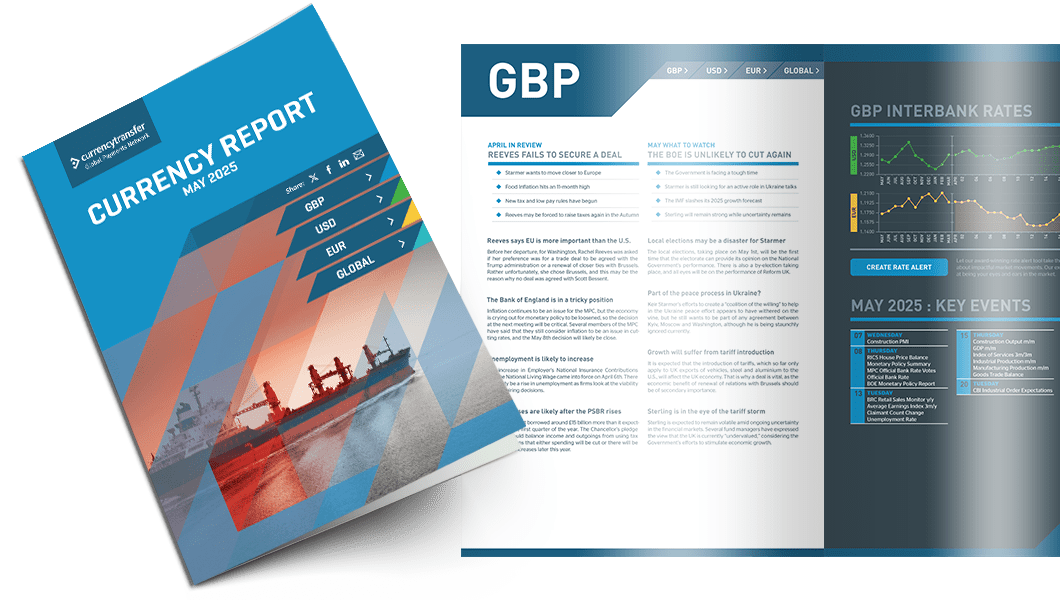
Read our latest currency report
Most impactful events planned this month and how they could impact your business
The interest rate decision may come down to hair-splitting inflation data
The intervention comes just before a closely watched monetary policy meeting, where investors are leaning towards a rate increase to counter inflation. That leaves the Fed facing three broad choices: cutting rates as Trump wants, holding policy steady, or raising rates if inflation risks remain dominant. While the vote will be crucial, the lack of comment on the decision disappoints traders and investors.
Warsh has repeatedly said he wants markets to “make their own minds up” about monetary policy decisions, so he will be ‘keeping his lips sealed’ after next week's meeting. However, his colleagues on the Committee still feel obliged to explain their decisions.
Investors largely shrugged off Trump's latest remarks, suggesting many still expect institutional safeguards to protect the Fed's operational independence. The rate-setting FOMC’s shared decision-making structure and the possibility of political constraints following the November midterm elections are also seen as factors that could limit direct pressure on the Central Bank.
Even so, such comments risk damaging the Fed's credibility at a sensitive moment for inflation expectations. Perceptions matter for monetary policy because consumer beliefs about future prices can influence actual inflation outcomes, making public attacks on the Fed a broader reputational risk.
Warsh’s Jackson Hole speech highlighted how the Fed leadership sought to reinforce its policy framework centred on the 2% inflation target while expressing scepticism about forward guidance amid uncertainty. The formation of new Fed task forces to strengthen analytical credibility, while beneficial, could, when seen alongside rising political pressure from President Trump for lower rates, put the Central Bank’s independence in sharper focus ahead of major decisions.
The USD weakened across FX markets yesterday, falling to nine-week lows and losing ground against most major currencies. The dollar came under broad pressure, driven by yen strength, oil-driven inflation worries, and a lack of conviction about a Fed hike.
An outside candidate may emerge as Lagarde's successor
The bar for a hawkish surprise has risen sharply after the summer repricing, with markets now expecting roughly 75bps of further tightening by mid-2026. Analysts see the greater risk skewed towards disappointment if Lagarde does not clearly endorse another hike before year-end, a scenario that could weigh modestly on EUR.
Near-term EUR/USD direction is still likely to be driven more by developments on the dollar side, with short-term fundamentals pointing to a level closer to the lower end of the recent 1.1400-1.1800 range.
Upcoming German state elections and rising natural gas prices heading into winter round out the list of downside risks to watch beyond today's meeting.
The most immediate effect of Germany's dramatic regional election centres on the necessary but painful economic reform course Chancellor Friedrich Merz's embattled coalition must pursue. But the far-right Alternative for Germany's landslide win in Saxony-Anhalt will also influence a central issue likely to surface in the next few days: the future leadership of the European Central Bank.
Amid political turbulence in France and Germany, and fiscal policy concerns exacerbated by the global rise in bond market yields, the ECB presidency takes on even greater importance.
Behind-the-scenes manoeuvring among the three main candidates for the succession to Christine Lagarde, Pablo Hernández de Cos of Spain, Klaas Knot of the Netherlands and Germany's Joachim Nagel, is likely to give way soon to a wider debate, which may include at least one more candidate, most likely from one of the Eurozone’s ‘smaller economies’.
Lagarde, President since 2019, is expected to announce that she will leave early next year, ahead of her scheduled departure at the end of October 2027. This would allow the former International Monetary Fund managing director and French finance minister to take up a post at an international organisation, probably the World Economic Forum.
A public statement of intent is likely to follow Lagarde's presiding over today's meeting of the ECB's governing council in Berlin. At the Berlin gathering, the council is almost certain to raise its benchmark deposit rate to 2.5% from 2.25%.
An early Lagarde withdrawal would give French President Emmanuel Macron, a prime instigator of Lagarde's surprise appointment in 2019, a hand in orchestrating a ‘package deal’ for an orderly board transition before he leaves office after the April 2027 Presidential election. Three important board members, including Isabel Schnabel and Philip Lane, will leave around the same time in early 2027.
Schnabel has already been heavily trailed as moving to the IMF as Head of the Monetary and Capital Markets, taking over from Tobias Adrian, who vacated the post last month. Adrian has agreed to stay on at the Fund for six months as an adviser to Managing Director Kristalina Georgieva. This would allow a seamless transition should Schnabel take up the position at the beginning of 2027.
The Euro was slightly stronger yesterday, rising modestly against the US dollar while remaining almost unchanged against sterling. EUR/USD traded around 1.163–1.164, supported by broad USD weakness and expectations of a 25bp ECB rate hike the following day.
Have a great day!

Exchange rate movements:
09 Sep - 10 Sep 2026
Click on a currency pair to set up a rate alert
Alan Hill
Alan has been involved in the FX market for more than 25 years and brings a wealth of experience to his content. His knowledge has been gained while trading through some of the most volatile periods of recent history. His commentary relies on an understanding of past events and how they will affect future market performance.