Highlights
- UK economic growth is set to peter out as consumers swap shops for pubs
- U.S. diesel prices top US$5 a gallon for the first time since 2022
- The ECB hikes rates and raises both inflation and growth forecasts
Get bank-beating rates — zero hidden fees
Join 10,000+ clients transferring salary, property deposits and business payments globally.


The Chancellor must work to restore business confidence
Britain's statistics office said yesterday that the economy grew slightly faster in 2023 and 2024 than previously thought, making economic output about 0.5% higher in 2024 than it had most recently estimated.
The revisions are part of an annual review of gross domestic product and reflect improved measurement of the services sector, property rents, and the benefit homeowners derive from not paying rent, the Office for National Statistics said.
"Incorporating this information into our estimates of GDP has led us to revise our estimates of services output upwards over several years and provides a more complete picture of how different parts of the economy contribute to GDP," said Craig McLaren, the ONS' Head of national accounts.
But this year, and the latest data, will interest the markets today.
UK economic growth is set to come to a halt in July, as consumers swapped spending in shops for drinking in pubs amid the heatwaves and the FIFA World Cup, according to economists.
It would mark a downbeat start to the leadership of Andy Burnham, who was appointed Prime Minister during the month.
It would also come after Chancellor John Healey insisted that there was an “optimistic story” about the UK economy that was “turning a corner”.
In June, the UK economy grew 0.3% as hospitality and leisure firms benefited from football fever and prolonged hot weather.
This meant GDP expanded by 0.4% in the second quarter.
However, economists predict activity was muted in July as other parts of the economy lagged, offsetting the continued World Cup and hot-weather boost to hospitality.
In particular, retail and wholesale activity is thought to have dipped by 0.3% for the month.
The Bank of England faces pressure to raise rates in response to a wave of energy-led inflation.
Government borrowing costs have surged to levels not seen in decades after a jump in oil prices reignited a bond market sell-off.
The Treasury’s 10-year interest rate rose above 5.3pc yesterday, a level not seen since 2007. Its 20-year borrowing costs rose above 5.8pc, the highest since 1998.
The rise in borrowing costs threatens to wipe around £10bn from John Healey’s fiscal headroom before his first Budget next month, according to economists at the Item Club.
The jump in borrowing costs came amid fears of a fresh wave of inflation after oil climbed by more than 6% to trade above $107 per barrel. It followed advances by Houthi rebels in the Bab el-Mandeb Strait, the southern entrance to the Red Sea and one of the world’s most important shipping routes.
The US Treasury sold $22bn of 30-year bonds at the highest interest rate since 2001, another sign of the pressure the Iran war is putting on government finances worldwide.
Earlier this week, the UK also agreed to pay the highest interest rate in more than a quarter-century on newly issued bonds.
“How’s that hopey, changey stuff working out?” American politician Sara Palin’s mocking taunt to Barack Obama came a year after his election. Less than 100 days into his premiership, the same jibe now haunts Andy Burnham.
In the short term, his optimistic, confident new style has energised Labour after two years of Sir Keir Starmer’s listless leadership. He has also benefited from Nigel Farage’s Reform UK faltering.
But the problems that engulfed his predecessor have not disappeared; if anything, they now look more intractable. Top of the list is the Government’s precarious financial position, reflected in the sharply rising interest it must pay on public borrowing. If he cannot deal with that, Burnham will soon be as boxed in as Starmer.
The markets will be watching carefully at Labour’s conference at the end of the month. Ministers will be choosing their words with caution to avoid triggering the kind of bond-market crisis that did for Liz Truss; but they will also have to set out convincing plans to break out of the financial trap they are in.
Will they offer more Starmer-Reeves-style incrementalism, or will Burnham and his new Chancellor, John Healey, attempt a bold stroke to escape it? There’s much talk about cutting the welfare bill, but elaborate rule changes take time to devise and even longer to work their way through the system, case by case. And simply cutting benefits risks creating serious hardship and injustice, which contributed to Starmer’s downfall when he lost the support of his backbenches.
The pound was broadly steady yesterday, trading in a tight range across major FX pairs, with modest intraday swings driven by energy-price shocks, ECB rate expectations, and anticipation of today’s UK and US data.
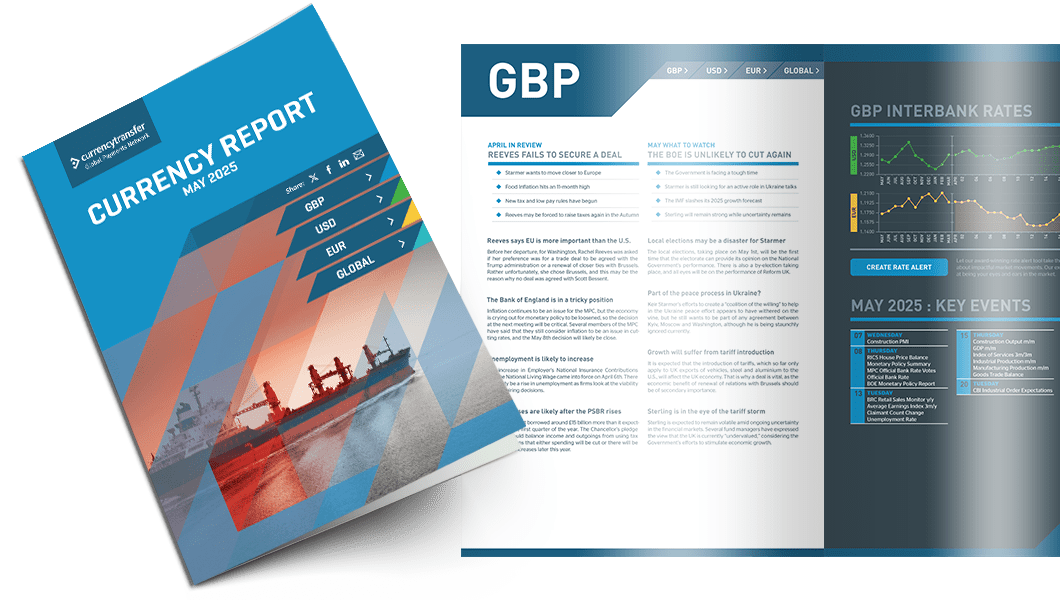
Read our latest currency report
Most impactful events planned this month and how they could impact your business
Warsh's Fed strategy risks 'unproductive market volatility'
He shocked his staff, economists and many of his supporters by offering $5k to every Republican voter if the Party retains control of the Senate and House of Representatives in November.
This $1trn commitment left his staff, particularly his Vice President, JD Vance, scrambling to interpret his comments in a more rational light.
Trump was in his element, preaching to the converted as he reeled off several policy successes, most of which exist only in his mind.
US diesel futures surged above US$5 a gallon for the first time since April 2022, the latest sign of a deepening global fuel squeeze as wars disrupt supplies and rapidly erode worldwide stockpiles.
Diesel in New York reached as high as US$5.03 a gallon yesterday, as escalating Middle East tensions threaten further disruptions through the vital Strait of Hormuz. At the same time, Ukrainian drone attacks have forced Moscow to ban exports.
Higher diesel prices, given diesel's role as the workhorse of the global economy, typically ripple through the economy and stoke inflation, creating headaches for Central Banks and President Donald Trump ahead of the US midterm elections. Diesel powers delivery trucks, machinery, and farm equipment.
The strain of record-high diesel prices will also be felt in states like Maine, where the highest proportion of households in the country heat their homes with heating oil, and in agricultural states like Kansas and Iowa, where diesel fuels farm equipment.
Oil product exports through the Strait of Hormuz had been recovering slowly, but they remain well below pre-war levels. With exports from Russia banned until the end of September, the world is scrambling to secure diesel fuel as the peak demand season kicks off. That’s left the US as the supplier of last resort, drawing down stockpiles to their lowest-ever seasonal levels heading into September.
Goldman Sachs chief economist Jan Hatzius is raising a red flag about the Federal Reserve’s new communication playbook under Chair Kevin Warsh. The core concern: by stripping away the transparency tools markets have relied on for years, Warsh may be trading clarity for chaos.
Hatzius argues that Warsh’s preference for shorter FOMC statements and reduced forward guidance will make market reactions to economic data “more random,” creating what he calls “unproductive volatility.”
Since taking over as Fed Chair, Warsh has trimmed post-FOMC statements to their shortest length since the Alan Greenspan era. He’s also downplayed the significance of the dot plot. This chart maps out individual Fed officials’ interest rate projections and has served as a beacon for bond traders and portfolio managers for over a decade.
The philosophy behind the shift is straightforward. Warsh wants markets to react to actual economic fundamentals rather than spend their energy trying to decode what the Fed might do next. However, what will happen if markets interpret the signals differently from FOMC members? Chaos could ensue.
Today’s publication of August inflation data will help guide markets ahead of next week's FOMC policy-setting meeting. However, because the committee is now in its pre-meeting blackout, its members will have no opportunity to comment on the data.
The US dollar was slightly weaker yesterday, drifting lower across most major FX pairs as markets traded in unusually tight ranges ahead of key US inflation data.
Can Germany’s economic recovery outrun the AfD?
At her press conference, ECB President Christine Lagarde described the rate increase as a 'no-brainer' and projected that inflation could persist beyond expectations. Despite slightly revised inflation forecasts, analysts note that these assessments may not fully reflect recent energy price spikes.
Market analysts now expect more than three rate hikes over the next 12 months, though Lagarde remains noncommittal about future moves amid prevailing uncertainties. She also remains noncommittal about her own future.
Meanwhile, she cited promising growth forecasts, suggesting the Eurozone economy is resilient to inflationary pressures.
Many Germans are in shock after the far-right Alternative for Germany (AfD) delivered an unexpectedly strong showing in state elections in Saxony-Anhalt on September 6th. One of them is Friedrich Merz. The Chancellor sounded unusually contrite after the results came in, describing the AfD’s landslide victory as the most serious ballot-box defeat his Christian Democrats have suffered in years, even decades.
He was less penitent when he vowed not to resign and to see his unpopular reforms through to completion, including those for the ailing public-pension system, the paralysed labour market, and other ills plaguing Europe’s biggest economy.
The French economy will grow markedly less this year than the government had anticipated, as declining purchasing power weighs on consumer spending and firms rein in investment, the national statistics office forecast yesterday, cutting its outlook.
The Eurozone's second-largest economy is now expected to grow by just 0.4% this year, down from INSEE's June forecast of 0.7% and less than half the 0.9% expansion recorded last year.
That would fall short of the government's current 0.7% forecast, though it is set to revise its forecast later today as it prepares to send its 2027 budget bill to parliament at the end of the month.
The weaker outlook makes France's current deficit-reduction target extremely difficult to reach. The government had aimed to narrow the fiscal deficit to 4.9% of GDP this year from 5.0% in 2025, but is also expected to revise that forecast later.
Quarterly, INSEE forecasts growth will only slightly pick up in the second half of the year after contracting in the first quarter and flatlining in the second.
With summer heatwaves and drought weighing on agricultural output, growth was only 0.1% in the third quarter from the previous three months, before picking up to 0.2% in the final quarter.
Meanwhile, Italy’s Prime Minister Giorgia Meloni’s hopes of delivering a pre-election budget that can both woo voters and assuage coalition partners have just received a boost from the Italian economy.
With Finance Minister Giancarlo Giorgetti now forecasting growth of up to 1% this year in the eurozone’s third-biggest economy, up from a previous estimate of 0.6%, the government may be gaining fiscal space at a key moment in the political cycle.
The improved outlook, reflecting unexpected resilience to the global energy crisis and trade tensions, could free up billions of euros that the premier and her cabinet might use to fund promised tax cuts while still respecting European Union rules.
While Meloni just made history by surpassing 1,413 days in power, making her government the longest-serving of the post-World War II era, Italy’s economic performance is still providing much-needed respite at a sensitive time.
The country hasn’t escaped the vortex of rising global bond yields, which have reached their highest since 2008, keeping attention focused on one of Europe’s biggest debt mountains.
Meanwhile, her ruling coalition needs constant attention to stay stable, and she is also fending off the ascendant threat posed by far-right leader Roberto Vannacci.
Against that backdrop, Meloni’s next challenge will be to shepherd her party towards elections due to take place in 2027, all while trying to shield families from the impact of the Iran war.ar.
The euro was broadly stable to slightly softer yesterday, with the ECB tightening fully priced in and markets showing little appetite for a higher Euro.
Have a great day!

Exchange rate movements:
10 Sep - 11 Sep 2026
Click on a currency pair to set up a rate alert
Alan Hill
Alan has been involved in the FX market for more than 25 years and brings a wealth of experience to his content. His knowledge has been gained while trading through some of the most volatile periods of recent history. His commentary relies on an understanding of past events and how they will affect future market performance.