Get bank-beating rates — zero hidden fees
Join 10,000+ clients transferring salary, property deposits and business payments globally.


Key takeaways
- Vietnam’s official currency is the Vietnamese đồng (VND, ₫).
- Cash in đồng is essential for everyday transactions, especially outside major cities.
- The đồng is stable but tightly managed, supported by strong economic growth and foreign reserves.
Vietnam context
Vietnam today is a rapidly growing economy – GDP was around US$468.5 billion in 2024 and the economy grew about 7.1% in 2024. Inflation has been kept low (about 3.63% in 2024) and the country ran a current-account surplus (~5.8% of GDP in 2023 ). This underlying strength helps back the đồng, though in absolute terms the Dong is weak: by late 2024 one US dollar was worth roughly VND 25,500.
Using Vietnam’s currency
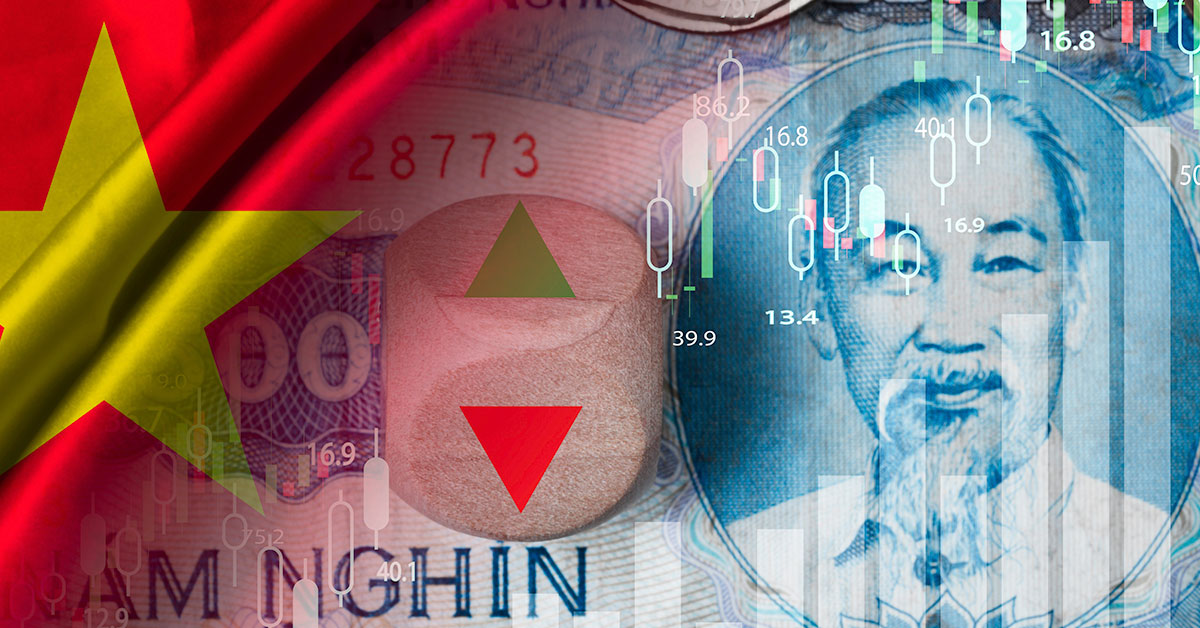
Everyday payments in Vietnam are made in đồng. Cash is king, especially outside major cities. Vietnamese shops, taxis, street vendors and even many hotels expect payment in dong. In big cities and tourist areas, you may see prices quoted in US dollars or euros, but businesses will typically give change in dong and may apply unfavourable rates if you pay in foreign cash. ATMs and banks are widely available – tourists should plan to obtain dong after arrival, as using USD or other currency directly is uncommon. Credit cards and digital wallets (Visa, Mastercard, local apps) are growing in use but still limited mostly to large hotels, restaurants and modern stores. In short, visitors to Vietnam will get best value by carrying and spending the local currency (1 ₫ = about 0.004 pence), similar to how travellers use baht in Thailand or dirhams in the UAE.
History of Vietnam’s currency
Vietnam’s monetary history reflects its political history. After World War II, the đồng was introduced in North Vietnam (replacing the French Indochinese piastre in 1946). South Vietnam kept its own đồng until reunification. Following the end of the Vietnam War, in 1978 the northern and southern đồng were merged into a single currency. (The name đồng comes from the Vietnamese word for “copper”.)
The early decades saw wild inflation. For example, by 1986 inflation had ballooned to ~774%, eroding the currency’s value. The government responded with redenominations: in the mid-1980s the đồng was reformulated (old notes were exchanged for new ones at rates like 10 old đồng = 1 new đồng). Over time inflation was brought under control. Today the đồng floats against other currencies, whereas some neighbouring countries peg theirs (for instance, the UAE dirham has been fixed at 1 USD = 3.6725 AED since 1997).
Coins, banknotes and issuance
Vietnamese money is almost entirely in banknotes, as coins have negligible value. In theory the State Bank mints coins (in denominations 200, 500, 1,000, 2,000 and 5,000 ₫), but these are seldom seen in circulation. In practice, vendors often refuse coins because of their tiny worth. Instead, cash transactions use notes. Common banknotes range from ₫1,000 (about £0.04) up to ₫500,000 (roughly £20). Larger bills (50k, 100k, 200k, 500k) are frequently used for shopping and bills, while small notes (1k, 2k, 5k) mostly serve change. Vietnamese banknotes feature national imagery – all current notes portray the leader Ho Chi Minh on the front – and newer series use polymer (plastic) for durability. The State Bank of Vietnam prints all notes and withdraws old designs as needed.
Vietnam’s currency is fully managed by the central bank, which also holds foreign reserves to back it. As of 2023 Vietnam’s reserves were over US$92 billion (projected to fall to ~$84 billion in 2024). These buffers give the bank scope to intervene if needed to smooth extreme volatility. For travellers, the takeaway is that you will always exchange larger foreign banknotes (like US$, € or £) for bundles of dong when paying for goods and services in Vietnam. Always verify the current rate so you know if a cashier or kiosk is offering a fair deal.
Recent trends
In recent years the Vietnamese đồng has been relatively stable. Strong export growth and investment inflows have balanced the trade ledger – Vietnam ran a current account surplus of about 5.8% of GDP in 2023, thanks to booming electronics and textile exports. Inflation is modest: the government targets roughly 4–4.5% per year, and consumer prices in 2024 rose about 3.6%, well within that range. Correspondingly, the dong only lost a few percent against the dollar (about 4.9% in 2024 ) – a gentle depreciation that often mirrors global US dollar moves.
Vietnam is also moving toward a more digital payments economy: mobile banking, QR-payments and e-wallets are growing fast (the government aims to cut cash transactions sharply). This may reduce demand for physical dong coins over time, but for now cash remains dominant. Overall, the dong’s recent track has been one of steady resilience rather than wild swings. Key supporting factors have included prudent fiscal and monetary policy, the external surplus, and the central bank’s control over liquidity.
Future outlook for the dong
Looking ahead, most analysts expect the đồng to remain broadly stable. Vietnam’s economy is forecast to keep growing (the IMF sees continued expansion) and inflation is expected near the central target. The State Bank of Vietnam has repeatedly emphasised its commitment to low inflation and a market-based rate, which should limit sharp moves in the exchange rate. In fact, analysts note that large reserves (tens of billions of USD) give Vietnam a cushion to smooth any external shocks. As long as trade continues surpluses and foreign investment stays strong, the đồng should hold its value.
For businesses and travellers, this means relative predictability. Each dong will buy roughly the same basket of goods each year unless inflation surges. Financial markets will watch for any inflation or policy surprises, but for now the outlook for the đồng is stable but cautious.
Conclusion
In summary, Vietnam’s currency is the Vietnamese đồng (₫), which has been in use since the country reunified in 1978. It is a floating fiat currency, managed by the State Bank of Vietnam, and is used in every transaction in Vietnam. Although it is one of the world’s weaker currencies (requiring tens of thousands of dong to equal a US dollar), its value is backed by Vietnam’s fast-growing economy and solid reserves. Anyone living in or visiting Vietnam should plan to use dong cash for day-to-day expenses. Understanding the current exchange rate and carrying local currency will ensure smooth payments. In practice, the Vietnamese đồng remains stable enough for business and travel, provided one deals through official channels and stays informed of exchange rates.
As always, for currency news and insight into the world of currency, make sure to stay up to date with our Expert Analysis, as well as our daily Market Commentary.
Caleb Hinton
Caleb is a writer specialising in financial copy. He has a background in copywriting, banking, digital wallets, and SEO – and enjoys writing in his spare time too, as well as language learning, chess and investing.