
Highlights
- Untenable
- Fed Divisions Deepen as Powell Faces a Tougher Path to Consensus
- Eurozone risks falling behind global rivals, says ECB Member
Get bank-beating rates — zero hidden fees
Join 10,000+ clients transferring salary, property deposits and business payments globally.


The BoE rate decision weighs on sterling
Despite her colleagues at the Treasury having primed the public on what to expect from her, Rachel Reeves still wanted to “test the water” by making her speech yesterday to several financial journalists who did not hold back questioning her entire time as the country’s finance minister.
She dodged many questions from her audience about whether she plans to abandon Labour’s election manifesto pledge not to raise income tax, national insurance or VAT. She tried to explain why such a move might be necessary if it happened. The punishing cost of servicing the national debt while maintaining public services was the prime reason.
She talked a lot about difficult choices and how everyone must rise to the challenge of repairing the economic black hole. Everyone seemed to agree that the black hole was 20 billion pounds, but there was some doubt about whether that included or was in addition to the pre-existing situation. Reeves made no effort to clarify.
Now the country faces an agonising three-week wait before the full extent of the expected financial carnage is revealed. Yesterday may have been the most dreadful public relations blunder since the days of Liz Truss.
Reeves declared, “Our past does not have to determine our future”, then proceeded to outline why past failures of the Tories, the original 22 billion pound “black hole” in the nation’s finances and “political expediency” mean tax hikes aren’t off the cards. It was yet another declaration that Labour has abandoned working people.
Those who keep society running must be held accountable for the havoc wreaked by those who profit from it.
Later in the day, speaking to LBC, Reeves insisted that she will not resign if she is “forced to raise taxes.” She talked about choices, and since she will not abandon public spending to another round of austerity and her “financial morals” will not allow her to increase Government spending, she is left with tax increases.
Following last week's hawkish cut from the American Federal Reserve, the markets are now expecting a dovish hold from the Bank of England’s Monetary Policy Committee tomorrow. It is sure to be another cliffhanger, with the Bank likely to avoid the fiscal discussions currently taking place and lean into the fact that inflation is almost double the Bank’s target rate of 2%.
The pound fell to its lowest level since Donald Trump announced plans to impose tariffs on U.S. imports of finished goods and raw materials. It reached a low of 1.3010 and closed at 1.3018.
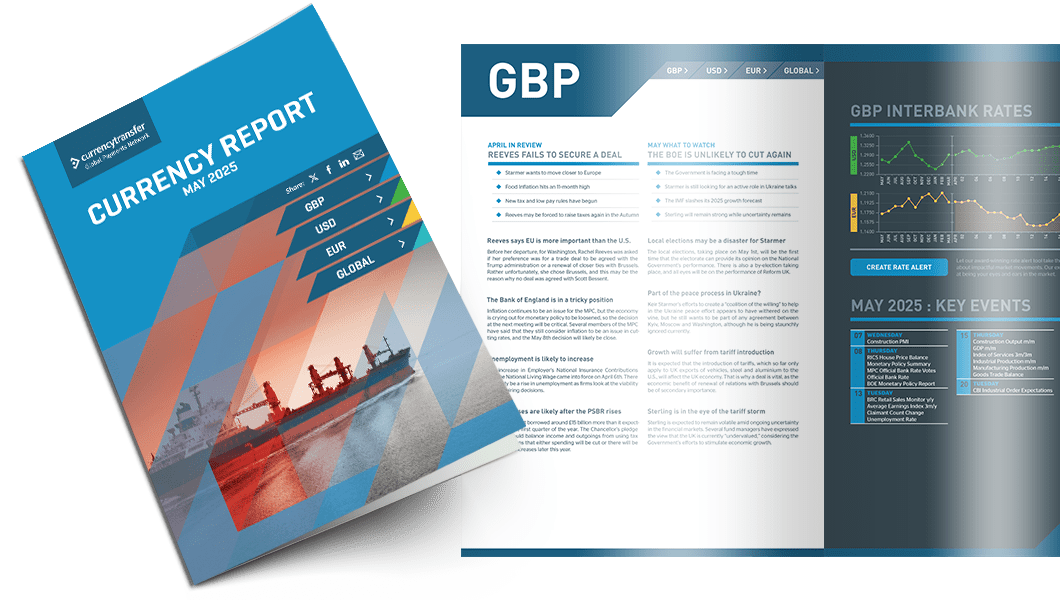
Read our latest currency report
Most impactful events planned this month and how they could impact your business
Fed Consensus is a thing of the past
The latest meeting of the U.S. The Federal Reserve has revealed an unusually divided institution, reflecting how difficult it has become to steer monetary policy amid weak growth, persistent inflation, and political pressure.
The vote at the meeting was 10/2 in favour of the eventual cut, but the two dissenters came from radically different perspectives. Stephen Miran, Trump’s “fifth columnist” on the committee, believes that the time has come for a “jumbo” fifty-point cut. At the same time, Kansas City Fed President Jeffrey Schmid voted for no change as he said he voted against the US central bank’s decision to lower interest rates this week because he’s concerned that economic growth and investment will put upward pressure on inflation.
“By my assessment, the labour market is largely in balance, the economy shows continued momentum, and inflation remains too high,” Schmid said in a statement released Friday.
It is becoming increasingly surprising that the FOMC decided to cut rates again, as it is still operating in a fog of uncertainty created by the current shutdown of the Federal Government.
One side will be proved correct when the Government cranks back into action, while the other will be left with egg on their face. If that side includes Fed Chairman Jerome Powell, the pressure for him to depart early from the role will increase substantially.
The Trump administration has radically reshaped U.S. trade policy with extremely high tariff rates. A variety of objectives have been used to justify these tariffs, including reducing trade deficits, retaliation against other countries, national security, and bringing production back to the United States. Unlike these frequently-debated objectives, raising revenue has long been considered an irrelevant factor in modern trade policy, but the Trump tariffs are bringing it back to the forefront.
More than a century ago, tariffs were an important source of U.S. government revenue. Taxing goods at the border or imposing excise taxes on specific goods produced in particular places is the easiest way to raise funds. Today, only younger, less developed nations rely on tariff revenue to fund the government. Developed nations use taxes that require significant administrative capacity, such as personal and corporate income taxes, sales taxes, value-added taxes, and payroll deductions.
There is a reason the United States and all other wealthy nations have moved away from funding their governments through tariffs. They are a damaging and inefficient way to raise funds. In short, tariffs are either taxes that lead to lower growth and eat into revenue, or distortions that allow circumvention and therefore raise little revenue, or a combination of both.
It is doubtful that the markets have heard the last of “Trump’s favourite word” with volatility likely to increase again as he reviews his actions over the coming weeks.
The dollar index reached a high of 100.26 and closed at 100.21.
Nagel tries to look hawkish but fails
The event's opening session was attended by Prime Minister Rosen Zhelyazkov and Kristalina Georgieva, Managing Director of the International Monetary Fund. Christine Lagarde, President of the European Central Bank (ECB), who is visiting Bulgaria for the first time, also delivered an address.
The euro is not merely a monetary unit; it is a strategic choice that affirms Bulgaria’s place at the heart of a united and strong Europe, said Prime Minister Rosen Zhelyazkov in his remarks to the audience.
IMF Managing Director Kristalina Georgieva, who is Bulgarian, noted that although adopting the euro is a crucial step, it does not, by itself, guarantee a higher standard of living. According to her, the task now is to embrace the euro, align it with sound policies, and advance economic convergence to the next level so that per capita income reaches the EU average over the next decade.
The standard of living will be a concern as another former Russian satellite looks west for economic advancement after more than fifty years in the wilderness. The four largest economies in the Eurozone, Germany, France, Spain and Italy, see the increase in the size of the bloc as a boon in the good times, as the size of the market for European manufactured goods is increased, but in bad times, will it become “yet another mouth to feed?”
Only time will tell.
Prime Minister Rosen Zhelyazkov met with representatives of Germany’s Committee on Eastern European Economic Relations on Tuesday, the Cabinet's press centre reported. “Bulgaria has proven to be a reliable partner and a promising market. We are ready to strengthen our cooperation with the German economy through real projects. I believe that the coming months will be a time for concrete actions,” Zhelyazkov said at the meeting.
During the discussion, the German Prime Minister emphasised that Germany is a leading trade and economic partner and a major investor in Bulgaria. Over the past decade, bilateral trade between the two countries has grown steadily, reaching record levels. In the last 30 years, total trade has increased sixteenfold, while Bulgarian exports have grown twenty-threefold.
As Beijing prepares its next five-year plan, LVMH expects Chinese consumers to remain central to the global luxury market. “The future of luxury is being shaped here, in China, with China and with our Chinese clients,” said Marc-Antoine Jamet, LVMH’s secretary general, in Paris before heading to the annual China International Import Expo in Shanghai.
China is a top market for the French luxury giant, where it operates 46 brands, more than 1,800 stores and about 27,000 employees.
Therein lies the issue for the Eurozone. It needs Chinese buyers for its products, as the market for high-end luxury goods in Europe is shrinking.
The euro is moving inexorably toward significant support near 1.14. Yesterday, it fell to a low of 1.1473 and closed at 1.1479.
Have a great day!

Exchange rate movements:
04 Nov - 05 Nov 2025
Click on a currency pair to set up a rate alert
Alan Hill
Alan has been involved in the FX market for more than 25 years and brings a wealth of experience to his content. His knowledge has been gained while trading through some of the most volatile periods of recent history. His commentary relies on an understanding of past events and how they will affect future market performance.