
Highlights
- EasyJet acquired by a US firm in a £5.7 billion takeover
- US workers' share of GDP skids to a fresh record low
- Eurozone Retail Sales miss forecasts
Get bank-beating rates — zero hidden fees
Join 10,000+ clients transferring salary, property deposits and business payments globally.


The Treasury Declines to Rule Out Higher Bank Taxes in the Budget
“The Chancellor is fully focused on his priorities, which will boost business, help with the cost of living and support people in every postcode,” the Treasury said in a statement when asked whether the Government would rule out changes to the tax regime facing Britain’s banks. “Tax decisions are a matter for the Chancellor to set out at fiscal events, rather than routinely commenting on proposals made.”
By contrast, Burnham ruled out changes to stamp duty on property purchases after a newspaper reported that he was considering scrapping the tax. He did not mention stamp duty on share purchases, which means the change is still possible.
The Prime Minister faces calls to squeeze financial institutions after HSBC’s second-quarter UK profit rose 60% to more than £6 billion, and the rest of the big four, which includes Barclays, Natwest and Lloyds, posted cumulative profits in the first half of almost £30 billion.
The Trades Union Congress is calling on him to increase the surcharge paid by banks, currently set at 3% above the 25% corporation tax rate, to fund support for consumer energy bills. “The big banks are making a killing off the back of higher interest rates and mortgage misery across the country,” said Paul Nowak, General Secretary of the TUC. “They can well afford to pay more tax.”
However, many sources believe that it would be more acceptable to impose a windfall tax on ‘Big Oil’ profits, which come directly from oil prices.
Burnham has taken an active stance on fiscal matters since becoming Prime Minister, announcing a cut to VAT on electricity and reducing business rates for pubs and music venues in his first week, policies normally announced by a Chancellor at a budget. He has said that a priority of his premiership is giving voters “breathing space” with their bills.
The June heatwave in the UK resulted in an estimated £1.15 billion loss to the UK economy and 24 million lost working hours, according to a study by the Grantham Research Institute on Climate Change and the Environment at the London School of Economics, in collaboration with the Euro-Mediterranean Centre on Climate Change.
As part of the study, a nationally representative sample of almost 2,000 adults across the UK was surveyed about the effects of the heatwave on their lives, covering topics such as commuting, working hours, and sleep during the week commencing 22 June.
It found that respondents reported an average reduction of close to 0.5 working hours per week, with those in physically demanding roles, such as construction and agriculture, reporting larger reductions.
Elsewhere, some 3.6% of respondents, equivalent to around 1.25 million workers nationally, did not work at all during that week because of the heat. This accounted for a further eight million lost working hours.
“While more than £1 billion is lost overall, the greatest effects are borne by outdoor workers and those in physically demanding jobs, many of whom are among the lowest paid in the labour force,” commented Shouro Dasgupta, environmental economist at CMCC and visiting senior fellow at the Grantham Research Institute. “Extreme heat is widening existing inequalities in the labour force.”
One of the country’s largest and most popular discount airlines has been sold to a US private equity firm in a multi-billion-pound deal. EasyJet has confirmed it has agreed to be acquired by US firm Apollo in a £ 5.7 billion deal.
The announcement came after a rival bidder revealed it was withdrawing from the bidding war for the budget airline. As one of Europe's largest airlines, EasyJet flies to around 1,2000 routes across dozens of European countries and employs over 19,000 people.
As part of the acquisition, the US company, which also owns Wagamama, will pay 715p per share for the business. Commenting on the deal, EasyJet chief executive Kenton Jarvis said: "We welcome Apollo's commitment to our business and our people, and believe that its experience in the aviation sector makes it a strong partner for EasyJet." Alex van Hoek, partner and European private equity lead at Apollo, added: "EasyJet is a leader in European aviation, having built a differentiated market position through its compelling customer proposition, expansive network and strong brand."
Furthermore, Apollo reiterated that it was "highly supportive" of EasyJet's existing strategy, citing "a significant opportunity to accelerate the operational and commercial ambitions" for the group.
The pound’s performance yesterday was mixed yet stable, with no major breakout. It gained slightly against the dollar amid broader USD softness, stayed flat against the euro, and underperformed against commodity currencies in a mild risk-on environment.
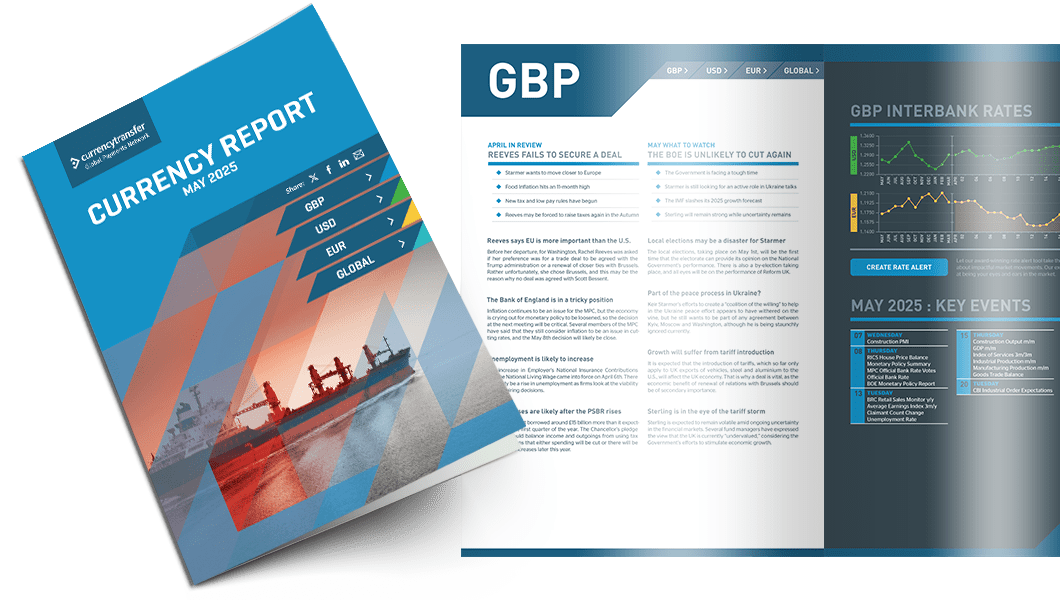
Read our latest currency report
Most impactful events planned this month and how they could impact your business
US Initial Jobless Claims remain stable below 200,000
US-based employers announced 33,429 job cuts in July, down 27% from the previous month and 46% lower than the same month last year, Challenger, Gray and Christmas said in a new report.
Up to and including July, employers have announced 477,033 job cuts this year, down 41% from the first seven months of 2025, according to the firm.
Companies are still laying off employees, but not as many as last year, even as AI became the leading reason for job cuts for the fifth consecutive month, Challenger said.
“The pace of layoffs fell dramatically this summer. Layoff plans continue to be announced primarily in tech, and artificial intelligence is still the story, as investments in the technology reshape organisations,” Andy Challenger, workplace expert and chief revenue officer for Challenger, said in his statement.
“Hiring has also increased by 25% over last year, so while AI is shifting the labour market, it is not dismantling it.”
Meanwhile, the number of Americans filing claims for unemployment benefits increased slightly last week. At the same time,e layoffs dropped to a two-year low in July, also showing the stability of the labour market. Initial claims for state unemployment benefits rose 1,000 to a seasonally adjusted 199,000 for the week ended August 1, the Labour Department said.
Economists polled by Reuters had forecast 202,000 claims for the latest week. Claims have dropped considerably since surging in early June. Though some of the decline reflects difficulties adjusting the data for seasonal fluctuations in summer, layoffs have remained very low despite the oil price shock from the U.S.-Israeli war with Iran. There are also no signs of widespread job losses linked to the artificial intelligence buildout, with layoffs mostly confined to the technology industry.
U.S. workers again saw their share of the U.S. economy slide to a record low in the second quarter, amid an ongoing productivity boom that is producing output gains outpacing wage growth, the Bureau of Labour Statistics reported.
The so-called labour share of nominal GDP, which BLS defines as the percentage of output that accrues to workers as compensation, fell to 52.9% in the second quarter from 53.7% in the first quarter.
That was the lowest since the series began in 1947, BLS said as it reported stronger-than-expected growth in second-quarter productivity.
The labour share has been falling for decades, driven by forces such as the diminishing breadth and power of organised labour and globalisation, which shifted relatively high-paying manufacturing jobs to low-cost overseas production centres.
Yesterday, the US dollar softened broadly but modestly, driven by weaker US labour data, reduced safe-haven demand, and position unwinding. It was not a sharp sell-off, and USD strength against JPY and CHF shows the move was risk-sentiment-driven, not a fundamental collapse in dollar demand.
The economic toll of Spain's wildfires
The 0.3% monthly decline in overall sales volumes is the second in the four full months since the start of the conflict, according to data published by the European Union’s statistics agency. Economists polled last week by The Wall Street Journal expected a 0.1% increase in June compared with May, after a 0.4% rise in May.
The decline was driven by a 1.1% drop in Germany and a 0.5% drop in France, the Eurozone’s two largest economies. Sales of food, drinks and tobacco fell by 0.5%, while non-food product sales fell by 0.4%. Petrol sales grew by 1.5% after oil prices retreated amid easing tensions in the Middle East.
The Eurozone economy outpaced U.S. growth in the second quarter, though June’s retail-sales data reinforces the view that consumption wasn’t a major driver.
Consumption momentum slowed after the conflict erupted, as consumer confidence sank in April to its lowest level since 2022, the start of Russia’s invasion of Ukraine, amid rising energy prices. However, much of that slowdown was due to uncertainty prompted by the war, rather than to reduced purchasing power from rising inflation, the European Central Bank bulletin said this week.
Higher-income households chose to pare back discretionary spending amid high uncertainty. In contrast, lower-income households were hit harder by higher energy prices, which make up a larger share of their spending.
The recent retreat in energy prices, prompted by diplomatic efforts to secure passage through the Strait of Hormuz, has significantly softened market expectations of an aggressive, multi-hike cycle from the European Central Bank.
Money markets have pared back bets on consecutive policy rate increases, though traders still price in an 88% probability of a 25-basis-point hike to 2.50% at the ECB’s Sept. 9 meeting.
Resilient Eurozone economic data, including second-quarter GDP growth of 0.4% and an eight-month high in July business activity, continue to bolster expectations for at least one additional rate increase before the end of the year.
Charred tree stumps, melted asphalt, burned-out cars and destroyed buildings: The wildfires in southern Europe are leaving a trail of devastation and causing billions of euros in damage.
Spain's economy, in particular, is at risk of being choked by clouds of ash. According to the EU's Copernicus Earth observation system, around 206,000 hectares of forest in Spain have already gone up in flames this year.
"According to the European Commission, the economic impact of wildfires in Spain in 2022 amounted to approximately €7.1 billion, representing around 4.5% of the country's GDP. This figure reflects not only the direct costs of firefighting but also the long-term economic consequences of recovering the affected areas," Emilio Vizuete Luciano, an economist at the University of Barcelona, told reporters.
The fires often devastate the local economy and disrupt trade in the affected regions, Luciano says. "Tourism is also severely affected. Given Spain's strong dependence on tourism, the disappearance of this activity in fire-affected regions has particularly significant economic repercussions."
According to the European Commission, the EU loses around 500,000 hectares of land to wildfires every year. Spain, Greece and France are among the countries where wildfires are most widespread.
The economic damage goes far beyond losses to tourism. It also includes the loss of biodiversity, declining forestry revenues, soil erosion, destroyed infrastructure and property, and the costs of fighting the fires.
A heated debate has erupted in Spain over the cost of fighting wildfires. Since 2009, investment in prevention has declined, even as the number and scale of wildfires have reached alarming levels.
According to official figures, spending on wildfire prevention in Spain fell from €364 million in 2009 to €144 million in 2024. Over the same period, annual spending on actually fighting and extinguishing fires remained stable at around €417 million.
Yesterday, the euro strengthened clearly against the US dollar but held steady against most other major currencies. The move was driven by USD softness, stronger Eurozone PMI data, and easing geopolitical tensions.
Have a great day!

Exchange rate movements:
06 Aug - 07 Aug 2026
Click on a currency pair to set up a rate alert
Alan Hill
Alan has been involved in the FX market for more than 25 years and brings a wealth of experience to his content. His knowledge has been gained while trading through some of the most volatile periods of recent history. His commentary relies on an understanding of past events and how they will affect future market performance.