
Highlights
- The UK and India have agreed on a free trade deal
- China warns the US tariff war is a 'huge risk' to the world economy
- The Eurozone Services PMI was revised higher to 50.1 in April
Get bank-beating rates — zero hidden fees
Join 10,000+ clients transferring salary, property deposits and business payments globally.


Now Labour may cut the cut in winter fuel payments
Trade between the two countries reached £42.6 billion last year, and the deal is expected to increase that figure by another £25 billion by 2040.
India's prime minister, Narendra Modi, described the agreement as a historic milestone that was "ambitious and mutually beneficial".
The UK’s services sector contracted for the first time since the end of 2023 as fears over the effect of tariffs to be introduced by U.S. President Donald Trump gripped businesses.
A poll of purchasing managers in services businesses showed that the US President’s tariff campaign had sent a chill through the sector, which accounts for about three-quarters of the UK economy, hitting business confidence about the prospects for the years ahead.
Service sector export sales were particularly subdued, with total new work from abroad decreasing at the fastest pace since February 2021, during the COVID pandemic.
Smaller domestic services companies also said tax increases introduced by the chancellor, Rachel Reeves, were weighing on costs and had led to them laying off workers at a faster rate in April.
At 49.0 in April, down from 52.5 in March, the headline seasonally adjusted S&P Global UK services PMI activity index was the lowest since January 2023. A score of more than 50.0 represents expansion.
While the latest index reading signalled only a marginal decline in overall output, after a period of modest growth in the first quarter of 2025, the outlook was clouded by the likelihood of further US tariffs.
As the Bank of England’s monetary policy committee begins its latest meeting, with a decision on any change to the base rate to be delivered tomorrow, the outcome is not clear-cut, they seldom are, given the mix of views that make up the MPC, on balance, a rate cut is expected to be delivered by Andrew Bailey.
With inflation as close to being under control as it can be given the global uncertainties that exist, growth is likely to be hit by the imposition of tariffs on several key UK export sectors by President Trump, Bailey and his colleagues do not wish to be seen as acting preemptively, but they believe a further cut in rates is currently justified.
The UK and US are in intensive discussions about an economic agreement that would reduce the impact of some tariffs, with a team of British officials in Washington to negotiate terms this week.
There is optimism that a deal can be struck, but it was still too early to say whether an agreement could be reached this week, sources said. A senior UK official said Britain would not be bounced into signing a deal that was not in its interests just because the Trump administration was keen to announce deals to soften the impact of its tariffs.
The Cabinet will want to be sure that the “t’s are crossed and the i’s are dotted” before giving markets any reason to doubt, following raised expectations during the Chancellor's recent visit to Washington.
The pound initially rallied to a high of 1.3397 yesterday, but as New York traders arrived for work, it began to drift lower, closing at 1.3349.
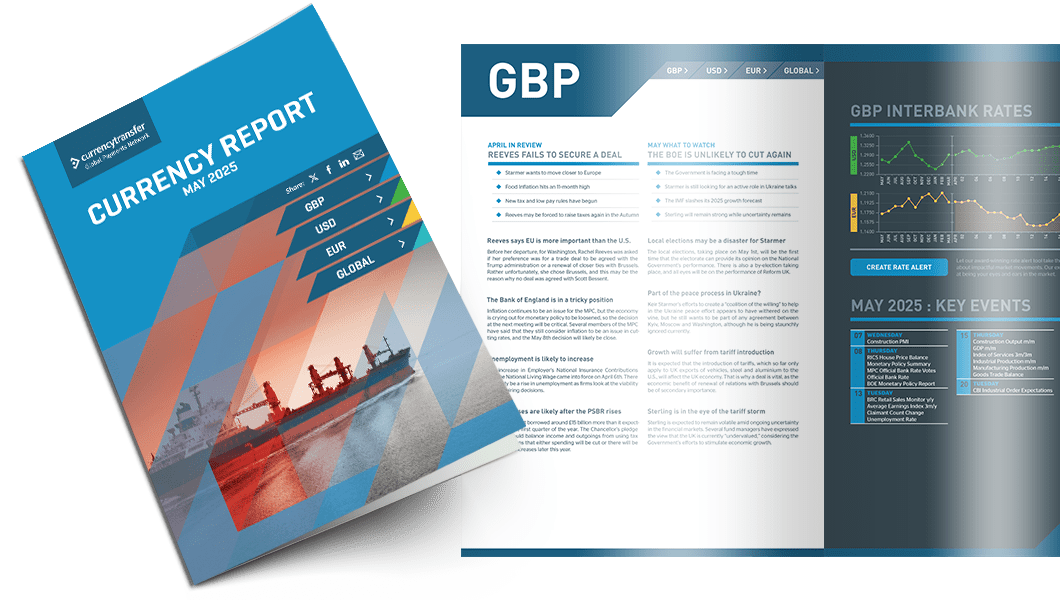
Read our latest currency report
Most impactful events planned this month and how they could impact your business
It's a choice between reactive and proactive
There have been a multitude of attitudes presented by economists and the business community in general about the expected effect of the tariffs, but the Federal Reserve, as it often does, wants solid evidence of their effect before changing monetary policy.
President Trump has toned down his rhetoric recently since some of his advisers warned that his almost daily attacks on Fed Chairman Jerome Powell had become counterproductive.
Trump feels that rates should have been cut more quickly during the run-up to his taking over as President, for any short-term negative effects of his economic policies to be lessened.
The result of the vote on interest rates will be announced by Powell at 7 pm London time today and be followed by a statement from Powell, accompanied by a question and answer session with the financial press.
Those hoping for relief on mortgages, credit cards, and other loans will likely be disappointed. The Fed is currently caught between a rock and a hard place, trapped by a dual mandate of low inflation and unemployment, goals that often contradict one another.
Reducing interest rates shores up employment but triggers inflation, while raising interest rates reduces inflation but causes unemployment. The monetary policy tug-of-war is particularly hard this year, given that the U.S. is experiencing sticky inflation and more layoffs. That's made picking the proper mandate to target particularly tough.
The latest employment figures showed that more jobs were created in April than were expected, and this will add an element of caution to the FOMC’s deliberations.
The markets won’t have to wait long for the opinions of FOMC members to become known. A Plethora of Regional Fed Presidents and board members are scheduled to make speeches before this week’s close of business.
New York Fed President John Williams, Cleveland’s Beth Hammack, St Louis’ Albert Musalem, Chicago’s Austan Goolsbee, among others, as well as board members Barr and Kugler, will all provide their opinions on the decision.
Since September, the Fed has cut its key rate from a two-decade high to stimulate the economy and prevent a recent slowdown in the labour market from turning into mass job losses. But the latest data has shown inflation staying stubborn and the job market humming along, so financial markets expect the Fed to hold off on more rate cuts for the time being.
Unemployment has gradually increased following the Fed's most hawkish policy in decades. After admitting inflation wasn't transitory, Fed Chair Powell embarked on the most restrictive pace of interest rate hikes since Fed Chair Volcker battled inflation in the early 1980s.
As a result, inflation has retreated, but higher interest rates have capped economic activity, contributing to the unemployment rate rising to 4.2% from a low of 3.4% in 2023.
The dollar index fell to a low of 99.20 yesterday as speculation mounted about the possibility of a rate cut later today. At the same time, day traders avoided being caught in any volatility by curtailing positions. The index closed close to its day's low at 99.25.
It took two votes to agree to Merz as Chancellor
In Germany, the services sector is weighing on the economy. The Services PMI for April edged higher to 49.0 from 48.8, after the March read of 50.1. This marked the lowest level since February 2024.
The services report points to stagnation in the eurozone and Germany, the largest economy in the bloc. New orders were down, and businesses pointed to economic conditions and US tariffs as key concerns.
The European Central Bank lowered its main interest rate to 2.25% last month, as the eurozone economy continues to sputter and US tariffs have raised fears of a global trade war. The main rate is now at its lowest level since Oct. 2022. The ECB meets next in June.
The HCOB Composite PMI Index for the eurozone dropped from 50.9 in March to 50.4 in April, indicating the fourth consecutive month of expansion, albeit at a marginal pace. This result suggests a slowing of momentum in business activity growth compared to the previous month.
Friedrich Merz needed two rounds of voting to become chancellor after a surprising defeat in Parliament hours earlier that threatened to hobble his new government.
Merz immediately began the ceremonial tasks of assuming the country’s top leadership post, which were delayed half a day by the events in Parliament, and he and his cabinet were sworn in after meeting with Germany’s president. On Wednesday, Mr. Merz is set to travel to Paris and Warsaw to meet with key allies.
Meanwhile, France's service sector remained a drag on the economy as the second quarter of 2025 got underway. According to the latest HCOB PM survey data, business activity fell for an eighth successive month amid a sharp and accelerated decrease in new orders.
Competition for work also led prices charged to hold steady, aided by input cost pressures of a more modest nature. Meanwhile, French services companies grew slightly more optimistic towards the 12-month outlook, but expectations fell considerably short of their long-term average as global uncertainties dampened confidence.
The European Central Bank (ECB) has established a platform to facilitate collaboration among European stakeholders in the development of the digital euro project. This initiative includes the participation of almost 70 entities, including merchants, fintech firms, start-ups, banks, and payment service providers, all aiming to investigate the potential functionalities and use cases of a digital euro.
In response to a call for interest issued in October 2024, over 100 applications were received, with approximately 70 participants joining either or both “pioneers” and “visionaries” workstreams.
The euro was well-supported throughout the day, rallying throughout and closing at 1.1378.
Have a great day!

Exchange rate movements:
06 May - 07 May 2025
Click on a currency pair to set up a rate alert
Alan Hill
Alan has been involved in the FX market for more than 25 years and brings a wealth of experience to his content. His knowledge has been gained while trading through some of the most volatile periods of recent history. His commentary relies on an understanding of past events and how they will affect future market performance.