
Highlights
- Credit card spending rises 2.0% in July as consumer confidence hits a 21-month high
- The economy looks strong. So why are markets worried?
- Eurozone GDP rose by 1.2% YoY in Q2
Get bank-beating rates — zero hidden fees
Join 10,000+ clients transferring salary, property deposits and business payments globally.


Burnham’s economic optimism is already unravelling
Changes to the judicial review process for Nationally Significant Infrastructure Projects will fix a system in which every decision can face another challenge, consultation or review before a single brick is laid or a spade enters the ground.
Sending a clear signal of his ambition for UK business, John Healey also set a goal to double the number of unicorn firms, companies valued at over £1 billion, in the UK.
Healey will work with the Business and Trade Secretary to identify the next generation of high-growth companies and help them overcome regulatory barriers, access capital, and win government contracts as an early customer.
He also announced the ‘Northern 500’, which will bring together 500 of the North’s most ambitious mid-sized businesses into a single growth community led by the Great North partnership of Mayors and supported by the private sector and Central Government.
Healey went on: The UK is third in the world for innovation. Our record is extraordinary, but too often, ideas born here in Britain have to go elsewhere to secure the capital and funding needed to grow.
I’m setting an ambition to double the number of unicorn firms in this country. Together with the Secretary of State for Business and Trade, we will identify the next wave of unicorns and, as an early customer, ensure they have the backing they need to scale.
In an interview after his speech, Healey refused to discuss tax increases in the upcoming Budget or whether he is considering abandoning the triple lock on the state pension.
Healey acknowledged that achieving growth won’t be easy, insisting that fiscal discipline is his top priority. He has warned that the next Budget will be a “tough one”, blaming the war in Iran for stoking inflation and damaging public finances.
Rumours continue to swirl that more tax rises are on the way, even as Prime Minister Andy Burnham has committed to the Labour manifesto pledge of no increases to VAT, income tax, or national insurance, and has refused to raise corporation tax.
Burnham offered himself as an optimistic antidote to the dour economic management of the Keir Starmer-Rachel Reeves era. Yet just six weeks into his premiership, his chancellor is warning of difficult times to come.
Any Prime Minister would be in a similar bind, but Burnham’s personality will make Healey’s job much more difficult than it has to be. His opponents have already seized on his apparent inability to say no: at his first Prime Minister’s Questions, Tory leader Kemi Badenoch branded him a “spendthrift who wants to say yes to everyone”.
Card spending grew 2.0 percent year-on-year in July, up from 1.9% in June, but remained below the latest CPIH inflation rate of 2.8%. Spending on ‘essentials’ grew 2.9%, and non-essential spending increased 1.6%, with England’s run at the World Cup, the July heatwave and recovering consumer confidence all contributing to the uplift.
Confidence in the strength of the UK economy reached 30% in July, a 21-month high and a six% improvement on June. Confidence in the European economy also climbed six points to 35%, the highest level recorded since Barclays started tracking this measure in 2015.
Consumers reported feeling more confident in both their job security and their ability to spend on non-essential items, at 47% and 53% respectively (up from 46% and 51%). Confidence in household finances stabilised at 64%, with most feeling able to manage their money without significant stress and to make good financial decisions in uncertain times (both 57%).
The pound was broadly flat to slightly weaker across major FX pairs yesterday, with small declines against the dollar and euro and modest gains against commodity currencies. Moves were narrow, reflecting a quiet session dominated by rate-spread dynamics and cautious sentiment ahead of the U.S. Labour Day holiday.
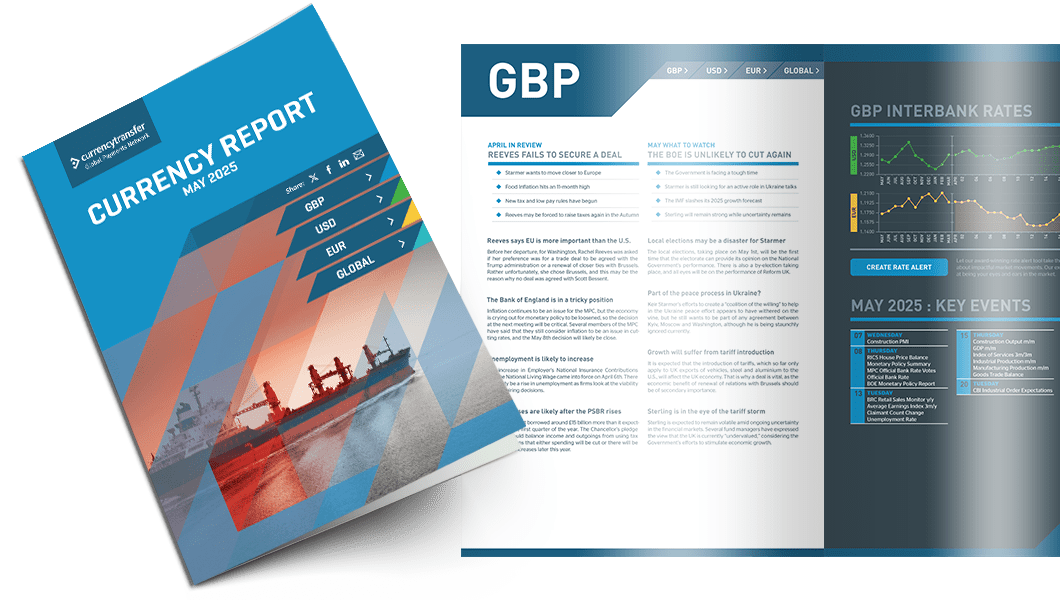
Read our latest currency report
Most impactful events planned this month and how they could impact your business
Trump becoming major liability for Republicans in midterms
Warsh, who took the helm of the Fed in mid-2026 and held his first FOMC meeting in June, has guided the federal funds rate to remain at 3.5% to 3.75%. His approach is aggressively data-dependent, and he believes that his mandate is not to offer Wall Street the kind of forward guidance it has grown accustomed to over the past decade.
Williams has characterised inflation, running at roughly 4%, as “unquestionably too high” but has simultaneously predicted it will decline.
Warsh isn’t buying it. During his July congressional testimony, he told lawmakers that the Fed has “no tolerance for persistently elevated inflation.” At Jackson Hole, he went further, noting that half of the items in the Personal Consumption Expenditures index were rising above 3% annually. Core PCE inflation stood at about 3.7% YoY at the time of his speech.
When the chair of the Federal Reserve says there is “significant work” left to do if underlying inflation doesn’t show a clear trend towards the 2% target, markets listen. The probability of a September rate hike jumped after his Jackson Hole remarks.
Warsh has also emphasised that short-term interest rates should be the Fed’s primary instrument, expressing visible caution about unconventional measures such as large-scale asset purchases.
On the ‘hawkish scale’, Williams sits firmly in the middle of the most dovish of members of the FOMC. The committee is the most split it has been in decades, with three members dissenting after a vote at the last meeting.
Donald Trump is becoming a major liability for Republican candidates in the upcoming midterms, as dire predictions that the opposition will sweep the House and Senate continue to mount, according to a new poll.
Research by The Financial Times found that 46% of people felt that Trump’s record in the White House since returning to power in January 2025 had made it “harder” for conservatives to win their elections on November 3.
A majority of Democrats and independents agreed, but more damningly, 30% of Republican voters did too. Conversely, only 26% of that demographic said Trump’s record had made it “easier” for the GOP’s nominees to win.
The same poll also found that 43% of people overall felt an endorsement from the President was likely to do a Republican candidate more harm than good.
While only 13% of conservatives thought that was true (compared to 69% of Democrats), fewer than half (48%) of those on the right believed a nod from the President would help.
Markets are becoming worried because several financial-market risk indicators are flashing red, even though headline U.S. economic data still looks strong. The tension is between solid growth and mounting market-structure vulnerabilities, and history shows that when these diverge, markets usually move first.
Strong GDP, low unemployment, and robust corporate earnings coexist with surging leverage, rising yields, and fragile risk appetite. This combination often precedes instability.
Reuters reports that multiple market warning signals are approaching crisis territory: margin debt has hit $1.5 trillion, deepening investor cash shortfalls, and AI-linked stocks, which powered much of the rally, are now sputtering. Meanwhile, oil prices near $100 threaten a fresh inflation pickup, and long-term Treasury yields above 5% are pressuring mortgages and weaker corporate borrowers.
These are classic late-cycle stress points: high leverage, expensive credit, and fragile speculative positioning.
Despite the Labour Day holiday, the U.S. dollar was modestly stronger across most major FX pairs yesterday, supported by higher Treasury yields and renewed expectations of a September Fed rate hike.
Moves were modest but broadly positive for the USD.
France headed for a recession as economic troubles mount
Inflation in the Eurozone, which is heavily dependent on energy imports, hit a three-year high of 3.3 percent in August, substantially above the ECB’s two-percent target. With fears growing that prices will spiral even higher, the Central Bank is set to raise its benchmark rate for the second time this year when it meets on Thursday.
The ECB’s Governing Council looks certain to raise its deposit rate from 2.25 percent to 2.5 percent, according to several European banks’ economists.
The ECB delivered its first hike since 2023 in June to tame surging prices, but then hit pause at its most recent meeting in July to see how the conflict would develop.
But with Tehran and Washington now seemingly at an impasse, Isabel Schnabel and Joachim Nagel, both inflation hawks and members of the ECB’s rate-setting governing council, have signalled in recent days that policymakers will resume hiking rates.
In the second quarter of 2026, seasonally adjusted GDP rose by 0.6% in the euro area and by 0.7% in the EU compared with the previous quarter.
Compared with the same period last year, seasonally adjusted GDP in the eurozone rose by 1.2% in Q2, whilst that of the EU rose by 1.4%. In Q1, these figures stood at 0.6% year-on-year and 0.9% year-on-year, respectively.
The Eurozone faces a dilemma in managing data releases from its members. Several cannot produce timely estimates of economic activity, let alone confirmed data.
France could be heading for a recession this Autumn. The country is certainly on the edge. Nearly all indicators are flashing red: growth remains sluggish, consumer spending is still weak despite a slight spring uptick, and employment is down. Slightly accelerating inflation is further eroding purchasing power.
France's National Institute of Statistics and Economic Studies has released worrying figures confirming the country's economic troubles. Growth has stalled, inflation is rising, purchasing power is falling, and employment is weakening.
Few signs suggest a rebound that could lift the country out of this gloom.
The Euro was essentially flat to slightly weaker in FX markets yesterday, trading in a very tight range against the dollar and making only modest moves against other majors. The session was dominated by the Labour Day holiday, which considerably reduced liquidity in the European afternoon, and by anticipation ahead of the ECB meeting.
Have a great day!

Exchange rate movements:
07 Sep - 08 Sep 2026
Click on a currency pair to set up a rate alert
Alan Hill
Alan has been involved in the FX market for more than 25 years and brings a wealth of experience to his content. His knowledge has been gained while trading through some of the most volatile periods of recent history. His commentary relies on an understanding of past events and how they will affect future market performance.