Highlights
- Starmer defends his India trade deal
- Stagflation may be a problem post-FOMC
- Eurozone growth stalled in April
Get bank-beating rates — zero hidden fees
Join 10,000+ clients transferring salary, property deposits and business payments globally.


Starmer calls for calm amid ‘rising tensions’ over Kashmir
He dismissed opposition criticism of tax exemptions in the UK-India trade deal as “incoherent nonsense” as he insisted the agreement was a “huge win” for Britain.
The Prime Minister defended the arrangement, which will allow some Indian workers transferred to Britain to temporarily avoid paying social security in this country and vice versa, following attacks from the Tories and Reform UK. He didn’t mention that the flow of Indian migrants to the UK could become a flood, while movement in the opposite direction could be little more than a trickle.
Speaking in the Commons, Sir Keir said similar reciprocal agreements exist between the UK and up to 50 countries and challenged opponents to tell if they would also “tear up” those pacts on the same grounds.
Starmer is still being called upon to defend the Government over its treatment of pensioners over the removal of the winter fuel payment for all but the most needy.
The threat of a backbench rebellion is still a serious concern for him and his Cabinet in the wake of the Party’s disastrous showing at last week's by-election and local government elections.
One of the party’s MPs, Ian Byrne (Liverpool West Derby), said he would “swim through vomit to vote against” proposed welfare changes.
He was joined in criticizing the policy by his Labour colleagues Richard Burgon (Leeds East), Rachael Maskell (York Central), Andy McDonald (Middlesbrough and Thornaby East), Cat Eccles (Stourbridge), Nadia Whittome (Nottingham East), Imran Hussain (Bradford East) and Ian Lavery (Blyth and Ashington), who each said they were among the MPs who would vote against the Government’s proposals.
The potential rebels are all from so-called “red wall” constituencies that Labour won back last year after they had been captured by a Boris Johnson-inspired defection by those constituencies in the previous election.
In its Pathways to Work Green Paper, the Government has proposed tightening the eligibility requirements for the personal independence payment, known as PIP.
Rachel Reeves looks set to miss her budget targets again, in part due to the economic growth hit from her tax increase on employers, raising the prospect of more tax hikes later this year, a think-tank revealed yesterday.
Weaker than expected growth over the remainder of this Parliament could see the government spending £57 billion more than it collects in taxes in the 2029/30 tax year, the National Institute of Economic and Social Research said.
In its quarterly report, which has been labelled unnecessarily pessimistic by the Treasury, the NIESR cut its forecasts for GDP this year to 1.25% down from 1.50% previously, and lowered its projections for the subsequent year of this Parliament.
The MPC’s latest meeting concludes later this morning, with the market expecting a twenty-five basis point cut to be delivered.
The pound rallied to a high of 1.3363 versus the dollar yesterday but settled back to close at 1.3290 as the Fed left unchanged.
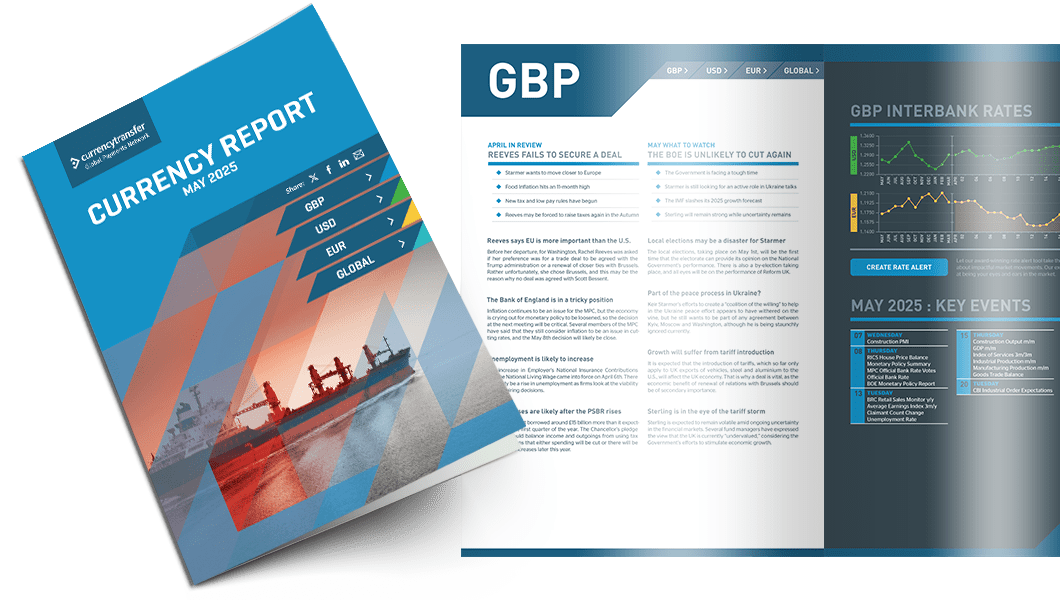
Read our latest currency report
Most impactful events planned this month and how they could impact your business
No Change rings out loud and clear
Powell won’t be rushed into lowering borrowing costs until he sees more clarity over the direction of trade policy coming from the White House. The conclusion of the first FOMC meeting since Trump’s April 2nd Liberation Day speech saw Powell comment that risks of higher inflation and unemployment had risen, leading committee members to conclude that there is too much uncertainty for them to come to clear and definitive conclusions.
Powell went on to say that the economy overall has “continued to expand at a solid pace,” attributing a drop in first-quarter output to record imports as businesses and households rushed to front-run new import taxes.
The labour market also remained “solid” and inflation was still “somewhat elevated,” the central bank’s policy-setting Federal Open Market Committee said, repeating the language used in its previous statement.
However, the latest statement highlighted developing risks that could leave the Fed with difficult choices in the coming months.
“Uncertainty about the economic outlook has increased further,” Powell said in a prepared statement at the end of a two-day meeting, during which officials agreed unanimously to keep the central bank’s benchmark interest rate steady in the 4.25 to 4.50 per cent range.
“The Committee is attentive to the risks to both sides of its dual mandate and judges that the risks of higher unemployment and higher inflation have risen,” he went on to say.
Powell also said trade policy remains a source of uncertainty that affirms the Fed’s need to be in a wait-and-see mode. “I don’t think we can say which way this will shake out,” he said, adding, “I think there’s a great deal of uncertainty about, for example, where tariff policies are going to settle out.”
The President will hold a “big” press conference at 10 am Washington time this morning to announce what he called a major trade deal, the first such agreement since the announcement of tariffs on April 2nd. There is speculation that the announcement will be the delivery of a trade deal with the UK, even as Trump was expected to delay it to coincide with his State Visit.
He will visit Saudi Arabia, Qatar and the UAE in the coming days, with the announcement of individual investment deals with those countries set to be delivered, including the building of a Disney Theme Park in Abu Dhabi.
The dollar reacted positively to the Fed’s announcement, although the index is still unable to break the 100 level conclusively. It closed at 99.65, having earlier reached a high of 99.95.
The new German finance minister says 'no time to lose'
Underlying this slow expansion is a divergence between sectors. Manufacturing grew at its fastest pace in two years, supported by improving supply chains and a recovery in industrial activity.
In contrast, the services sector, the bloc's economic engine, barely registered growth, with the services PMI falling to 50.1 from 51.0 in March. This is the weakest reading since the end of 2024 and indicates that demand for tourism, hospitality, and business services is losing momentum.
Behind the headline figures, the underlying data paints a worrying picture. New business orders fell for the eleventh consecutive month, slightly faster than in March. Manufacturers and service providers reported weaker sales, continuing the weak demand trend that has been holding back growth since mid-2023.
France stood out for the wrong reasons, with its composite PMI signalling contraction for the eighth month in succession. The eurozone's second-largest economy remains mired in political uncertainty and stagnation, in contrast to the relatively better performance of Spain, Italy, and Germany.
Spain leads the way in terms of growth, followed by Italy. Germany saw insignificant growth, and France was in last place. Germany should overtake Italy soon thanks to its generous fiscal package, while France is likely to remain in the doldrums."
Employment in the bloc rose for the second consecutive month, with the growing number of people employed in the services sector offsetting the continuing decline in manufacturing. However, companies appear hesitant to expand their workforce, reflecting greater caution amid ongoing economic uncertainty.
The rush to cut interest rates at major central banks slowed to a trickle in April, as policymakers faced uncertainty on the outlook for economic growth and inflation in the wake of escalating trade tensions.
Two of the five central banks overseeing the 10 most heavily traded currencies that held meetings in April, the European Central Bank and the Reserve Bank of New Zealand, lowered interest rates by a cumulative 50 basis points.
Forecasts for the stalled German economy, which new Chancellor Friedrich Merz has promised to jump-start, have sagged under the weight of President Trump’s tariffs and trade war. Relations with Trump’s administration have continued to fray.
Friedrich Merz’s party won Germany’s national election in late February. After weeks of coalition negotiations, Merz finally made it to the chancellor’s office late Tuesday afternoon, one failed parliamentary vote and several hours behind schedule. In the interim, nearly all of Merz’s problems got worse.
The region will remain in a state of flux pending the outcome of President Trump’s imposition of tariffs on the region. The ECB doesn’t meet again until next month, when there will be speculation will mount about whether its Governing Council will feel that the time is right to pause its run of eight consecutive rate cuts.
The Euro lost ground as the Fed left rates on hold. On a quiet trading day, it earlier reached a high of 1.1358 before dropping to close at 1.1301.
Have a great day!

Exchange rate movements:
07 May - 08 May 2025
Click on a currency pair to set up a rate alert
Alan Hill
Alan has been involved in the FX market for more than 25 years and brings a wealth of experience to his content. His knowledge has been gained while trading through some of the most volatile periods of recent history. His commentary relies on an understanding of past events and how they will affect future market performance.