Highlights
- Only a hike will surprise markets
- Almost half of U.S. imports now have steep tariffs
- The Eurozone economy is growing at its fastest pace in over 2 years
Get bank-beating rates — zero hidden fees
Join 10,000+ clients transferring salary, property deposits and business payments globally.


Keeping interest rates high for too long is risky
Rate-setter Catherine Mann warned there is “obvious upside evidence” of UK inflation lingering above the central bank’s 2% target for longer. At the same time, Bank of England Deputy Governor Sarah Breeden said earlier this week that a recent climb in headline inflation was unlikely to last. There were risks to the economy if interest rates were kept high for too long. She was among the majority of MPC members who, at the BoE's September meeting, voted to keep borrowing costs on hold at 4% after voting to reduce them by 25 basis points in August, in a narrow 5-4 vote by the MPC.
Breeden said the recent "hump" in inflation was unlikely to lead to additional inflationary pressure.
The BoE expects inflation to hit 4% in September before falling only slowly to its 2% target in 2027. But it is also worried about a slowdown in economic growth.
It is not the next “look” for the MPC to be constantly on a knife-edge when deciding on monetary policy. Still, if every result were to be unanimous, it would draw criticism that the committee is little more than a “talking shop”.
After yet another dreadful week, the Chancellor, Rachel Reeves, must be praying that the Bank of England helps her out by cutting interest rates later.
It would reduce the considerable amount of interest the government has to pay, put more money in people’s pockets, and even stimulate growth. The trouble is, the Bank’s governor, Andrew Bailey, can’t afford to bail Reeves out of the hole she has dug for herself. If the Bank does, it risks its independence.
The City’s experts clearly have no concrete opinions on what the Bank will decide on interest rates this week. The markets have priced in a one-in-three chance of a cut, rising to a two-in-three chance by the end of the year. On Polymarket, the popular predictions market, the overwhelming consensus is that rates won’t change, with just a 12 percent chance of a quarter-point reduction.
Governor Andrew Bailey is set to have the deciding vote again on whether to cut interest rates by 25 basis points, analysts have said. Mann’s comments earlier in the year, that rates should be unchanged or changed by a substantial amount, rather than "tiptoeing" around the issue, have far greater credibility than what is happening at present.
Traders will sit on their hands this morning, waiting until the decision is made, after which the fate of Sterling between now and year-end is likely to be decided. Yesterday, Sterling made some ground back after Tuesday’s precipitous fall. It reached a high of 1.3053 and closed at 1.3050.
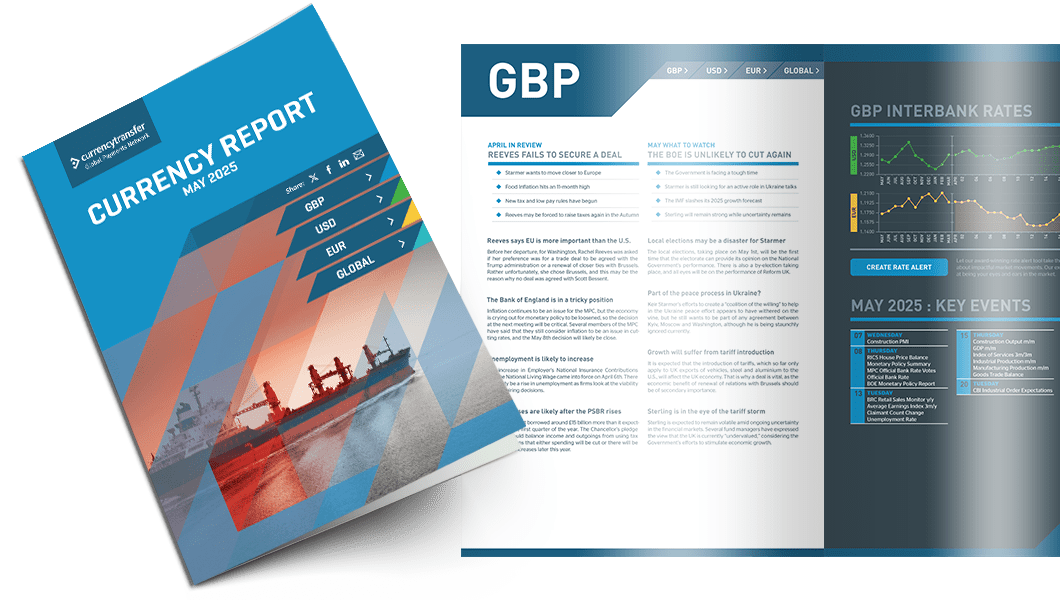
Read our latest currency report
Most impactful events planned this month and how they could impact your business
Can the Fed change a K-Shaped Economy?
This creates a "K" shape when graphed, with one arm of the "K" representing the sectors or groups that are doing well and the other arm representing those that are not.
This is what the U.S. economy is facing currently. As Americans have raised concerns about rising prices, a possible recession, a cooling labour market, and an ongoing government shutdown in recent months, economists have warned that the U.S. economy may be “K-shaped,” with spending trends dividing low- and high-income consumers.
JPMorgan Chase reported earlier this month that income growth for Americans aged 25 to 54 slipped from about 3% annually to 2%, matching rates during the 2007 to 2009 financial crisis. Meanwhile, Federal Reserve Chair Jerome Powell noted last month that there was “anecdotal” data indicating the U.S. economy had become divided, including recent layoffs and a slowing labour market, while also citing earnings reports that suggested “consumers on the lower end are struggling.”
Powell said consumer spending had risen and defied “a lot of negative forecasts,” but it may be fueled by “mostly high-end consumers,” adding, “Lower-income Americans are pulling back while higher earners continue to spend.”
Federal Reserve Governor Stephen Miran indicated yesterday that, based on current conditions, he would support an interest rate cut at the central bank’s December policy meeting.
Miran has publicly warned that maintaining a tight policy could risk triggering an economic downturn, emphasising the need for proactive rate adjustments. Miran’s public comments are considered reasonable and balanced, but underlying them is always the knowledge that he was appointed a Fed Governor by the President with the express task of lowering rates.
At the latest Federal Reserve meeting, Miran dissented, advocating a larger rate cut, highlighting divisions among officials about the pace of easing. Federal Reserve Chair Jerome Powell has indicated that policymakers' views on future cuts vary widely, leaving room for debate ahead of the December decision.
Close to 50% of goods and raw materials imported into the U.S. currently have tariffs above the 10% minimum set by Trump in April. There is still work to be done, as several of the country’s “principal” partners believe they are still in trade talks with the Administration.
The dollar index climbed to a five-month high yesterday. It is pushing higher after the US Oct ADP employment change rose more than expected, a hawkish factor for Fed policy. The dollar added to its gains as the Oct ISM services index rose more than expected to an 8-month high.
The dollar also garnered some support today from a Washington Post report that said a handful of moderate Senate Democrats are considering voting to end the government shutdown. In addition, the dollar has carry-over support from Fed Chair Powell's warning last week that another rate cut in December is not a foregone conclusion.
It reached a high of 100.36 but drifted lower to close moderately below its previous closing level at 100.16.
The Economy, rather than migration, is a top priority for German voters
The HCOB final composite output index improved to 52.5 in October from 51.2 in September. This was the highest score since May 2023, indicating a breakout from the generally subdued growth trend seen so far in 2025.
Manufacturing and services contributed to the Eurozone expansion in October. Factory production growth picked up but at a marginal pace, while services registered marked acceleration of growth.
The HCOB final services Purchasing Managers' Index rose to 53.0 in October from 51.3 in the previous month. The score suggested the fastest growth in output for almost a year and a half.
"France is clearly putting the brakes on eurozone economic growth," Hamburg Commercial Bank Chief Economist Cyrus de la Rubia said.
"On the bright side, it's not just Germany where the expansion rate has picked up significantly," de la Rubia added. The economist noted that the recovery is gaining broader traction.
At the national level, the latest PMI figures showed an almost broad-based improvement in economic conditions across the union. Spain outperformed other countries, reporting the fastest growth in ten months.
Germany's business activity grew at the strongest rate in almost two-and-a-half years. Italy also logged faster expansion. In contrast, France moved in the opposite direction, falling to an eight-month low.
Germany's private sector output growth quickened to a 29-month high in October. The composite output index rose to 53.9 from 52.0 in September. The flash reading was 53.8.
Within the Eurozone itself, confidence is rising that the economy may have “turned the corner, although in the broader global economy, there is a belief that more work needs to be done on recession-proofing the entire region.
There needs to be more cooperation, and the ECB and European Commission cannot continue to lean on the fact that the economy is still “learning” to work as a single unit.
German voters are increasingly focused on the country’s economy rather than on migration, which played such a significant role in the Federal Election. 60% of respondents to a new poll see fixing the economy as the Government’s primary responsibility, which was 6% higher than in a similar survey in October.
The overall takeaway from this poll is that support for Friedrich Merz’s ruling coalition is continuing to erode.
The euro steadied yesterday after several sessions of losses. It reached a high of 1.1498 and closed at 1.1488.
Have a great day!

Exchange rate movements:
05 Nov - 06 Nov 2025
Click on a currency pair to set up a rate alert
Alan Hill
Alan has been involved in the FX market for more than 25 years and brings a wealth of experience to his content. His knowledge has been gained while trading through some of the most volatile periods of recent history. His commentary relies on an understanding of past events and how they will affect future market performance.