Get bank-beating rates — zero hidden fees
Join 10,000+ clients transferring salary, property deposits and business payments globally.


That matters because Spain remains one of the most popular destinations for British movers: the Spanish National Statistics Institute recorded 266,462 UK nationals resident in Spain on 1 January 2025, making Britons the sixth-largest foreign nationality in the country. Spain's resident population also reached 49.1 million at that point, with 14.1% holding foreign nationality, which underlines just how important immigration routes have become to the country's housing, labour and services landscape.
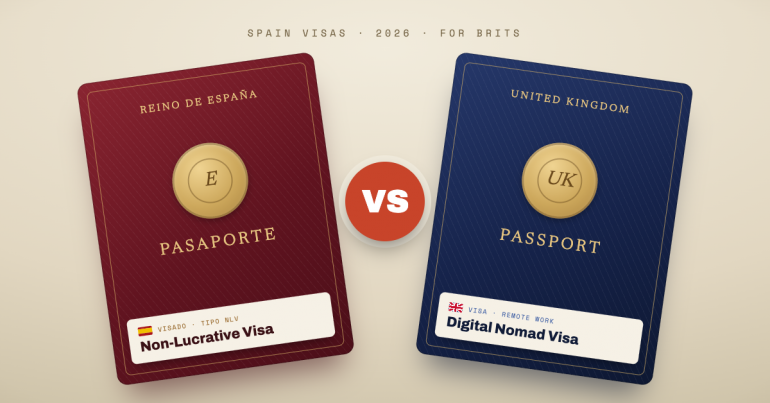
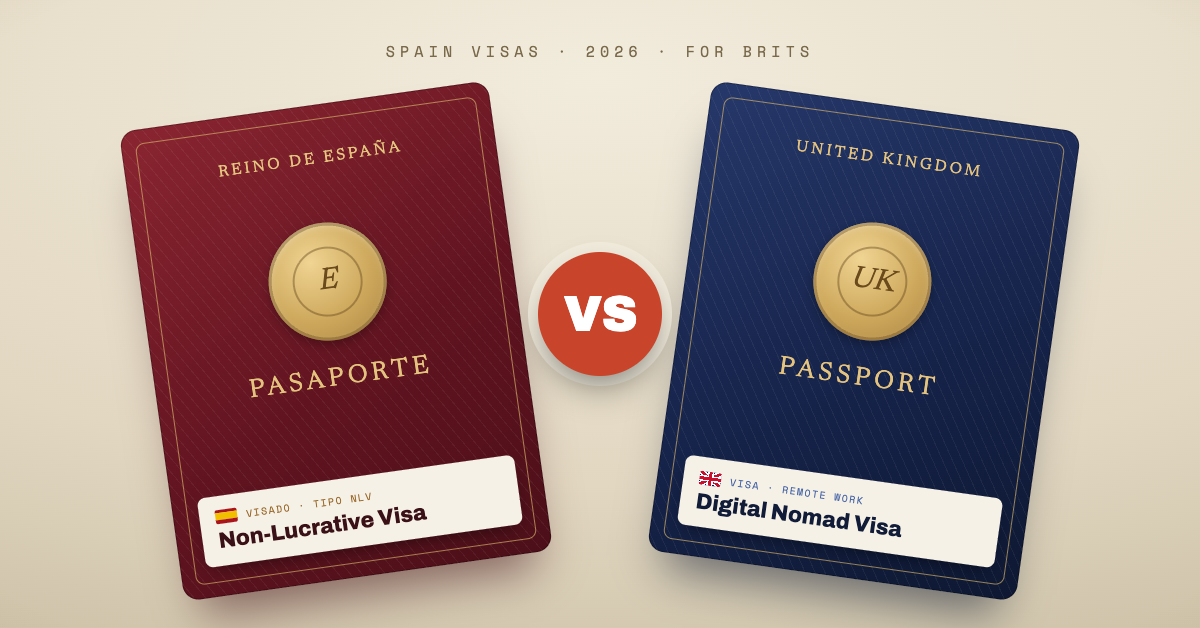
The two visas most Britons compare are the Spain Non-Lucrative Visa and the Spain Digital Nomad Visa. On paper, they can look similar because both can lead to a legal long-term stay in Spain. In practice, they are designed for very different people. The non-lucrative route is for those who can support themselves without working, while the digital nomad route is for remote workers and freelancers whose income comes from outside Spain. That distinction has become more relevant as work patterns have changed in Britain: the Office for National Statistics reported that 28% of workers in Great Britain were hybrid workers between 8 January and 30 March 2025.
What the Spain Non-Lucrative Visa actually allows
The Spain Non-Lucrative Visa is the classic route for retirees, financially independent households and some passive-income movers. Spain's migration guidance defines it as an authorisation requested from the applicant's country of origin that allows residence in Spain without carrying out work or professional activities. In other words, it is designed for people who can fund life in Spain without employment income earned from ongoing work.
Requirements for British applicants in 2026
For a British applicant in 2026, the core test is financial self-sufficiency. Spain requires monthly means equal to 400% of the IPREM for the main applicant and 100% of the IPREM for each dependant. Spain's 2026 IPREM is €600 per month, so that works out to €2,400 per month for a solo applicant, or €28,800 over a year, plus €600 per month for each family member included in the application. This is one reason the Spain Non-Lucrative Visa is so often associated with pension income, investment income, savings and rental income rather than salary.
The route also comes with familiar residence-style conditions. Spain requires proof of health insurance from a public or private insurer authorised to operate in Spain, as well as a criminal record certificate and other supporting documents. The initial permission lasts one year from entry into Spain, and the applicant must apply for a foreigner's identity card after arrival. After that, renewal is possible for two years at a time, but Spain's renewal rules are not casual: the holder must continue to show sufficient means and insurance, and must have lived in Spain genuinely and effectively for more than 183 days during the calendar year.
That 183-day rule is one of the biggest practical differences for Brits comparing routes. The non-lucrative visa is set up for people who are really relocating their lives to Spain, not for those trying to split their year loosely between Britain and the Costa del Sol while keeping a live UK role. Spain's own teleworker FAQs are explicit on the wider principle: if you already hold a non-lucrative residence permit, you cannot claim remote work carried out under it as lawful prior telework, because the non-lucrative permit does not authorise work. Put more simply, if you intend to keep working online, the Spain Non-Lucrative Visa is the wrong visa.

What the Spain Digital Nomad Visa actually allows
Spain's Digital Nomad Visa, officially the international telework route, was built for a different kind of mover. The Ministry of Inclusion describes it as a route for third-country nationals who move to Spain to carry out remote professional or employment activity for companies located outside Spain, using only computer, telematic and telecommunications systems. For Britons, that means the visa is aimed squarely at employees, contractors and freelancers whose work is location-flexible but whose client or employer base sits mainly abroad.
The eligibility rules are more technical than on the non-lucrative route, but they are also far better aligned with modern working life. Spain requires proof that the foreign company has had real and continuous activity for at least one year. The applicant must usually show a work or professional relationship of at least three months before the application date. Spain also asks for either a relevant university or postgraduate qualification, recognised professional training, or at least three years of comparable experience. On top of that, the teleworker must satisfy social security and health cover requirements, either through the applicable system or qualifying insurance arrangements.
Income threshold
The income threshold is also specific, and this is one area where the figures have moved during 2026. Spain requires resources equivalent to 200% of the Spanish minimum wage (SMI) for the main applicant, plus additional percentages per family member. The Spanish government approved a new SMI for 2026 on 29 January 2026 (Real Decreto 126/2026, backdated to 1 January 2026), setting the monthly SMI at €1,424.50. That puts the Digital Nomad Visa income threshold at approximately €2,849 per month (around €34,188 per year) for a solo applicant, plus roughly 75% of the SMI for the first accompanying relative and 25% for each additional relative. Some older consular pages still quote the pre-uprating figures, so it's worth checking the current SMI before budgeting for your application.
Where the digital nomad route becomes particularly attractive is flexibility. Spain's official FAQs state that an employed applicant may work only for the foreign company that underpins the teleworking activity. But applicants on a professional, self-employed basis may work for Spanish companies too, as long as that Spanish work remains professional rather than employed and does not exceed 20% of total professional activity. Spain also states that dependent family members under this route may live and work in Spain without restrictions. That alone makes the Digital Nomad Visa far more appealing for younger British households or couples where one partner wants immediate labour market flexibility.
There is also a tax angle that makes the route worth serious attention. Spain's public tax guidance expressly includes employed teleworkers holding the international telework visa within the circumstances that can qualify for the special impatriate tax regime, subject to the usual conditions. That does not mean every British digital nomad will automatically receive a lower bill, but it does mean the route can be structurally more tax-efficient than a non-lucrative move for some working professionals.
The key differences Brits should focus on
If you strip away the paperwork, the choice comes down to one decisive issue: will you work once you are in Spain? If the answer is no, and your income genuinely comes from pension payments, investments, savings or other non-work sources, the Spain Non-Lucrative Visa is the cleaner answer. If the answer is yes, and you want to keep your UK employer, overseas clients or freelance contracts, the Spain Digital Nomad Visa is built for that reality. That conclusion is not marketing language; it follows directly from Spain's official wording, which bans work on the non-lucrative route and positively regulates remote work on the telework route.
Administrative complexity
The second key difference is administrative complexity. The non-lucrative visa is simpler conceptually because it is about proving resources and insurance. The digital nomad route demands more evidence: company trading history, prior work relationship, qualifications or experience, and social security compliance. But the reward for that extra paperwork is legality. For many Brits, especially those with location-independent jobs, this is the safer route because it matches their actual source of income instead of trying to fit a working life into a non-working visa.
Your stay in Spain
The third difference is how you use Spain. The non-lucrative visa suits people who really want to settle and spend most of the year there, because renewal expects effective residence above 183 days a year. The digital nomad framework is also for real residence, but its practical design is more compatible with ongoing international professional life. Spain's teleworker guidance also makes clear that an international teleworker visa authorises residence and work in Spain for one year, and the applicant may seek a residence authorisation if there are 60 days remaining before the visa expires and it is still valid. Meanwhile, Spain's non-lucrative residence process gives a maximum of one month for the residence decision after consular communication.
Cost, evidence and tax points to check before you apply
For Britons, the money question is often broader than the headline income threshold. Spain wants evidence that stands up: bank statements, proof of incoming income, insurance cover, criminal record checks and properly legalised or apostilled documents where required. On the non-lucrative route, Spain says financial means can be evidenced by different forms of proof, including property titles, certified cheques or even credit cards accompanied by a bank certificate showing available credit. On the digital nomad side, Spain asks for payslips or invoices from the previous three months, bank certificates showing those payments landing, and employer or client letters setting out the role, duties and remote-working basis.
Relocation planning
This is also where practical relocation planning matters. A couple moving on a Spain Non-Lucrative Visa may need to demonstrate enough liquid wealth to satisfy immigration, pay a rental deposit, furnish a new home and maintain a cushion for healthcare and utilities. A digital nomad might have smoother monthly cash flow but still face currency risk if earnings arrive in sterling and bills are paid in euros. That is why visa planning and foreign exchange planning should never be treated as separate projects. If you are organising the wider relocation, it is worth pairing this article with CurrencyTransfer's guide on moving to Spain from the UK. If remote work is your likely route, the site's Spain digital nomad visa guide is the natural companion read.
One final long-term point is worth stressing. Both routes can matter beyond the first year. Spain's long-term residence rules state that legal and continuous residence for five years is the general route into long-term residence, and Spain's nationality rules state that the general residency period for citizenship is 10 years. So the visa you choose at the start affects not just your first application, but the legal story you build over time.
Which visa is the better fit for you
For most retired Britons, early retirees and financially independent movers, the answer is still the Spain Non-Lucrative Visa. It is purpose-built for a move funded by pensions, savings or passive income, and it avoids the extra employer and compliance layers that come with the teleworker route. If what you want is a quieter administrative path into Spanish life, and you truly will not work, it is still a strong and sensible option.
For most working-age Britons with a remote salary or freelance business, the Digital Nomad Visa is usually the better and safer route in 2026. It is aligned with the reality of hybrid and remote work, it gives clearer legal cover for continuing to earn, it offers some flexibility for self-employed professionals with limited Spanish clients, and it can be more attractive from a family and tax perspective. Trying to use a non-lucrative visa while still working online may look simpler at first, but Spain's own guidance shows why that is risky.
The decisive test is straightforward. Choose the Spain Non-Lucrative Visa if you are moving to Spain to live, not to work. Choose the Spain Digital Nomad Visa if you are moving to Spain and your work is coming with you. For Brits in 2026, that is the cleanest way to avoid an expensive mismatch between your immigration status and your real life.
If you’re looking for an efficient solution to transfer currencies into various countries, take a look at our platform: CurrencyTransfer offers access to a network of payment providers, live quotes and 5-star customer service. Sign-up today.
Caleb Hinton
Caleb is a writer specialising in financial copy. He has a background in copywriting, banking, digital wallets, and SEO – and enjoys writing in his spare time too, as well as language learning, chess and investing.