
Highlights
- Healey acknowledges high government borrowing costs
- Canada’s retaliatory tariffs take effect as US trade talks stall
- ECB Policy Meets a Eurozone Economy Already Under Strain
Get bank-beating rates — zero hidden fees
Join 10,000+ clients transferring salary, property deposits and business payments globally.


Mortgage rates are set to rise ahead of BoE monetary policy decision
Any thought of Healey having meaningful headroom against the Government’s outgoings is becoming increasingly difficult to imagine every day as rates continue to rise.
The Governor of the Bank of England is sounding the alarm over the "upside" inflation risks facing the UK economy in the months ahead. Testifying before Parliament's Treasury Committee, Andrew Bailey pushed back against suggestions that the Bank has a predetermined path for borrowing costs.
He acknowledged that the balance of risks to inflation remains tilted to the upside, driven primarily by energy prices. Still, he insisted that market expectations of rate rises should not be taken as a foregone conclusion. He told MPs: "The risks are to the upside, the risk particularly being with energy prices. What I want to dispel is the idea that we have a secret plan and we know where we are going to go."
The base rate in the UK currently stands at 3.75 percent, and the Bank's Monetary Policy Committee (MPC) is due to convene again next week to decide whether to raise borrowing costs.
Economists expect rates to rise at least once over the next twelve months, as expectations mount that inflation will edge higher.
Financial markets are already pricing in tighter monetary policy, though Bailey stressed that such market pricing does not guarantee any particular outcome from the committee's deliberations.
Megan Greene, an external MPC member who backed a rate rise at last month's vote, expressed unease about instability in energy and commodity markets stemming from the ongoing Middle East conflict. She told the committee: "The conflict has been going on for six months, so that worries me in terms of second-round effects.
She continued, "We face such incredible uncertainty, so, in my view, it is appropriate to take a risk management strategy and think about how you manage monetary policy."
Bailey added: "To state the obvious, the conflict is still going on and is the cause of high levels of energy prices."
The Governor warned that significant price swings in energy markets are spilling over into broader financial conditions.
Bailey told MPs that the UK is not "on the verge of a recession", adding that the latest data was solid. He added that the jobs market is softening, with the hiring rate declining.
Sterling was slightly firmer yesterday, trading around 1.3540–1.3550 against the dollar, supported by cautious BoE remarks and a softer dollar backdrop, but it remained capped within its established August–September range.
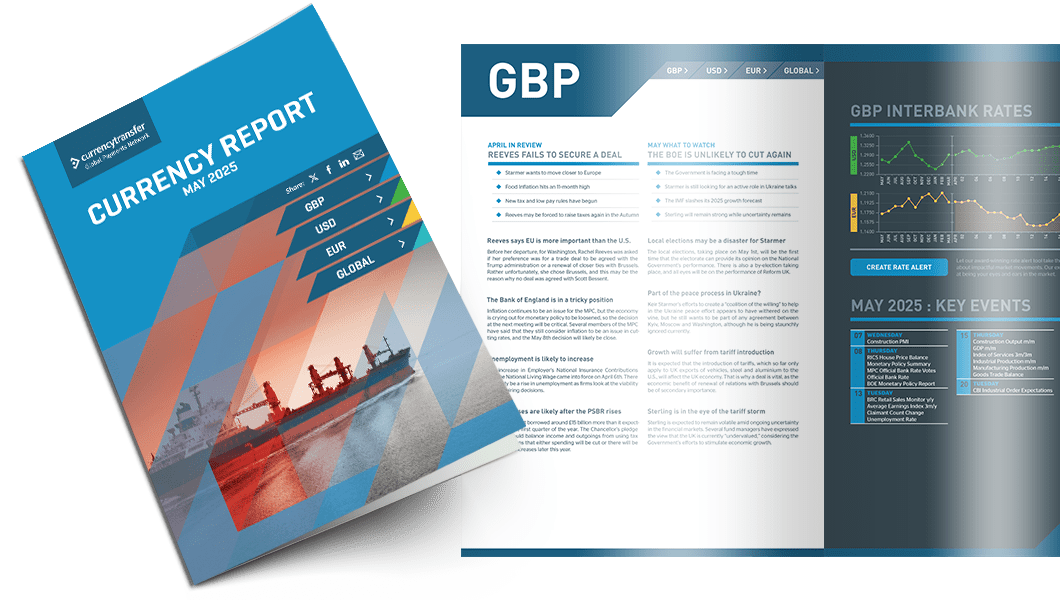
Read our latest currency report
Most impactful events planned this month and how they could impact your business
The dollar’s share of global reserves hits a 30-year low
Canadian Prime Minister Mark Carney has stood firm, acknowledging that reducing economic ties with the United States would come at a cost but saying the benefits would outweigh the pain.
A range of Canadian products, from mattresses to motorboats and golf carts, will face a 50% surcharge from September 15, according to Trump's latest executive order issued late yesterday.
The import ban, which targets various alcoholic beverages as well as some dairy products such as whey, will take effect on September 29, according to other executive orders issued at the same time.
Canada's retaliatory tariffs took effect earlier in the day, applying to C$27.6 billion (US$20 billion) in US imports, including steel and aluminium products and dairy goods such as cheese, in response to duties Washington announced on August 22nd.
Donald Trump's unfathomable link between U.S. interest-rate policy and trade ties with America's biggest partners led to more head-scratching than market impact. But the strangeness of the President's take offers Federal Reserve Chair Kevin Warsh an opportunity to convincingly distance himself from the White House and bolster his credibility by pushing for a Fed rate rise this month.
Last Friday should have been a reasonably good day for the President on the economy. After all, August U.S. payroll gains were triple the forecasts, and much of the soft summer jobs picture was revised away as well. Diesel prices hit a record high earlier in the day, potentially putting upward pressure on inflation. But tepid wage gains in the employment report could just as easily be read as another reason for the Fed to stand pat on rates as it awaits an inflation update this Friday, just days before its next FOMC meeting.
Trump needs some good economic news. With the midterm congressional elections just two months away, his overall approval ratings are at the lowest point of his two terms in office, with 71% of Americans, including 40%, disapproving of his record on the cost of living.
The US dollar's share of global foreign exchange reserves has fallen to levels not seen in about three decades, fuelling claims that Central Banks are accelerating their retreat from the world's dominant reserve currency. But new analysis suggests these claims may overstate the scale of de-dollarisation.
The dollar accounted for roughly 56% of global official foreign exchange reserves in 2025, down from 64% in 2015, according to data cited by researchers at the Federal Reserve Bank of New York.
That is a substantial decline over a decade. However, the New York Fed found little evidence that it reflects a coordinated or broad-based move by Central Banks away from dollar assets.
Instead, a handful of major reserve holders appear to account for much of the shift.
The dollar’s reserve share hit a 30-year low because a few large countries (China, Russia, Mexico, Morocco) cut dollar exposure; sanctions risk pushed some governments to diversify; record gold buying and BRICS local-currency systems reduced dollar demand, while valuation effects mechanically lowered the reported share.
The USD was broadly mixed and slightly weaker yesterday, with a sharp yen rally the key driver, which overwhelmed otherwise supportive U.S. macroeconomic conditions. Against most other majors, the dollar was flat, reflecting a market in “wait-and-see” mode ahead of U.S. inflation data.
Lagarde is to publish her own story
Economists overwhelmingly expect Christine Lagarde to announce a quarter-point rise in the deposit rate to 2.5% tomorrow, with rates to remain there through 2027, according to a Bloomberg Survey.
Traders, meanwhile, are pricing in about three more hikes by mid-next year.
On Monday, strategists at Deutsche Bank said many are underestimating the scale of rate hikes required to tackle inflation. They added that the “fundamental dislocation” between the ECB's outlook for limited interest rate rises and rising inflationary pressures appears unsustainable.
“Either inflation needs to fall, or the pressure on rates will continue,” the German bank told investors.
The divergence highlights the ECB’s challenge in calibrating monetary policy as renewed fighting in the Middle East jolts energy markets again.
Despite elevated inflation not showing signs of becoming entrenched, risks abound.
The ECB is likely to present a 25-basis-point hike as necessary. Still, it will probably stop short of signalling another hike, keeping the focus on data dependence, anchored inflation expectations, still-contained wage growth, and the need to gauge how strongly past tightening is feeding through.
Almost no survey respondents can point to evidence that businesses and consumers are bracing for stronger price pressures, and most are only mildly concerned about knock-on effects, including in wages.
While policymakers largely agree that inflation at a three-year high hasn’t shifted medium- to longer-term expectations or affected workers’ pay, that could still change.
ECB President Christine Lagarde will publish an autobiography in January, as speculation intensifies that she will leave the ECB before her term ends.
The book, Lady First, will be released in German on January 29, according to a press statement from publisher Piper. It will “feature” prominent figures, including former US Secretary of State Hillary Clinton, former French President Nicolas Sarkozy, U2 lead singer Bono and fashion designer Diane von Furstenberg, it said.
“Christine Lagarde has always been first: France’s first female Minister of Economic Affairs and Finance, the first woman to lead the International Monetary Fund, the first female President of the ECB,” the press release said. “Now, for the first time, she tells the story of her own life.”
Ms Lagarde plans to promote the book in person in Germany and Switzerland in February, Piper said. It will also be published in English.
News of the memoir arrives as rumours build that Ms Lagarde won’t see out her eight-year term at the ECB, which wraps up in October 2027. Bloomberg reported last month that the World Economic Forum, known for its annual gathering in Davos, is still courting her to take over, and that she appears ready to accept the role.
The Euro was essentially flat to slightly softer yesterday, trading in a narrow range with no meaningful directional momentum. Against GBP, EUR slipped marginally; against USD, it held steady near recent levels. Markets were awaiting tomorrow’s ECB meeting and US inflation data due on Friday, leaving EUR in consolidation.
Have a great day!

Exchange rate movements:
08 Sep - 09 Sep 2026
Click on a currency pair to set up a rate alert
Alan Hill
Alan has been involved in the FX market for more than 25 years and brings a wealth of experience to his content. His knowledge has been gained while trading through some of the most volatile periods of recent history. His commentary relies on an understanding of past events and how they will affect future market performance.