Highlights
- Will the Iran War Push the UK Economy Into a Recession?
- US manufacturing has expanded the most since 2022
- Euro area unemployment rate increases to 6.2% in February
Get bank-beating rates — zero hidden fees
Join 10,000+ clients transferring salary, property deposits and business payments globally.


Sterling rallies on the back of improved risk appetite
Starmer responded to U.S. President Donald Trump’s comments regarding Washington’s potential withdrawal from NATO.
At a press conference at 10 Downing Street, Starmer stated there had been “a good deal of pressure” on him to change his stance on joining the war, but he would not do so.
“Whatever the pressure, whatever the noise, I am Britain’s Prime Minister, and I must act in our national interests,” he said. He added that he would not choose between Europe and the United States.
“But I do think that when it comes to defence and security, energy, emissions, and the economy, we need a stronger relationship with Europe,” he said.
During his speech, Starmer did not once mention the “special relationship” the UK has, or had, with the United States, which has led to speculation that, should Trump decide that America’s interests are best served by its departure, he would try to move closer to Europe.
For the second time in just over 12 months, global economic expectations have been upended.
Regarding the impact on the UK, some economists are more sanguine than others, but all agree that the effect on the UK economy will last longer than the war itself, no matter Trump's rhetoric, which seems to change daily.
The outlook for inflation over the coming quarters is highly dynamic and will depend on how long the conflict in the Middle East plays out in the coming weeks and possibly months. However, supply-side shocks, such as the one that we’re currently going through with higher energy prices, are transitory by nature.
The use of that word is highly subjective. It will need the Bank of England to carefully weigh the impact of higher inflation against its effect on economic activity. The MPC will need to consider whether it could choke off any remaining growth potential in the economy once the situation settles down.
The Chancellor said in an interview yesterday that she supports new North Sea oil and gas drilling, a stance likely to heighten tensions with Energy Secretary Ed Miliband.
Rachel Reeves said she would be “very happy” to see development proceed at two proposed fields, citing the benefits for employment and tax revenues. Her comments come as Miliband, who has previously ruled out new exploration, prepares to decide on licences for the Rosebank and Jackdaw fields.
The Chancellor noted that the Government has already eased restrictions on drilling in adjacent fields and defended continued support for domestic oil and gas production.
She argued that although expanding North Sea output would not directly decrease global prices, it would strengthen the UK economy through job creation and fiscal revenues. She also stressed the importance of greater energy security, citing recent geopolitical disruptions, from the war in Ukraine to instability in the Middle East, as evidence of the risks posed by global supply shocks.
Senior Cabinet members need to understand that they cannot create policy in a vacuum, expecting to avoid making significant adjustments during Parliament's term. Any government needs to be dynamic and show a significant degree of flexibility.
The markets reacted positively to Trump's comments about the war, even though they are the very epitome of “transitory”. The pound rallied to a high of 1.3346 and closed at 1.3306 as traders saw an increase in risk appetite.
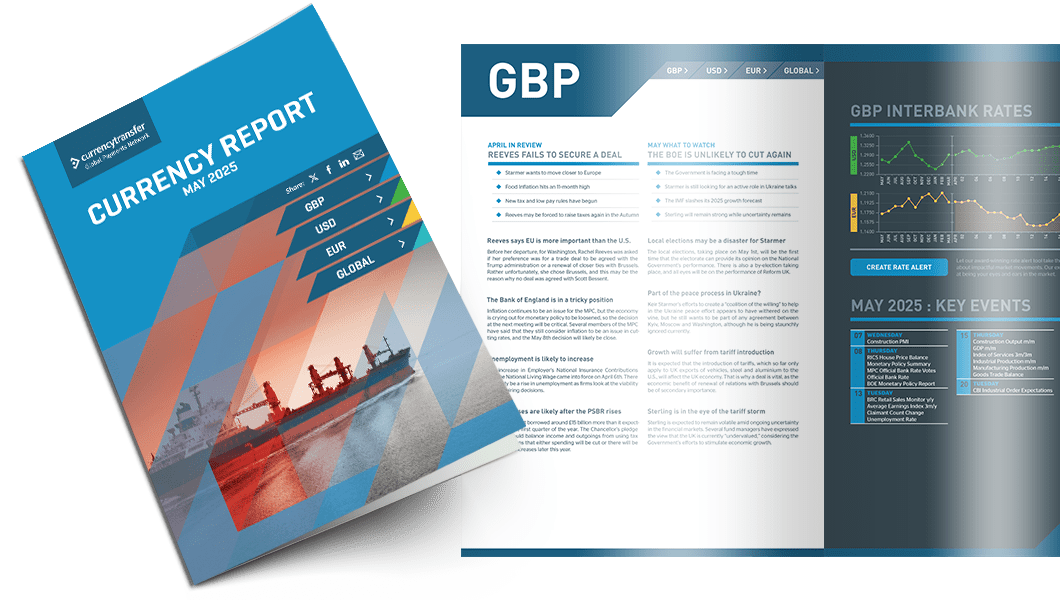
Read our latest currency report
Most impactful events planned this month and how they could impact your business
Trump addresses the nation, but fails to be convincing
The St. Louis Federal Reserve Bank, under its President Raphael Bostic, argues that optimism about AI could hamper productivity and serve as a news shock that influences household and business decisions.
It explains that when households see a news shock, such as AI adoption, they interpret it as a sign of a future pay rise, leading them to spend more today in anticipation of higher income later.
The same logic applies to businesses: if they buy into the promise of miracle innovation, reducing labour costs and increasing productivity, they increase investment in that technology.
All of this enthusiasm results in short-term inflation as demand exceeds supply.
AI hype is pervasive. Analysts compare the current trajectory of AI development to that of the month before the COVID-19 pandemic disrupted the world.
It’s in the words and minds of tech leaders, from Elon Musk to Mark Zuckerberg. The technology is already creeping into the lives of workers at law firms, start-ups, and consulting firms, among others.
The use of AI is hard to fight against; it is a reminder of 1950’s America, when door-to-door salesmen would travel across the country trying to sell the latest time-saving gadget or product to hard-pressed housewives.
While consumer prices have stabilised from a high of about 9% in June 2022, inflation remains stubbornly above pre-pandemic levels. The consumer price index rose 0.3% from January, rising 2.4% compared to a year earlier. While it’s challenging to assess whether AI hype is influencing prices, given that the war in Iran is shaping the current macroeconomic picture, researchers suggest the technology could be contributing to current price rises.
However, they warn that their assessment is purely qualitative: they can forecast that inflation might rise in the short term, but cannot specify by how much.
AI appears to be more than a bubble, but it will take years to prove that.
In both the dotcom era and the current AI hype, there is a disconnect between technological optimism and the actual economic data. During the dotcom boom, economists explained that the economy reflected the latter scenario, where gains failed to materialise, leading to the bubble bursting.
AI is truly everywhere, and one could reasonably think it’s boosting economic growth. But the technology’s benefits are yet to be fully realised.
Until tangible returns are seen that can be unequivocally attributed to AI, a question mark will remain over the technology. At the same time, a high-profile “disaster” could kill it in its tracks.
President Trump said U.S. forces will “finish the job” in Iran soon as “core strategic objectives are nearing completion,” offering a full-throated defence of the war last night in his first national address since the conflict began more than a month ago.
He used his platform before a wide audience to praise the success of the U.S. operations and argue that all of Washington’s objectives have so far been met or exceeded, but said Iran would continue to face a barrage of attacks in the short term.
“We are going to hit them extremely hard over the next two to three weeks,” Trump said. “We’re going to bring them back to the Stone Ages, where they belong.”
But Trump also spent much of a just-under-20-minute address repeating numerous things he had already said in recent weeks and offering few new details. The speech appeared unlikely to move the needle of public sentiment at a time when polling shows many Americans feel the U.S. military has gone too far in Iran, and as gas and oil prices remain high.
The dollar index retreated yesterday as Trump’s earlier comments boosted risk appetite. It fell to a low of 99.29 and closed at 99.56.
German institutes cut growth forecasts
The Eurozone economy’s prospects already appeared challenging in February, when reports of a possible early exit by Lagarde first emerged.
Since then, U.S.-Israeli bombings of Iran have introduced a new element of global economic risk. Lagarde's successor will need both strong economic credentials and political finesse, and must be prepared to innovate amid the multiple crises threatening Europe.
The difficulty of finding such a rare candidate should encourage Eurozone leaders to consider a broader list than the current two frontrunners.
In times like these, the EU already has a proven method for addressing the issue. Why appoint one President when you can have two? It is apparently being considered that a role requiring a diplomat like Lagarde and a technocrat like Draghi could be split into two, although how that might work in practice remains speculative.
Looking at Lagarde’s successor on a more practical level, favourites have already emerged.
If you believe economists, the former head of the Dutch Central Bank, Klaas Knot, is most likely to get the job if Lagarde leaves early, according to a Bloomberg survey. The 58-year-old has been on hiatus since leaving his position in July 2025.
He ticks the traditional boxes for ECB hopefuls. Knot sounded like a classic hawkish Central Banker when he took over De Nederlandsche Bank in 2011. Still, he approved of the new tools devised by then-President Mario Draghi to take the eurozone out of its existential crisis, including massive bond-buying programmes.
His would-be rival is former Banco de España Governor Pablo Hernández de Cos. The 55-year-old now serves as general manager of the Bank for International Settlements.
Like Knot, he comes with impeccable technocratic credentials. Yet hailing from the once-embattled south of the euro zone, he will be seen as a dovish candidate more likely to push the ECB to play a proactive role in fending off potential recessions than to drive a still “juvenile” economy forward.
There may still be plenty of water to flow under the bridge before a decision needs to be made, but in today's world, it is just as likely that Lagarde could be gone by late summer.
Germany's leading economic institutes lowered their growth forecasts for this year and next, and significantly increased their inflation projections as the war in Iran drives up oil and gas prices.
The five institutes cut their joint 2026 growth forecast to 0.6% from 1.3% projected in September and lowered their 2027 forecast to 0.9% from 1.4%, as reported by Reuters earlier this week.
The conflict in the Middle East is increasing pressure on German policymakers to address structural reforms consistently," German Economy Minister Katherina Reiche said in response to the spring report.
The institutes forecast inflation at 2.8% in 2026 and 2.9% in 2027, up from previous projections of 2% and 2.3%, respectively.
Higher energy prices are expected to reduce Germany's income by approximately 50 billion euros over this year and the next, as the country will need to spend more on imported energy, the institutes said.
"This shock makes Germany poorer," said Oliver Holtemoeller of the Halle Institute for Economic Research (IWH).
A spike in oil and gas prices following the start, on 28 February, of joint U.S.-Israeli strikes on Iran has already helped push German inflation to 2.8% in March.
The energy price shock triggered by the war in Iran is hitting the recovery hard. Still, at the same time, expansionary fiscal policy is supporting the domestic economy and preventing a stronger decline," said Timo Wollmershaeuser, head of forecasts at the Ifo Institute.
Losses in purchasing power will weigh on private consumption, the institutes said, forecasting that after household spending rose 1.6% in 2025, it would increase by only 0.4% in 2026 and 2027.
The Euro rallied on hopes that, for once, Trump may actually have a plan to end the conflict in Iran. The common currency rallied to a high of 1.1627 but lost momentum and fell back to close at 1.1582.
Have a great day!

Exchange rate movements:
01 Apr - 02 Apr 2026
Click on a currency pair to set up a rate alert
Alan Hill
Alan has been involved in the FX market for more than 25 years and brings a wealth of experience to his content. His knowledge has been gained while trading through some of the most volatile periods of recent history. His commentary relies on an understanding of past events and how they will affect future market performance.