Highlights
- The OBR’s boss resigns over the leak
- The US manufacturing slump deepens in November
- Eurozone manufacturing slips into contraction
Get bank-beating rates — zero hidden fees
Join 10,000+ clients transferring salary, property deposits and business payments globally.


The US is to zero out tariffs on UK pharma under trade deals
Sir Keir Starmer told reporters that the measures announced by Rachel Reeves are an accurate representation of a Labour Government’s policies, and he is honoured to be the leader of a Government that has lifted 500,000 children out of poverty.
It is indeed an admirable achievement, but that is not the issue that has angered Opposition Parties and the press. It is the fact that Ms Reeves was misleading in her explanation of why she had to raise taxes.
In her pre-budget press conference, she inferred that she may have to raise taxes to fill a black hole in the country’s finances, the size of which was estimated to be in the region of £20 billion, when in fact she was raising taxes to finance the burgeoning cost of welfare.
The chair of the Office for Budget Responsibility has resigned after a damning internal inquiry into the leak that threw Rachel Reeves’s budget into chaos described it as the “worst failure” in the institution’s history.
The departure of Richard Hughes, who said he took “full responsibility” for the watchdog’s failure to handle sensitive information, dragged the rolling recriminations over the budget into a fifth day.
The Prime Minister had notably failed to express confidence in the senior economist, while criticising the OBR for the “serious error” that he said was a breach of market-sensitive information and a “massive discourtesy” to Parliament.
While ministers hope the resignation will draw a line under tensions with the OBR, the chancellor remains under pressure, with critics seeking to contrast Hughes’s decision to quit with Reeves’s defiance over her handling of the budget.
Kemi Badenoch, the Conservative leader, said: “Someone has resigned as a result of the budget chaos … but it isn’t Rachel Reeves. The Chancellor is trying to use the OBR chair as her human shield. But I will not let her.”
Pete Wishart, the SNP’s deputy leader at Westminster, said: “The head of the OBR has taken responsibility and resigned, to restore confidence following the budget leak. The BBC Director General took responsibility and resigned. Why is Rachel Reeves refusing to do the same?”
The UK and the U.S. have reached an agreement that means exports of prescription drugs from Britain to America will continue to be zero-rated for tariffs for the next three years. The deal means Britain will be exempted from the hefty US tariffs on pharma imports that took effect on October 1.
It is the only country to reach such a deal.
The high cost of medications has been a major political issue in the United States for years, with a Rand Corporation study showing that Americans pay 2.5 times as much for pharmaceuticals as French people do.
The pound initially rallied to a high of 1.3275 but lost ground as U.S. markets opened, closing the first day of a new month on the back foot at 1.3213.
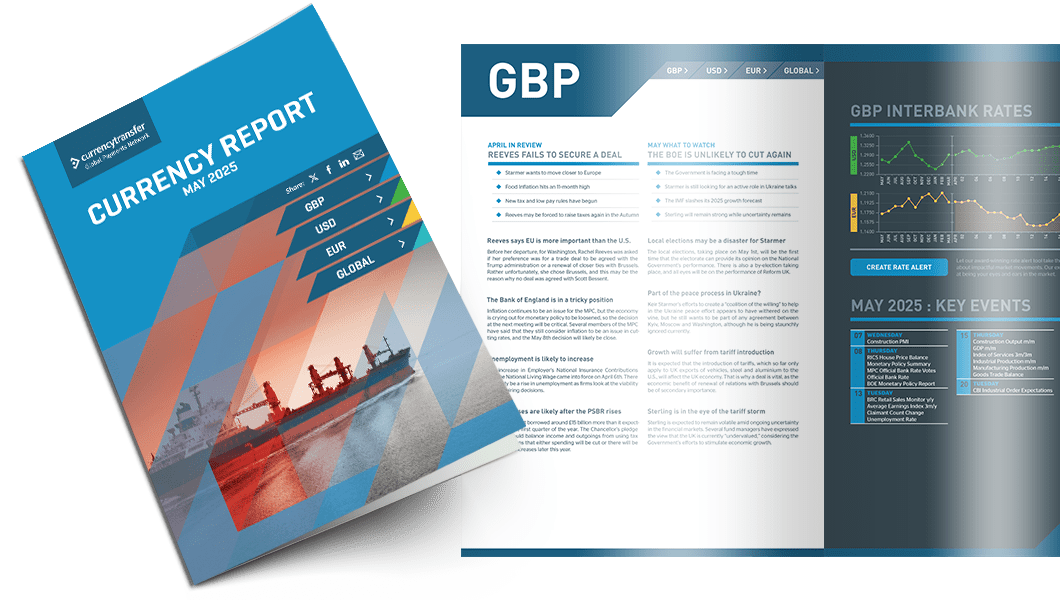
Read our latest currency report
Most impactful events planned this month and how they could impact your business
Hassett has become the hot favourite to become Fed Chairman
The decision will be based on concerns about a weakening jobs market, balanced against fears that a cut at this time will fuel inflation.
Members of the FOMC entered a self-imposed blackout from last Saturday, in which any public comment about their voting intentions is not allowed. This ensures that officials do not influence Financial markets, which react strongly to even slight hints about interest rates or policy changes.
Restricting communication prevents unintended volatility.
Despite the blackout, economists, traders and investors are providing ample volatility in the lead-up to the six-weekly meeting, as speculation reaches a crescendo before 2 pm Washington time tomorrow.
Williams, Waller, Bowman and Miran appear to favour a cut, while Collins, Goolsbee, Musalem and Schmid would like to see rates held at their current level. Powell, Cook, Jefferson and Barr have been non-committal in recent comments.
The New York Fed’s John Williams's comments on Friday were crucial to markets because he's part of the so-called "troika", which includes Fed Chair Powell, Vice Chair Jefferson, and Williams.
In financial markets, these three are considered the most important members and their policy signals have more weight.
President Trump has announced that he has decided on his choice for the next chairman of the United States Federal Reserve. Trump has made it clear that he expects his nominee to bring about interest rate cuts.
Trump has frequently criticised current Federal Reserve Chairman Jerome Powell for failing to cut rates quickly, and has signalled that he wants a chairman who will pursue cuts more forcefully. American media reports that Kevin Hassett, the Director of the White House National Economic Council and Trump's top economic advisor, is seen as a possible choice to succeed Powell. Trump trusts Hassett and sees him as connected to the desire to push for more aggressive interest rate cuts at the Central Bank.
The Dollar index has lost ground over its last five trading sessions, closing out November and beginning December under pressure, primarily due to the prospect of a rate cut. It fell to a low of 99.01 yesterday but rallied to close at 99.41 as traders closed short positions ahead of the FOMC meeting.
Greece teaches Germany a lesson
“Pablo was an excellent Governor, he restored Banco de España’s reputation,” Guindos told the Spanish newspaper El Periódico in an interview published yesterday.
De Cos “understands precisely how Central Banks work and now holds an important position as general manager of the Bank for International Settlements in Basel, but many factors come into play when these decisions are made,” said Guindos, whose own non-renewable eight-year term finishes at the end of May.
Heading a national Central Bank in the current EU environment holds significantly different challenges from being President of the ECB. The holder of this position needs to find a balance between ensuring that monetary policy is determined for all twenty members while being sufficiently diplomatic to ensure that all voices are heard and considered.
Christine Lagarde is a highly skilled diplomat, but has on occasion been found wanting in the technocratic side of the role. Her predecessor, Mario Draghi, is considered not only to have got the balance just right but also to have been sufficiently trusted and forceful to drive the Central Bank and the currency forward.
Eurozone manufacturing slipped back into contraction in November, driven by weaker demand, according to the latest purchasing managers' index (PMI) data. The HCOB Eurozone Manufacturing PMI, a measure of the overall health of eurozone manufacturing, fell from 50.0 in October to 49.6 in November, signalling a renewed deterioration in factory conditions across the single currency union.
After three years of stagnation, eurozone manufacturing has been hovering around the 50 mark, which separates expansion from contraction, for several months.
New orders declined after stagnating in October. Export orders fell for the fifth consecutive month, highlighting persistent challenges in international markets. In response to weakening demand, manufacturers cut jobs at the fastest rate since April, while finished goods stocks depleted by the most significant margin since July 2021.
“The current picture of the Eurozone is sobering, as the manufacturing sector is unable to break out of stagnation and is even tending towards contraction,” said Cyrus de la Rubia, chief economist at Hamburg Commercial Bank.
Bureaucracy is identified as one of the biggest obstacles to the European economy. Companies spend time and money to deal with complex administrative processes. In Germany, for example, many business owners complain about having to hire employees who only do paperwork. But there is one country that shows that it is possible to do things differently: Greece.
The revolution happened after the euro crisis. The difficulties made Greece decide to reinvent itself. Dimitris Papastergiou, Minister of Digital Administration and Artificial Intelligence, explains that measures have been implemented to make life easier for citizens and companies and speed up time-consuming processes.
Now there are digital ID cards, and this is just one example. Everyone recognises that digitalisation has drastically reduced waiting times in public services and made it easier for companies to meet their legal obligations.
The changes not only simplified citizens’ lives but also boosted the economy. In 2024, the country recorded robust growth of 2.3%. For the government, the signal is clear: the commitment to digitalisation is bearing fruit.
Germany has even asked Papastergiou for a blueprint that it can copy to move the process forward at home.
The Euro started the month on the front foot, but traders are unsure about how far it can advance. The common currency climbed to a high of 1.1652 but settled back to close at 1.1609.
Have a great day!

Exchange rate movements:
01 Dec - 02 Dec 2025
Click on a currency pair to set up a rate alert
Alan Hill
Alan has been involved in the FX market for more than 25 years and brings a wealth of experience to his content. His knowledge has been gained while trading through some of the most volatile periods of recent history. His commentary relies on an understanding of past events and how they will affect future market performance.