
Highlights
- UK house price growth slowed sharply in May
- Anthropic’s valuation raises bubble concerns
- The German infrastructure fund misses its spending targets
Get bank-beating rates — zero hidden fees
Join 10,000+ clients transferring salary, property deposits and business payments globally.


UK banks blocked from cyber Mythos get an offer from rival OpenAI
There were several reasons for the decline: higher borrowing costs and rising market interest rates are weighing on demand; geopolitical tensions in the Middle East have pushed up energy prices, adding to household pressure. This has weakened buyer sentiment, with surveys showing a decline in enquiries and softer confidence.
The May drop also reflects a correction after four months of gains, according to Pantheon Macroeconomics.
Analysts caution that this is not necessarily the start of a downturn, but rather a soft patch driven by uncertainty and affordability pressures. Regional patterns remain uneven: northern regions continue to show stronger resilience, while London and the South East lag.
Official ONS data also shows house price inflation slowing to 0% in the year to March, reinforcing the cooling trend.
Bank of England Governor Andrew Bailey has signalled growing concern about public-sector wage growth as a potential source of inflationary pressure, saying policymakers are paying closer attention as pay increases continue to outpace those in the private sector.
In remarks published by the Financial Times yesterday, Bailey said the widening gap between public- and private-sector pay growth could prompt the Bank to reassess how it evaluates wage-driven inflation risks.
Public-sector wages are outpacing those in the private sector. Historically, the Bank of England has focused more heavily on private-sector pay growth when assessing inflationary pressures.
Private-sector wages tend to respond more quickly to changing economic conditions and are generally considered more likely to translate into higher prices charged by businesses. However, Bailey noted that recent trends have altered that dynamic.
"We have got more of a wedge opening up between private-sector pay and public-sector pay," Bailey said in an interview published by the Financial Times.
The divergence has persisted for an extended period.
Following Bailey’s comments over the weekend about UK banks failing to gain access to a new AI tool offered by Mythos, which could revolutionise cyber security, rival AI firm OpenAI has offered a similar product it has developed.
The pound started the new week and month trading in a 1.3476/1.3406 range, but, as has been the norm in recent sessions, it reverted to close virtually unchanged, as traders remain spooked by events outside the UK time zone, where liquidity is less plentiful.
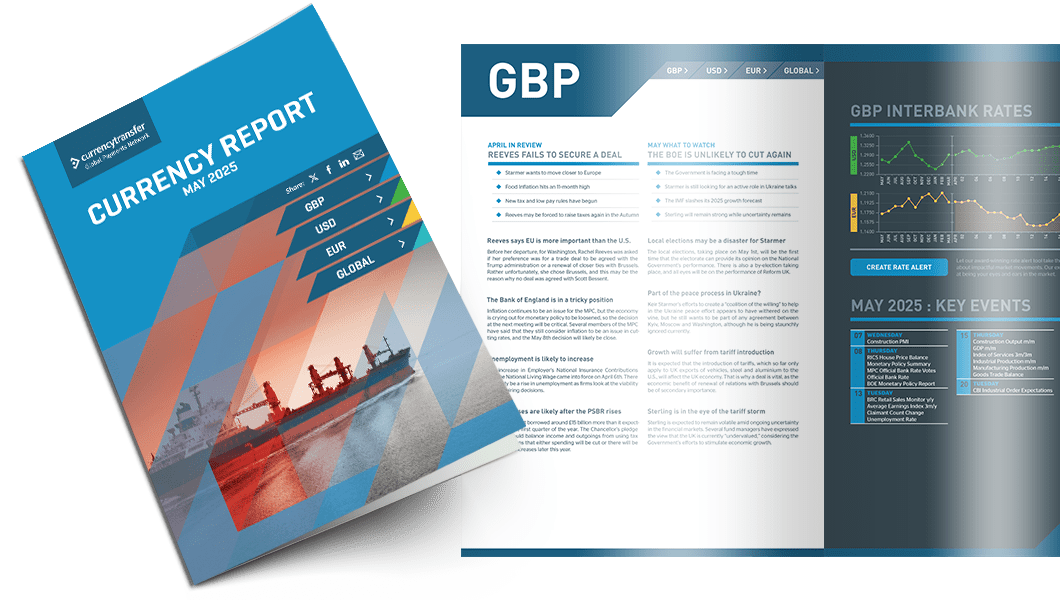
Read our latest currency report
Most impactful events planned this month and how they could impact your business
Prediction platform users bet on a strong jobs number
Speaking after accepting the John F. Kennedy Profile in Courage Award, Powell defended the Federal Reserve's longstanding independence and argued that insulating interest-rate decisions from political pressure remains essential to maintaining public confidence in the nation's financial system.
"Like many other institutions, the Fed has been undergoing a stress test," Powell said.
Powell's comments come as President Donald Trump continues to press the Federal Reserve to lower interest rates to stimulate economic growth. The administration has repeatedly criticised the Central Bank's approach to monetary policy, intensifying a debate over the proper relationship between elected officials and the Fed.
Addressing the issue directly, Powell said, "Congress wisely chose to insulate monetary policy decisions from political pressure." He added that "These protections have served the public well, and administrations from both parties have respected them."
Anthropic’s valuation has shot into the stratosphere, making it one of the clearest flashpoints in the debate over whether we’re living through an AI super-bubble.
The latest funding rounds put Anthropic at $965 billion post-money following a $65 billion raise, the largest equity round ever for an AI lab. This leap came just 105 days after the previous cash raise, which valued it at $380B, meaning its valuation more than doubled in a single quarter. Other sources report earlier valuations of around $300B, which already raised bubble concerns.
Anthropic is now the most valuable private AI company, surpassing OpenAI’s last reported valuation of $ 852 billion.
Traders are looking to this week's key jobs report to confirm their bets that the US economy is strong enough to prompt the Federal Reserve to raise interest rates.
Beyond developments in the Middle East, a big focus will be on Friday’s release of monthly employment figures, which are projected to show the labour market remained resilient in May.
Combined with elevated oil prices and reaccelerating inflation, that may bolster expectations that officials will remove the easing bias in their statement in June, in the Fed’s first meeting under Chairman Kevin Warsh.
Traders see a hike this month, underscoring how the spike in energy prices has upended expectations that Warsh would deliver cuts soon after taking over.
By Bloomberg Economics’ calculation, the jump in bond yields since the conflict began has already tightened financial conditions by the equivalent of about three-quarters of a percentage point of Fed rate increases.
“Yields have risen, and it’s adding restrictiveness to the US economy and doing the work of the Fed,” said George Catrambone, head of fixed income at DWS Americas.
The dollar index saw renewed buying interest yesterday as flare-ups in Lebanon and Iran weighed on risk appetite. The index rallied to a high of 99.39 and closed at 99.20.
French manufacturing contracts for the first time since November
Almost three and a half years after the introduction of the euro in Croatia, Vujčić joins the ECB’s Executive Board at a time when the institution is expected to raise interest rates to tackle rising inflation as a result of the war in Iran.
Vujčić is known as a moderate hawk on monetary policy, that is, an advocate of keeping inflation low through higher interest rates.
Markets and analysts expect the ECB to raise its interest rate on bank deposits, currently at 2%, by a moderate amount at its meeting on 11 June.
The Governing Council preferred to wait until the end of April to gather more information before raising interest rates to curb inflation driven by rising energy costs stemming from the war in Iran.
A significant majority of members supported the decision to keep interest rates unchanged because there was no acute urgency for a rise. Still, some members would not have opposed a hike at that time had the option been on the table.
Vujčić has been a member of the ECB Governing Council for years, having served as Governor of the Bank of Croatia, and therefore knows the institution well.
The Croatian follows Spain (Luis de Guindos, 2018–2026), Portugal (Vítor Constâncio, 2010–2018), Greece (Lukas Papademos, 2002–2010) and France (Christian Noyer, 1998–2002).
De Guindos recently wished Vujčić “good luck, because difficulties and new developments will be there”.
Germany's much-heralded special infrastructure fund has so far failed to meet its disbursement targets, according to a 383-page finance ministry report due to be published this week, Handelsblatt said on Sunday.
The €500 billion ($583 billion) fund was created last year to revive the German economy, but it has taken time to have an effect. Economists and business groups have warned that the fund alone cannot deliver sustainable growth. The report is due to be sent to the lower house of parliament's budget committee and then made public early this week.
A finance ministry spokesperson declined to comment.
Last year, the fund was supposed to disburse €37.4 billion but instead spent only €24 billion, Handelsblatt reported. Of 109 planned "milestones" for 2026, it had achieved only 26 by the end of May, it added.
Meanwhile, in the EU’s second-largest economy, the manufacturing sector contracted in May for the first time since November, as a spike in energy prices and transport disruptions stemming from the Iran conflict weighed on businesses, according to an S&P Global survey.
The S&P Global France Manufacturing final Purchasing Managers' Index (PMI) fell to 49.7 points in May from 52.8 in April, although it came above the flash April manufacturing PMI figure of 48.9 points.
Any number below 50 indicates a contraction in activity, while above 50 indicates expansion.
The final April manufacturing PMI figure of 49.7 points was its lowest since November and the first time it had fallen below the 50-point level since then.
The euro suffered yesterday following the draining away of confidence that a resolution to the conflict in Iran may be close. The common currency fell to a low of 1.1607 and closed at 1.1631.
Have a great day!

Exchange rate movements:
01 Jun - 02 Jun 2026
Click on a currency pair to set up a rate alert
Alan Hill
Alan has been involved in the FX market for more than 25 years and brings a wealth of experience to his content. His knowledge has been gained while trading through some of the most volatile periods of recent history. His commentary relies on an understanding of past events and how they will affect future market performance.