Highlights
- Can the blame be put on Brexit for the UK’s economic woes?
- The Fed is expected to cut rates as the focus switches to employment
- Eurozone Private Sector Growth Hits 18-Month High
Get bank-beating rates — zero hidden fees
Join 10,000+ clients transferring salary, property deposits and business payments globally.


The Budget argument rumbles on as MPs pass the measures
The realisation comes despite more than a decade of below-inflation pay awards, which have left police pay worth 20% less in purchasing power than in 2010. Even though they are finding it harder and harder to make ends meet, officers, even those in the lowest ranks, now face paying 40% income tax on some of their salary instead of 20%.
This drives home the fact that under Labour, the UK is now a high-tax, high-spend economy, which the Conservatives under Rishi Sunak warned would happen.
The comment from a senior figure at the OBR on Monday that, in his view, Rachel Reeves did not mislead the public barely stands up to closer examination. To say that the situation was challenging, and that is how he interpreted Reeves’s words, is almost an insult and is a wafer-thin attempt to shore up the relationship between the Treasury and the OBR.
If this were a mea culpa for the blunder in which the budget details were revealed in advance of Reeves' announcement, it is too late, since the two issues are unrelated. Irrespective of David Miles' comments, a new poll has shown that the Prime Minister is now less trusted on the economy than Liz Truss, and that over a third of voters believe the Chancellor misled the country into believing the situation was worse than it was.
Britons must accept the trade-offs of a closer relationship with the European Union, the U.K. prime minister said earlier this week. At a speech in central London, Keir Starmer said Brexit had “significantly hurt our economy,” warning “frictions” with the bloc must be reduced to enable “economic renewal” in the U.K.
It comes days after talks between London and Brussels to allow Britain to participate in the EU’s €150 billion Security Action for Europe loans-for-weapons program broke down, amid a disagreement over how much the U.K. would have to pay to participate.
This was not explicitly mentioned in the budget, and questions are being raised about whether, regardless of the level of the UK’s participation, this will immediately reduce the “headroom” the Chancellor has so carefully crafted.
Starmer said, “The most important things that we can do for growth and business are first, drive inflation down and second, to retain market confidence that allows for economic stability,” he said. But the U.K. must “confront the reality” that the deal struck with Brussels post-Brexit “significantly hurt our economy, he said.
“For economic renewal, we have to keep reducing frictions. We have to keep moving towards a closer relationship with the EU, and we have to be grown-up about that, to accept that that will require trade-offs.”
He later cited a proposed deal that aims to remove the need for border checks on plant and animal products, and talks on an emissions trading scheme as examples of where the U.K. is making progress.
The pound rallied strongly as traders unwound bets against measures that, in the end, were not included in the budget. IT rallied to a high of 1.3353 and closed at 1.3347 in thin, liquidity-starved trading.
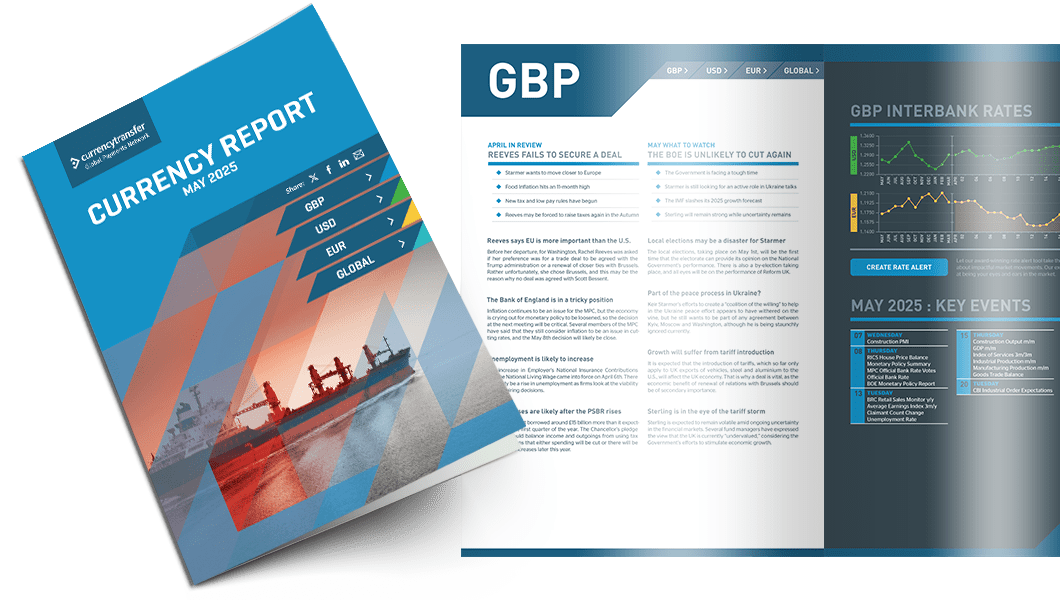
Read our latest currency report
Most impactful events planned this month and how they could impact your business
Hassett's appointment will close the gap between the Fed and White House
Bessent, speaking at The New York Times DealBook Summit, said that, going forward, he would press for the appointments of candidates who have not satisfied that threshold to be vetoed by the Fed's Board of Governors in Washington.
"The chair and the board have the final say on whom the regional bank boards can select," Bessent said. "So I believe that unless someone's lived in the district for three years, we're going to veto them."
This is a clear “shot across the bows” of current Regional Presidents, who have defied both Bessent and President Trump’s calls to loosen monetary policy. Several have made speeches confirming their concern about the continuing threat of inflation, which rate cuts could fuel.
The most outspoken are Chicago Fed President Goolsbee, Minneapolis Fed President Kashkari and Atlanta Fed President Bostic.
Bessent, who is in the process of selecting a candidate to recommend to President Donald Trump as the successor for Fed Chair Jerome Powell, said the fact that some of the current regional bank presidents were hired from outside their districts is at odds with the spirit of how the U.S. central bank's system was designed.
The leaders of that system include seven Fed Board Members based in Washington and appointed by the President, and 12 heads of Regional Reserve Banks hired by their own local boards of directors.
The system, set out in the Federal Reserve Act, was designed to ensure that U.S. Central Bank policy reflected input from officials from around the country, not just political appointees based in Washington.
Bessent, who, like Trump, wants interest rates set by the Fed to be lower, has repeatedly complained that several regional bank presidents are not from the districts they represent. I am going to start advocating, going forward, not retroactively, that Regional Fed Presidents must have lived in their district for at least three years."
Markets will begin to see that the Fed will be almost entirely influenced by the Administration going forward, which, to use Bessent’s words against him, is not in the spirit of the Federal Reserve Act.
The huge services side of the economy grew in November for the sixth month in a row, and inflationary pressures eased, but businesses were taking a cautious approach to hiring and investing due to lingering “tariff uncertainty.”
Those were the findings of a survey of top executives at banks, retailers, restaurants and similar businesses. A closely followed index rose to 52.6% last month from 52.4% in October and hit a nine-month high, the Institute for Supply Management said yesterday. This is positive for the economy, but there are still concerns about how manufacturing will fare as the full impact of tariffs on raw materials becomes clear.
The dollar’s decline accelerated yesterday as markets considered a shift in the Fed's focus for the New Year. The dollar index fell to a low of 98.82 and closed at 98.87.
ECB's Lane flags 'upside surprises' to Eurozone inflation
This may be wishful thinking, since although the single currency has gained since President Trump announced his complete tariff plan in April, it is now trading at its average level since its creation more than twenty-five years ago.
However, Eurozone inflation has delivered some "upside surprises" recently, raising questions about the European Central Bank's expectations for a dip early next year, Lane said yesterday.
Inflation in the 20 nations sharing the euro has been hovering around the ECB's 2% target for most of this year, but some price measures have come in higher than expected in the last couple of months.
Lane said there was still a risk that inflation, which rose sharply post-COVID before falling back to the ECB's 2% goal, might surpass the central bank's expectations.
"The inflation risk is not one way; we've seen some upside surprises recently," Lane told an event.
The ECB's September projections put inflation at 2.1% this year, 1.7% in 2026 and 1.9% in 2027.
Lane is due to present new forecasts, which will cover 2028 for the first time, at the ECB's next meeting on December 18, when the central bank is expected to keep its policy rate at 2%.
ECB President Christine Lagarde has recently revealed a “glass half full” side to her views on consumer prices.
Inflation in the euro area will probably remain near the European Central Bank’s goal for the time being. However, the outlook is still clouded by the situation around tariffs, she commented yesterday.
Consumer-price growth is close to 2%, with underlying pressures consistent with achieving that level over the medium term, Lagarde told lawmakers in the European Parliament. In September, the ECB predicted inflation would average 1.6% in the first quarter of 2026 and would only hit 2% again the following year.
After halving the base rate from a peak of 4%, ECB officials have signalled they don’t see a pressing need to adjust borrowing costs further. November’s reading showed prices increasing 2.2% from a year ago, a touch higher than in October. Core inflation, which strips out volatile energy and food costs, was unchanged at 2.4%.
Several members of the ECB’s Governing Council will need to forget their infatuation with fine-tuning and focus their efforts on finding a reliable, consistent level of growth, which, despite the successes in taming inflation, remains challenging to identify.
The Euro could see some selling pressure ahead of events due to take place in the U.S. next week, as it is reaching overbought territory, which may lead short-term traders to cut positions.
Yesterday it climbed to a high of 1.1677 and closed at 1.1665.
Have a great day!

Exchange rate movements:
03 Dec - 04 Dec 2025
Click on a currency pair to set up a rate alert
Alan Hill
Alan has been involved in the FX market for more than 25 years and brings a wealth of experience to his content. His knowledge has been gained while trading through some of the most volatile periods of recent history. His commentary relies on an understanding of past events and how they will affect future market performance.