
Highlights
- Spain says it ‘absolutely’ supports the UK rejoining the EU
- Trump wants a weaker dollar, but economists aren’t so sure
- Europe’s economy records a strong recovery
Get bank-beating rates — zero hidden fees
Join 10,000+ clients transferring salary, property deposits and business payments globally.


Reform vows to save pubs with £3 billion tax cuts funded by reinstating the two-child benefit cap
Incomes Data Research found that 39% of employers were eyeing pay rises of 3% to 3.50%.
Another 22% planned awards of 3.5% and 4%, while 16% planned increases of 2.5% cent to 3%
The survey was based on responses from 121 businesses in November and December, with a combined workforce of 2.8 million.
"Inflation is higher than it was a year ago, and this has applied upward pressure on pay," according to IDR. Inflation peaked at an 18-month high of 3.8% during the third quarter.
The rise was partly due to one-off increases in regulated prices and employer levies in April 2025. CPI has since fallen to 3.4 percent.
Although BoE Governor Andrew Bailey had said he expected inflation to drop back to close to its two percent target in April or May this year, not all of the Bank's rate-setters are sure whether it would stay there if it did.
Megan Greene, who opposed December's 0.25% rate cut, said last month that pay growth much above 3% was likely to put upward pressure on inflation, given weak productivity growth. She said she would closely follow employers' wage plans.
Economists polled by Reuters expect the BoE to keep interest rates unchanged at 3.75% at its meeting on Thursday.
Private-sector pay growth, excluding bonuses, slowed to an annual rate of 3.6% in the three months to the end of November. This was down from 3.9% in October, according to official data.
IDR found that employer sentiment is split mainly between maintaining the status quo and adjusting for inflation:
Reform UK leader Nigel Farage has announced his party would slash VAT on hospitality to bring down overall costs in the sector and pay for it by reintroducing the two-child benefit cap.
The plans have been slammed as ‘indefensible’ by poverty campaigners who backed Chancellor Rachel Reeves’ decision to scrap the cap at last year’s Budget.
Farage unveiled his proposals at a Westminster pub where beer tap labels had been replaced with Labour-mocking puns such as ‘Job Goblin’ and ‘Doomed Bar’.
He said: ‘What is happening to our pubs, what is happening to our hospitality sector, is little short of a disaster.
Of all the attention-seeking policies that Farage and his team have introduced, this is the first to split voters.
The pound saw minor gains as the market quietened a little following a torrid start to the year. It rose to a high of 1.3707 and closed at 1.3693.
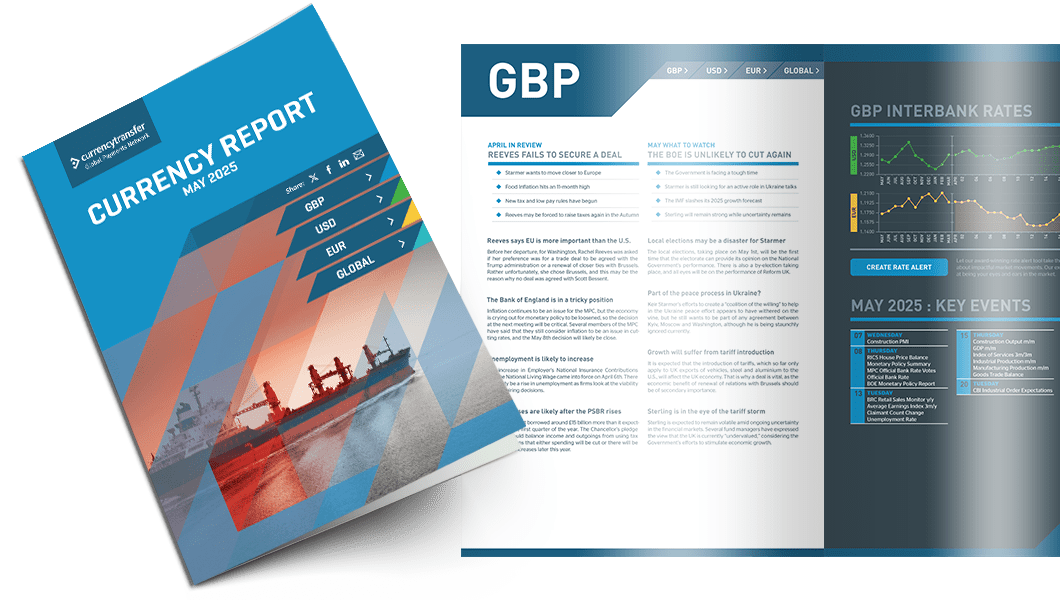
Read our latest currency report
Most impactful events planned this month and how they could impact your business
Miran still wants rate cuts this year
Warsh, a former Fed Governor, has spent years criticising the Central Bank for what he views as mission creep as policymakers expanded their toolkit to fight against the ructions wrought by the 2008 financial crisis and the coronavirus pandemic 12 years later.
It is those calls for “regime change” that helped win over Treasury Secretary Scott Bessent, who has similarly railed against the Fed in recent years. Now, Warsh is poised to lead an overhaul of the institution from its helm, subject to the Senate approving his appointment.
The Fed’s vast bond-buying programmes, which Warsh initially supported as a Fed governor during the financial crisis, are at the centre of the Trump administration’s allegations that the Central Bank is acting far beyond its remit to keep prices in check and maximise employment. Quantitative easing expanded the Fed’s balance sheet from less than $900bn in 2008 to a peak of almost $9tn.
Federal Reserve Governor Stephen Miran continued to make the case for aggressive interest rate cuts this year in an interview on Fox Business Network yesterday.
“I'm probably looking for a little bit more than 100 points of interest rate cuts over the course of the year,” Miran said. He described the current state of monetary policy as too tight for the economy and said that, although inflation is above the 2% target, underlying price pressures are more benign.
Meanwhile, the Bank’s Vice Chair for Supervision, Michelle Bowman, said late last week that she still believes interest rates should fall, but voted to hold monetary policy steady only to gather more data before the next reduction in borrowing costs.
Bowman said she anticipates the economy needing 0.75% in rate cuts this year, and that the decision following the U.S. central bank's two-day policy meeting last Wednesday was only about the timing of the next move. While Richmond Fed President Tom Barkin said the Fed’s 1.75% of rate cuts since Autumn 2024 were “insurance” for US jobs, even with inflation still about a point above its 2% target.
The value of the U.S. dollar has been steadily declining, but one person who doesn’t seem worried is President Trump. On the contrary, he has been lauding the dollar’s fall as a positive change for the American economy.
“I think it’s great,” Trump said to reporters last week. The President has repeatedly stated that a declining dollar is good for U.S. businesses. But with the dollar index recently hitting a four-year low of 95.56, some economists are sounding the alarm.
Trump’s main argument is that having a weaker dollar breeds more competition among American businesses. In his view, a “strong dollar, like higher interest rates, interferes with his priorities: faster growth, reshored manufacturing and a smaller trade deficit.”
This is an idea Trump has had since his first term. “I think our dollar is getting too strong,” and “that’s hurting, Trump told the Wall Street Journal in 2017.
A weaker dollar could provide “near-term benefits to the U.S. economy,” as a “lower currency boosts exports, without the uncertainty and distortions that tariffs entail,” commented the paper. This occurs as the weakening currency, combined with Trump’s sweeping tariffs, can “discourage imports.” Historically, Trump has also felt that the dollar “appreciated when the U.S. economy outperformed.”
Yesterday, after closing a gap on the charts that formed over the weekend before last, the index fell to a low of 97.30 and closed at 97.39.
The ECB is set to hold rates, but the Euro could change that
Investors think the ECB can afford to sit tight. Eurozone growth is holding up, and inflation is hovering near the 2% goal.
Markets agree, Bloomberg polling points to a fifth straight hold. But the euro is about 2.5% stronger versus the US dollar since the ECB finalised its December projections, and a firmer currency lowers imported inflation by making energy and other globally priced goods cheaper in euro terms.
If that strength lasts into the ECB’s March 19 meeting, when it updates forecasts, it may have to lower its inflation projections from December’s 1.9% for this year and 1.8% for 2027. That would make future rate cuts easier to justify, even if this week stays uneventful.
Currency moves can substitute for tighter policy by cooling prices, which is why a firmer euro can lower expected rate paths. That can show up quickly in government bond yields, bank funding costs, and rate-sensitive stock sectors like real estate and consumer goods.
There will probably be no change for a while, but the Central Bank is flagging the exchange rate as a key input into the next policy reset.
Friedrich Merz recently embarked on his first trip to the Persian Gulf region as Chancellor, seeking new energy and business deals he sees as critical to reducing Germany’s dependence on the U.S. and China.
The three-day trip with stops in Saudi Arabia, Qatar and the United Arab Emirates illustrates Merz’s approach to what he calls a dangerous new epoch of “great power politics”, one in which the U.S. under President Donald Trump is no longer a reliable partner. European countries must urgently embrace their own brand of hard power by forging new global trade alliances, including in the Middle East, or risk being coerced by greater powers, Merz argues. Recent comments by ECB President Christine Lagarde have backed this sentiment.
Accompanying Merz on the trip was a delegation of business executives looking to cut new deals on everything from energy to defence. But one of the chancellor's immediate goals is to reduce his country’s growing dependence on U.S. liquefied natural gas, or LNG, which has replaced much of the Russian gas that formerly flowed to Germany through the Nord Stream pipelines.
The Eurozone’s growth momentum is being driven mainly by the services sector, which is offsetting the contraction in manufacturing. The services sector is forecast to continue to grow moderately in 2026, while manufacturing could benefit from demand for defence equipment and construction machinery, helping the national economy grow by over 1%, albeit at a modest pace.
Expansion in services has also supported the labour market, with job creation reaching its fastest pace in 16 months.
The Euro has settled somewhat following a “burst of energy” in January, when it surged through the 1.20 level, although that has since subsided. The single currency rallied following its declines on Friday and Monday, driven by the dollar's appreciation after Kevin Warsh was nominated as the new Chairman of the Federal Reserve.
It reached a high of 1.1829 yesterday and closed at 1.1821.
Have a great day!

Exchange rate movements:
03 Feb - 04 Feb 2026
Click on a currency pair to set up a rate alert
Alan Hill
Alan has been involved in the FX market for more than 25 years and brings a wealth of experience to his content. His knowledge has been gained while trading through some of the most volatile periods of recent history. His commentary relies on an understanding of past events and how they will affect future market performance.