
Highlights
- Bank of England poised to hold UK interest rates
- Top Republican Senator Says Fed’s Powell didn’t commit a crime
- Draghi takes global issues “by the scruff of the neck”
Get bank-beating rates — zero hidden fees
Join 10,000+ clients transferring salary, property deposits and business payments globally.


The Bank of England will call a halt to interest rate cuts as 'sticky inflation' traps the economy
Following December's rate reduction to the lowest level in nearly three years, policymakers now face a more challenging phase in their easing strategy amid ongoing inflationary pressures.
The consensus among analysts points firmly towards a pause, driven primarily by renewed inflation concerns, with the CPI rate currently sitting at 3.4%.
Progress on services inflation and wage growth remains key, and with headline inflation ticking higher last month, the consensus expectation is that rates will be held at 3.75% this week.
The Bank's decision comes as consumer prices climbed unexpectedly towards the end of last year. December's CPI rose to 3.4%, up from 3.2%, marking the first increase since last July.
Bank of England Governor Andrew Bailey has indicated that future base rate reductions represent a "closer call," suggesting the MPC will adopt a wait-and-see approach.
The economy's relative resilience gives policymakers room to hold off on further cuts.
The vote will likely be close in the subsequent few meetings because individual committee members' opinions conflict. This is always the case, as either the economy is reaching the end of a cycle of rate changes or inflation and growth are in juxtaposition.
Also, the full disinflationary effects of the Chancellor’s Budget tax measures have not yet materialised, prompting expectations of cautious forward guidance.
Companies in the UK’s services sector cut jobs last month, as they turned to “automation” rather than hiring new staff, a closely watched survey showed.
The monthly purchasing managers’ index showed that employment fell more sharply in January than in December, continuing a trend that began in October 2024.
The PMI survey, which is considered to be one of the most reliable indicators of how a sector is performing, said this was the “longest period of job shedding” in the UK services sector in 16 years, with firms also choosing not to replace voluntary leavers.
This highlights the effect of artificial intelligence going forward, with the lowest employment expected to be countered by increased productivity. That will be cold comfort to those workers who have been “replaced by robots”.
The survey compiled by S&P Global said anecdotal evidence suggested some companies were turning to automation to make up for staffing shortfalls and increase productivity, while squeezed margins and fragile market conditions were also affecting hiring decisions.
While the “Mandelson saga” has not been a financial or economic matter, it needs to be raised now because the Prime Minister continues to lose the support of backbenchers and could lead to a leadership challenge in his Party.
Following closely on the heels of the denial of permission for Manchester Mayor, Andy Burnham, to stand in an upcoming by-election, Starmer’s former deputy, Angela Rayner, told the House of Commons yesterday that she intended to vote against the Government when the decision was made about publication of further revelations regarding the relationship between Mandelson and the deceased paedophile Jeffrey Epstein.
The pound lost more ground yesterday, falling to a low of 1.3642 and closing at 1.3650. Volatility will likely increase immediately after the MPC decision, which is expected at noon.
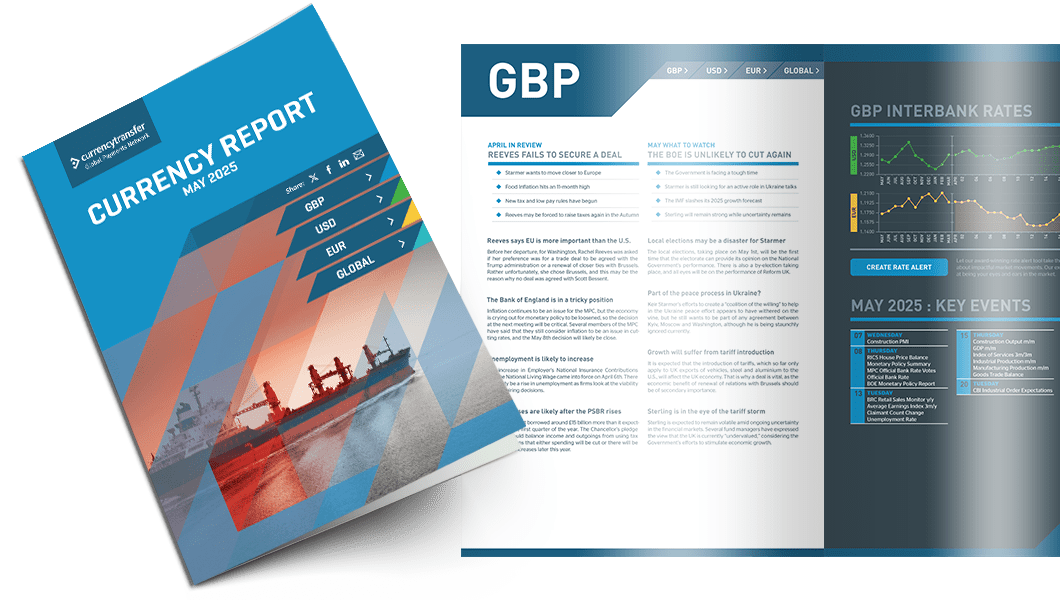
Read our latest currency report
Most impactful events planned this month and how they could impact your business
Bessent offers no opinion on Trump’s powers
Bessent told a U.S. House of Representatives Financial Services Committee hearing that there were “varying opinions” within the administration about a legal doctrine called the “unitary executive” theory that envisions vast executive authority for a President.
“There are varying opinions in the administration,” Bessent told lawmakers, saying he was not a lawyer and the issue would have to be decided by the U.S. Supreme Court.
A senior Republican congressman recommitted to his blockade of Kevin Warsh’s nomination to lead the Federal Reserve until the Department of Justice ends its investigation into Fed Chair Jerome Powell.
Thom Tillis said in an interview on CNBC that he’s “willing to let it play out for the remainder of this Congress, if that’s what’s necessary to get to the truth or to get back to a process that makes sense and that keeps the Fed independent.”
“I’d be one of the first people to introduce Kevin Warsh if we’re behind this and support him, but not before this matter is settled,” Tillis said.
Federal Reserve Governor Lisa Cook emphasised the importance of protecting the central bank’s credibility by ensuring inflation returns to its long-term target, signalling continued caution on monetary policy despite recent rate cuts.
Speaking in prepared remarks for an event in Miami, Cook said her primary focus remains on inflation until there is clear and convincing evidence that price pressures are moving sustainably back toward the Federal Reserve’s 2% target.
Cook explained that she supported the Federal Open Market Committee’s recent decision to hold interest rates steady, noting that inflation risks are now “tilted toward higher inflation.” While economic conditions have shown improvement, inflation has remained above target for nearly five years, reinforcing the need for vigilance.
According to Cook, achieving a durable disinflationary trend in the near future is essential for maintaining the Fed’s credibility with markets, households, and businesses.
Last week, the FOMC kept the benchmark interest rate unchanged at 3.5%-3.75%, following three consecutive rate cuts at the end of 2025.
In their statement, officials upgraded their assessment of overall economic activity and labour market strength, suggesting there was no immediate urgency for further monetary easing.
Cook aligned herself with other policymakers who have expressed concern that inflation progress has been uneven and that premature rate cuts could reignite price pressures.
If confirmed as chair of the Federal Reserve, is Kevin Warsh going to be an inflation hawk or Donald Trump’s poodle? His repeated statements on monetary policy and the broader obligations of the Fed suggest the former.
But his more recent statements on the inflation outlook, along with Trump's strong endorsement, strongly suggest the latter. More broadly, is he a man of conviction and judgment, or is he a weathervane, blowing with the wind from the Republican side of politics and so in favour of loose monetary policy when Republicans are in power and of tight money when the Democrats are?
The confirmation, or otherwise, is the most significant story dominating the economy as Trump enters the second year of his second term.
The dollar index continues to recover from a severe bout of “market jitters.” It closed yesterday at 97.63, having earlier touched 97.73, which was the expected limit of its recovery.
Eurozone inflation slows to 1.7pc in Jan
Core inflation, which strips out volatile energy, food, alcohol and tobacco prices, slowed to 2.2 percent in January from 2.3 percent in December. Energy costs fell by 4.1 percent in January, a significantly larger drop than the 1.9 percent decline recorded in December, according to Eurostat. But food, alcohol and tobacco price rises accelerated to 2.7 percent last month from 2.5 percent in December.
The ECB is widely expected to keep interest rates on hold at its next meeting later today.
January’s declines in headline and core inflation left both below the ECB’s forecasts for Q1.
This is consistent with the view that inflation will be lower than the central bank expects in 2026, but January’s data were not weak enough to alter the ECB’s messaging at tomorrow’s press conference.’
Rate cuts are pencilled towards the end of the year.
Speaking this week against the backdrop of what he declared the “now defunct” post-World War II global order, Mario Draghi unsentimentally appealed for European Federalism. His words didn’t express federalism as the aspiration it has long been, but as an urgent necessity brought on by the behaviour of the world’s two great powers: China and the United States.
“We face a United States that, at least in its current guise, emphasises the costs it has borne while ignoring the benefits it has reaped” through global leadership, said Draghi, the former ECBPresident and Italian Prime Minister, in a speech.
The United States “is imposing tariffs on Europe, threatening our territorial interests, and making clear for the first time that it sees European political fragmentation in its interests,” he said. “We face a China that controls critical nodes in global supply chains and is willing to exploit that leverage, flooding markets, withholding critical inputs, forcing others to bear the cost of its own imbalances.
This is a future in which Europe risks becoming subordinated, divided, and de-industrialised at once. And a Europe that cannot defend its interests will not preserve its values for long.”
Draghi’s speech, delivered on Monday at the Belgian university KU Leuven, builds upon Canadian Prime Minister Mark Carney’s address to the World Economic Forum in Davos last month. Carney called upon “middle powers” to unite in confronting a “rupture” in the international rules-based order, which he argued is being replaced by great-power rivalry in which the United States and China wield economic leverage as a tool of coercion.
The contrast with Canada, Draghi seemed to be saying, is that Europe has the wherewithal to become a great power. “Of all those now caught between the United States and China,” Draghi said, “Europeans alone have the option to become a genuine power themselves. So, we must decide. Do we remain merely a large market, subject to the priorities of others? Or do we take the steps necessary to become one power?”
The Euro appears to be back to being the amkewright in the dollar index recovery. Yesterday, the common currency fell marginally to a low of 1.1790 and closed at 1.1803.
Have a great day!

Exchange rate movements:
04 Feb - 05 Feb 2026
Click on a currency pair to set up a rate alert
Alan Hill
Alan has been involved in the FX market for more than 25 years and brings a wealth of experience to his content. His knowledge has been gained while trading through some of the most volatile periods of recent history. His commentary relies on an understanding of past events and how they will affect future market performance.