Highlights
- Another close-run thing
- As U.S. job cuts hit 2009 levels
- The ECB holds interest rates steady amid jitters about a strong euro
Get bank-beating rates — zero hidden fees
Join 10,000+ clients transferring salary, property deposits and business payments globally.


The Bank of England cuts the UK growth outlook to 0.9%
As has been the case for every meeting since last March, Breedon, Dhingra, Ramsden, and Taylor voted for a rate cut, while Greene, Mann, Lombardelli, and PIll voted to keep rates unchanged. This has left Bailey with the casting vote.
It may well be that then-Chancellor Gordon Brown and his colleagues at the Treasury intended that the MPC would operate this way, with Hawks and Doves having the opportunity to make the case for controlling inflation or driving growth and the jobs market, with the Governor making the final decision.
Although above the 2% target currently, CPI inflation is expected to fall back to around the target from April, owing to developments in energy prices, including from Budget 2025.
Reflecting the impact of monetary policy and consistent with evidence of subdued economic growth and the build-up of labour market slack, pay growth and service price inflation have generally continued to ease.
The risk from greater inflation persistence has become less pronounced, while some inflation risks from weaker demand and a loosening labour market remain.
Monetary policy is being set to ensure that CPI inflation not only reaches 2% but also remains sustainably at that level in the medium term, while balancing the risks involved.
The restrictiveness of policy has fallen as 150 basis points have reduced the base rate since August 2024.
Based on current evidence, rates are likely to decline further. Judgements around further policy easing will become a closer call. The extent and timing of further easing in monetary policy will depend on the evolution of the inflation outlook.
In their report alongside the decision, the MPC noted that it is currently “likely” that interest rates will be cut further.
Governor Andrew Bailey commented: “All being well, there should be scope for some further reduction in the base rate this year.”
Economists said that the tight vote has increased the likelihood that interest rates will be cut next month.
The latest assessments from most committee members suggest they’ve become less concerned about sticky wage and price pressures at the start of the year and more focused on the subdued growth outlook and the potential knock-on effects for the jobs market.
“There were no promises made on when the Bank of England may cut rates again, but such a closely balanced vote split clearly opens the door to a rate cut at the March meeting.”
It showed that it expects the UK economy to grow by 1.4% in 2025, down from its earlier 1.5% forecast. It also downgraded its GDP forecasts for 2026 to 0.9% from 1.2% and for 2027 to 1.5% from 1.6%.
Growth is, however, expected to lift above previous guidance to 1.9% in 2028.
Officials from the Bank found that consumer demand for goods and services has been subdued, and is expected to remain so “through 2026”, with firms citing rising unemployment and continued concerns over the cost of living.
Supermarkets told the Bank they have seen “modest” volume growth, with consumers cautious about their overall spending and therefore “forgoing treats”.
The report highlighted that wider pressures in the UK labour market also dampened growth.
The pound fell to a low of 1.3517 and closed at 1.3538 as the likelihood that rates would begin to fall from March dampened demand for Sterling.
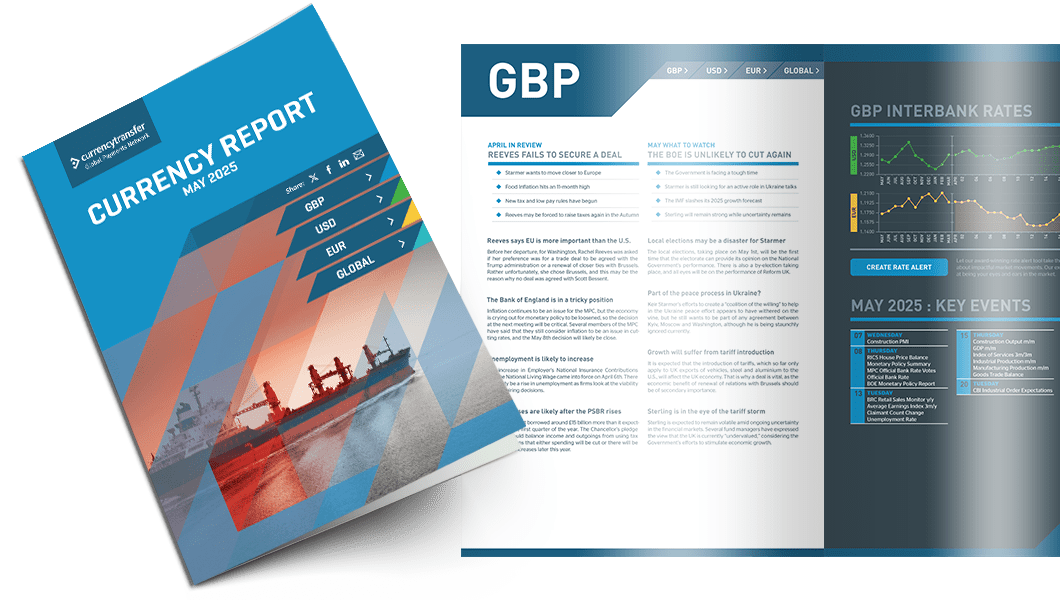
Read our latest currency report
Most impactful events planned this month and how they could impact your business
Bessent says suing Warsh ‘up to the president’
Initial unemployment claims rose, job openings fell to 6.5 million, and the monthly Federal jobs report was delayed due to the brief government shutdown. All of that leaves economists split: Are we seeing cooling, or are we inching toward recession?
Meanwhile, job openings unexpectedly fell in December to the lowest level since 2020, and layoffs edged up, adding to evidence of sluggish demand for workers.
The JOLTS report showed the number of vacancies per unemployed worker, a ratio Fed officials watch closely as a proxy for the balance between labour demand and supply, was 0.9 in December. At its peak in 2022, the ratio was two to one.
Jobless claims data, which rose last week amid frigid weather, have shown few signs of widespread layoffs despite some high-profile announcements of workforce cuts. Amazon and UPS have recently announced additional plans to reduce headcount, in addition to earlier 2025 announcements.
The Federal shutdown is still delaying the non-farm payrolls data, which will now be released next Wednesday, 11th February.
The Fed left rates unchanged last month and suggested there could be a long wait before any further cuts. Still, traders are fully pricing in one more 25-basis-point cut by July.
Kevin Warsh, President Donald Trump’s nominee to replace Jerome Powell as Fed chair when his term ends in May, has called for rate cuts and a smaller balance sheet. That mix could steepen the U.S. Treasury yield curve but leaves the broader direction of rates uncertain.
Central banks in major economies are parting ways: Australia raised interest rates this week for the first time in two years, while others are taking a more cautious approach, even though they are likely done with easing.
The European Central Bank and Bank of England held rates yesterday, although markets saw the UK decision as dovish. The U.S. Federal Reserve remains in the easing camp.
The Fed left rates unchanged last month, although it suggested there could be a long wait before any further cuts.
Still, traders are fully pricing in one more 25-basis-point cut by July, which is assumed to be Kevin Warch’s first meeting as Fed Chair.
Treasury Secretary Scott Bessent yesterday left open the possibility the administration could sue President Donald Trump’s pick for Federal Reserve chair, Kevin Warsh, if he doesn’t deliver on the president’s desired interest rate cuts.
Trump said on Saturday he would consider suing Warsh if he did not cut interest rates. The Fed is an independent agency, but the possibility of legal action tells Warsh and the market all they need to know about the size of the role facing the new Fed Chair.
When asked by Sen. Elizabeth Warren during a Senate Banking Committee hearing about the possibility of a lawsuit, Bessent refused to answer.
“That is up to the president,” he said, before adding: “Warsh is highly qualified.”
Bessent furthered the criticism of Powell last Thursday, saying the Treasury cannot print “magic money” to solve some of the nation’s economic issues, referring to the Fed’s ability to expand the amount of money in circulation, a power both Bessent and Warsh say has been overused.
The dollar index continued its recent rally yesterday. Since making a new multi-month low on January 27th, the dollar has recovered strongly, reaching 97.99 and closing at 97.96. The next upside target is 98.30, a breach of which will open up a path towards its recent high of 99.50.
Rates are still on hold
In January, Eurozone inflation dropped to 1.7%, primarily driven by falling energy prices.
President Christine Lagarde said the eurozone economy "remained resilient," but acknowledged that the recent strengthening of the euro had raised internal concerns.
Lagarde warned that "a stronger euro could bring inflation down beyond current expectations," adding that the matter had been actively discussed during the bank’s meeting.
Despite the recent surge, Lagarde emphasised the euro’s exchange rate as "very much in line with the overall average" since its inception. She offered no forward guidance on potential rate changes. However, the combination of lower inflation and a stronger currency has led some analysts to expect possible rate cuts in the second half of the year.
The ECB last cut rates in June 2025, bringing the deposit facility rate down to 2%.
Lagarde maintained that the ECB is "in a good place," a phrase widely interpreted as contentment with current policy settings. Still, investors remain alert for shifts as eurozone price growth continues to undershoot the central bank’s objective.
Lagarde noted that the "outlook is still uncertain," citing persistent global trade tensions and geopolitical risks. Volatility in U.S. policy, particularly under President Donald Trump, has been a recurring source of instability for European policymakers.
Last month, tensions flared when Trump threatened to impose tariffs on eight European nations over disagreements about his policy on Greenland. Additionally, his criticism of U.S. Federal Reserve Chair Jerome Powell had drawn concern globally, although his recent nomination of Kevin Warsh to lead the Fed was met with a more positive reception.
"We go back a long way, and I very much welcome the announcement of his appointment," Lagarde said of Warsh.
France is sinking the European Union's wealth list and risks acquiring "third world status", a former civil servant has warned. Once among Europe's wealthiest nations, France has firmly dropped into its second tier after recording three consecutive years of per capita wealth below the bloc's average of 100, according to Eurostat data.
It has fallen far behind Germany, formerly its economic equal, with a per capita wealth of 111, and even dropped behind the UK.
Italy, which was 10.1% poorer than France in 2020, has also caught up with its economic rival, with GDP per capita at $59,453 in Italy and $59,683 in France as of 2024.
Nicolas Baverez, a former senior civil servant, warned that his country had entered an "infernal spiral" and dubbed it the "Argentina of Europe" in an article for Le Figaro, a nod to the South American nation's long-term economic instability.
The Euro is following the dollar again, having briefly been the driving force in currency markets recently. The single currency fell to a low of 1.1780 yesterday and closed there.
Have a great day!

Exchange rate movements:
05 Feb - 06 Feb 2026
Click on a currency pair to set up a rate alert
Alan Hill
Alan has been involved in the FX market for more than 25 years and brings a wealth of experience to his content. His knowledge has been gained while trading through some of the most volatile periods of recent history. His commentary relies on an understanding of past events and how they will affect future market performance.