
Highlights
- Surveys point to a weakening UK economy
- The Fed expects 1.6% growth in Q2
- Inflation fell to 1.9% in May
Get bank-beating rates — zero hidden fees
Join 10,000+ clients transferring salary, property deposits and business payments globally.


Crisis for Rachel Reeves as ministers erupt over spending plan
The Prime Minister has confirmed that the defence budget will account for 2.5% of GDP by 2027, although the increase to 3%, which had been expected to be confirmed during the review, has been deferred. Sir Keir Starmer has said that he expects the increase to happen during the life of the next Parliament.
“We are moving to war-fighting readiness,” Starmer said as he unveiled the government’s much-anticipated “strategic defence review” at a time of heightened vulnerability on the continent, with the U.K. saying the threat and instability posed by Russia and other adversaries “cannot be ignored.”
The U.K.’s defence plans include building 12 new nuclear-powered attack submarines, a boost to the manufacturing of drones, missiles and munitions, as well as bolstering cyber warfare capabilities.
Starmer said the U.K.‘s defence spending would rise to 2.5% of gross domestic product (GDP) by 2027 and set out the “ambition” to increase that to 3% of GDP in the next Parliament, that is, by 2034 if “economic and fiscal conditions allow.” NATO estimates suggest the U.K.’s defence expenditure as a share of GDP was 2.33% in 2024, above the alliance’s 2% target set out in 2014.
Rachel Reeves has been sidelined during the review, having been presented with a fait accompli but left to face the wrath of MPs who are concerned about how the plans will be funded.
NATO aims for its 32 members to commit to spending 5% of their GDP on defence and security-related infrastructure by 2032 and is set to push for this target when it next meets on June 24-25.
Analysts and economists argue that, while the U.K.’s defence plans are welcome news in uncertain times, they could ultimately prove to be too little, too late, and that they might be potentially difficult to deliver, given fiscal constraints in the U.K.
It is likely that during this Parliament and the next, should Labour remain in power, Starmer will announce a “fudge” in which he redefines exactly what defence spending refers to, which will allow items that are considered outside the defence budget to be brought inside.
Bank of England Monetary Policy Committee external member Catherine Mann has defended her colleagues’ work on interest rates amid questions from MPs about the division in voting patterns across the committee’s board.
In a Treasury Committee hearing yesterday, Mann said every MPC member "takes their job very seriously" and analyses the research leading to interest rate decisions thoroughly, after one MP noted the discrepancy in views between the Bank staff and its external members.
Several other policymakers, including BoE governor Andrew Bailey and deputy governor for financial stability Sarah Breeden, were summoned to explain their differing views on cutting or holding interest rates to the Treasury Committee.
Swati Dhingra, who is also an external member of the committee, voted for a 50 basis point cut and defended her work with the MPC, stating: "I take my job very seriously. I have to look at the research and the evidence and vote according to what I think is right."I am better at doing that job than figuring out what the dynamics of any committee," Dhingra said.
In its latest meeting in May, the MPC members voted by a slight majority of five to four to trim rates by twenty-five basis points.
The pound had a relatively sedate day, trading between 1.3550 and 1.3500, and eventually closing at 1.3522.
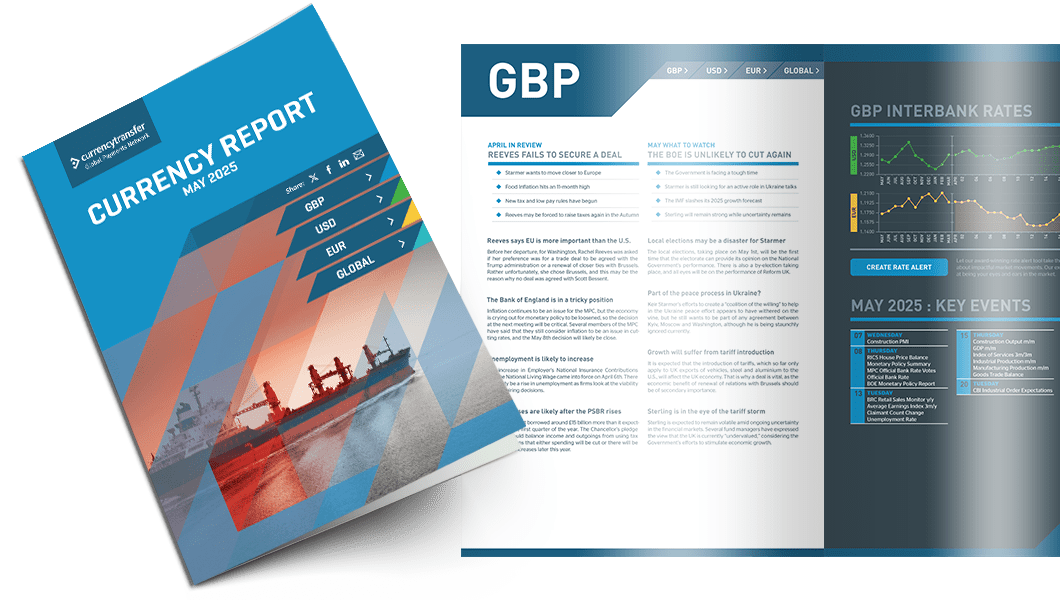
Read our latest currency report
Most impactful events planned this month and how they could impact your business
ISM Services data is predicted to expand marginally
The job market likely slowed down but kept rolling in May, according to forecasters.
The Bureau of Labour Statistics' widely watched report Friday is likely to show the U.S. economy added 125,000 jobs in May, a slowdown from the unexpectedly high 177,000 in April, according to a survey of economists by Dow Jones Newswires and The Wall Street Journal. The unemployment rate is expected to hold steady at 4.2%, the same as the month prior.
Should this prediction be proved correct, the markets will likely return to considering the likely impact of “Trump’s tariffs” on jobs going forward.
Analysts have been watching economic data for signs that President Donald Trump's tariff campaign is already hurting job creation and pushing up inflation, but so far neither has happened. A jobs report in line with expectations would indicate the economy has weathered the tariffs and the uncertainty about them, at least so far.
"At present, there are no obvious signs of a meaningful deterioration in the labour market," Brett Ryan, senior U.S. economist at Deutsche Bank, wrote in a commentary.
The job market has remained resilient over the past few years despite a series of upheavals, including the post-pandemic surge of inflation and the Federal Reserve raising interest rates in response. The economy has added jobs every month since December 2020. Still, the pace of job creation and the number of job openings have dropped significantly since mid-2022, when workers were in unusually high demand.
Trump's trade war could halt the job market's winning streak. Many economists expect consumer prices to rise and employment to suffer more as the summer goes on, as merchants pass on the cost of the tariffs imposed in April to customers.
Some forecasters expect the tariffs to hit the economy harder and sooner, and economists at Nomura called for only 110,000 jobs to be created in May.
If the headline NFP figure breaks the 100k level, it may be the spark that ignites the fears that a bout of stagflation is on its way, possibly arriving as soon as late summer.
Federal Reserve Governor Lisa Cook has expressed concern that recent lower inflation readings could be reversed as tariffs work their way through the economy. In addition, Cook expects Trump’s trade policies to adversely affect the labour market, although as things stand, the economy looks both robust and resilient.
The dollar index appears to have paused for breath with traders considering the next move in the trade wars, with the European Union expected to announce its reaction to the imposition of tariffs on its exports to the U.S. imminently.
The index has seen a reduction in volatility and is staying within well-trodden boundaries and closing yesterday at 99.24.
The ECB is now likely to cut rates after May inflation data
The average gross debt to GDP ratio in the Eurozone was 88.1% at the end of 2024. This is a slight increase from 87.3% at the end of 2023. In the EU as a whole, the ratio was 81.0% at the end of 2024.
The highest ratios of government debt to GDP at the end of the second quarter of 2024 were recorded in Greece (163.6%), Italy (137.0%), France (112.2%), Belgium (108.0%), Spain (105.3%), and Portugal (100.6%), and the lowest were recorded in Bulgaria (22.1%), Estonia (23.8%) and Luxembourg (26.8%).
Germany is expected to see a significant rise in its level of government borrowing as funding of its €150 billion infrastructure and defence fund begins.
The ECB warns of mounting eurozone sovereign debt risks in its latest review, citing high debt levels, fiscal slippage, and weak growth.
The European Central Bank (ECB) has raised the alarm over a potential resurgence of eurozone sovereign debt vulnerabilities, as elevated debt levels, sluggish growth, and fiscal slippage converge into a dangerous cocktail.
Elevated debt levels and high budget deficits, coupled with weak long-term growth potential, increase the risk that fiscal slippage will reignite market concerns over sovereign debt sustainability,” the Central Bank has stated.
Maturing debt is now being rolled over at significantly higher interest rates, despite short-term rates being cut, pushing up sovereign debt service costs. This dynamic poses particular risks for high-debt countries, where limited fiscal space could leave governments vulnerable to sudden market shocks.
Geopolitical tensions exacerbate the problem. Energy subsidies and other fiscal measures aimed at mitigating global disruptions are further stretching budgets.
“Sovereign vulnerabilities are deepening. Despite recent reductions in debt-to-GDP ratios, fiscal challenges persist in several euro area countries, exacerbated by structural issues such as weak potential growth and heightened policy uncertainty.” ECB vice-president Luis de Guindos remarked.
There is a significant difference between the cuts in short-term interest rates that have been happening over the past ten months and the risk-weighted rates that heavily indebted nations have to pay to fund long-term borrowings.
The market has long been immune to concerns over the levels of debt that are seen in Italy and Greece in particular, although Greece has made massive strides to reduce borrowing in its public sector.
While the monetary system is working and the ECB remains an implicit lender of last resort, the markets can stay relaxed, but any jolt may derail this composure, and with Germany no longer able to come to the rescue, the situation could change rapidly.
The Euro was also in a reactive mood yesterday as traders contemplated the fall in inflation in May to below the ECB’s target of 2% and what, if any, effect that will have on the rate decision that is expected tomorrow.
The single currency lost a little ground, but still closed at 1.1370.
Have a great day!

Exchange rate movements:
03 Jun - 04 Jun 2025
Click on a currency pair to set up a rate alert
Alan Hill
Alan has been involved in the FX market for more than 25 years and brings a wealth of experience to his content. His knowledge has been gained while trading through some of the most volatile periods of recent history. His commentary relies on an understanding of past events and how they will affect future market performance.