Highlights
- A skilled worker shortage could hit productivity
- Trump blames the Chinese for the delay in trade talks
- Services output continues to stumble
Get bank-beating rates — zero hidden fees
Join 10,000+ clients transferring salary, property deposits and business payments globally.


Confusion reigns over the winter fuel payment
Reeves’ Treasury team has consistently been frustrated that, despite announcing tax increases worth £40bn a year by the end of the parliament and radically rewriting the fiscal rules, Reeves has failed to win much political credit for unlocking additional investment.
The Chancellor was in Manchester and other northern cities yesterday to announce a raft of transport investments outside London, as part of this uplift in investment, with more to come next week.
Negotiations in Cabinet have been tense as the spending review will dish out the spending plans for the next three years. The infrastructure investments that Reeves announced yesterday are not opportunities for the Government to show physical evidence of what is happening on the ground, since these projects won't even see “spades in the ground” during the life of this Parliament.
There is a whole raft of new MPs who are already getting “twitchy” about fighting an election in 2029, at which they will have to defend their record in office rather than attack the record of the Conservatives.
Ordinary working people, the lifeblood of support for the Labour movement, are feeling badly let down by cuts in disability entitlements and the withdrawal of the pensioner’s winter fuel payment.
There has been some movement on the possible rollback of the means testing of the winter fuel payment, with Reeves announcing that she has listened to pensioner concerns. She is yet to say who will receive the payment, although she has said that she is working on new proposals that will be in place before the coming winter.
This government is becoming known for “promising jam tomorrow if people can put up with dripping today!”
With the advent of two main opposition parties, with Kemi Badenoch being forced to share the stage with Nigel Farage, Prime Minister's Questions if becoming a minefield for Sir Keir Starmer.
Yesterday, he faced Badenoch who demanded an apology to those who did not receive the winter fuel payment last year, since he has all but admitted that the measure will be reversed in the coming months, while Reform demanded that Starmer commit to “banning the burka” a question which clearly flustered the Prime Minister.
Better news about the economy does not appear to appease backbench grumblings about the direction of travel in which the Government is moving. Data published yesterday showed that the composite figure for economic output rose above the 50 level, which denotes expansion.
The S&P Global Composite PMI reached 50.9 in May, up from 49.4 in April.
The currency markets are still dominated by the uncertainty that is being driven by developments over tariffs in the U.S. Traders appear not to wish to expose themselves for fear that they will be crushed by yet another announcement from Washington.
The pound traded between 1.3510 and 1.3577, closing at 1.3546.
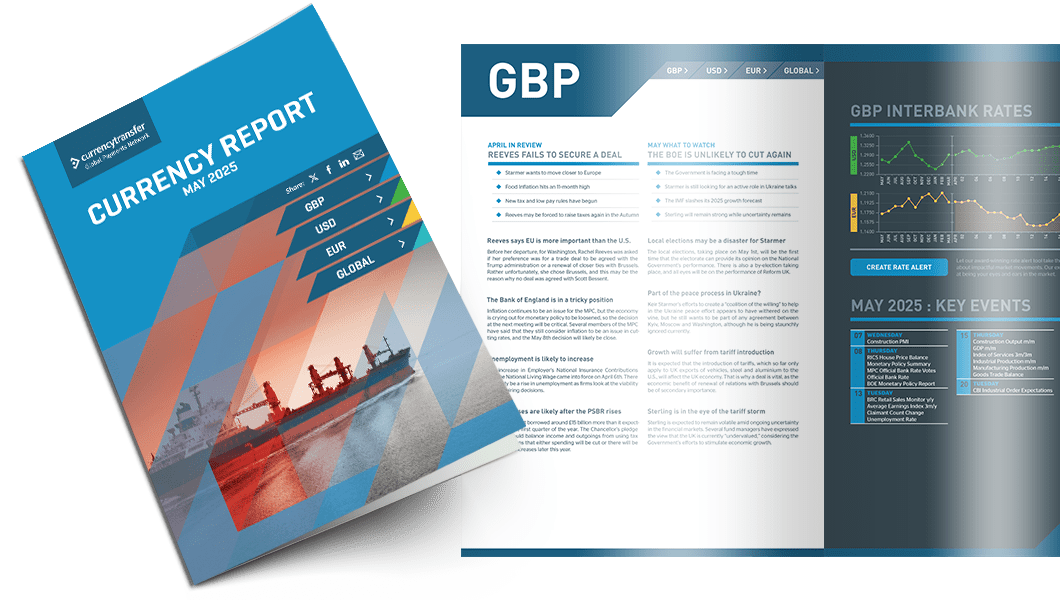
Read our latest currency report
Most impactful events planned this month and how they could impact your business
Weaker private payrolls may point to a rate cut
Markets always get a little impatient at this time of the month as they wait for the Employment Report, which is the single most important piece of data published about the strength or otherwise of the U.S. economy.
Despite in-depth studies of the other numbers that are published in the lead up to “the big one”, no one can say with any certainty the effect of data for job losses or private sector employment on the overall employment picture.
Economists have been reduced to making predictions based more on hope than sound judgment. It is true to say that the longer the non-farm payrolls sit between 100k and 200k or close to that range, the less importance will be attached to the outcome.
Jerome Powell and his colleagues are constantly trying to play down the importance of one single piece of data, saying that the Federal Reserve’s dual mandate means they have to look at the economy as a whole when making monetary policy decisions, and with the current uncertainty caused by the on again and off again nature of the imposition of tariffs, they prefer to do nothing than make a mistake that may need to be reversed in the short term.
As far as Donald Trump is concerned, it is as clear as the nose on your face that interest rates need to be cut, and cut radically. He is unable to understand that the FOMC has not seen fit to cut rates since December, when inflation has fallen significantly.
President Trump has called for the US debt limit to be scrapped entirely, following warnings that his “big, beautiful bill” will increase the deficit by $2.4 trillion over the next decade.
The president said a law that limits US government borrowing needed to be eliminated to “prevent an economic catastrophe”.
Writing on Truth Social, Mr Trump said: “It is too devastating to be put in the hands of political people that may want to use it, despite the horrendous effect it could have on our country.”
The debt ceiling, the legal limit that the US government is permitted to borrow, currently stands at $36.1 trillion. The cap has been revised more than 100 times since it was introduced more than a century ago.
Trump is also baffled by “officialdom” in the shape of the Federal Reserve and the courts in their efforts to limit what he is trying to do to “make America Great Again”.
The financial markets are no longer carried along on a wave of expectation, as uncertainty has gripped both traders and investors.
The dollar index is wallowing at a level that it was not expected to be at currently, particularly as monetary policy has not been eased for a significant period. The current level of the dollar remains counterintuitive.
Yesterday, the index fell to a low of 98.60, although it later recovered to close at 98.80.
If the ECB cuts, it may be the last for some time
The European Commission and Parliament know better than to interfere in the workings of the ECB, with barely a peep heard from Ursula von der Leyen or Roberta Metsola regarding monetary policy decisions.
ECB chief Christine Lagarde is expected to face questions about her tenure as head of the bloc’s Central Bank, amid speculation she may cut her term short.
With Eurozone inflation now below the bank’s target rate of 2 per cent, Ms Lagarde is likely to highlight the bank’s progress in taming inflation while flagging the elevated risk posed by tariffs, which are likely to delay consumption and investment decisions across the bloc.
Alongside the expected eighth consecutive cut in borrowing costs, ECB policymakers will also unveil the bank’s latest forecasts for consumer prices, which are expected to show them at target in the medium term.
It is unlikely that she will touch on the current volatility surrounding the path of the Euro, despite the rise in its value likely having had a supportive role in bringing inflation down.
Eurostat figures on Tuesday indicated eurozone inflation in May had slowed to 1.9 per cent, below the ECB’s 2 per cent target rate for the first time in eight months.
But the bloc now faces an incoming storm from US tariffs, but again, von der Leyen offers little in the way of resistance to Trump and his perceived hegemony.
Senior officials are hoping the EU can still win an exemption from the higher steel tariffs, which came into effect this week, and from tariffs on nearly all US imports from the EU due to come into force next month.
EU trade commissioner Maroš Šefčovič held a crunch meeting with US trade representative Jamieson Greer yesterday.
The ECB has cut interest rates seven times since last June, and markets have priced in another reduction today with wage growth easing, energy prices falling, and a strong euro all pointing to softer inflation.
While Ms Lagarde will likely stop short of providing clear forward guidance on rates, although markets can expect a dovish tone in her remarks, combined with a sizeable downgrade in the bank’s 2025 inflation projections, that will be interpreted as indicative of at least one more rate cut this year.
A pause in the cycle of cuts is expected to be adopted at next month's meeting of the Council to allow its members to disappear on their summer vacations with time to contemplate what has taken place already this year.
The Euro has barely noticed the considerable loosening of monetary policy, having climbed to a high that it was impossible to predict as recently as the end of the first quarter.
Yesterday, the common currency reached a high of 1.1443, but that level seems to be attracting strong selling interest, which is capping its advance without yet seeing any significant correction.
Have a great day!

Exchange rate movements:
04 Jun - 05 Jun 2025
Click on a currency pair to set up a rate alert
Alan Hill
Alan has been involved in the FX market for more than 25 years and brings a wealth of experience to his content. His knowledge has been gained while trading through some of the most volatile periods of recent history. His commentary relies on an understanding of past events and how they will affect future market performance.