
Highlights
- The Government’s house-building plans need consideration
- Imports Plummet in April as Tariffs Weigh on Trade
- The ECB cuts, then signals a pause
Get bank-beating rates — zero hidden fees
Join 10,000+ clients transferring salary, property deposits and business payments globally.


Labour is accused of “smuggling” the UK back into Europe
Housing bosses representing 1.5 million social homes across England will press Rachel Reeves to reclassify affordable housing as critical infrastructure spending, amid a battle between Rachel Reeves and Angela Rayner.
There is deep dissatisfaction with the level of funding for social homes in the spending review due next week. Rayner, the housing secretary, is one of the last remaining holdouts in negotiations with the Treasury over departmental spending settlements.
Housing associations believe that it is all well and good for the Government to make pledges, but the sector needs to be properly funded, and other measures have to be agreed upon for the sector to perform at the level that is required.
Another part of the secret that is critical is staffing levels among tradespeople. Since Brexit, the number of plumbers, electricians and bricklayers working on building sites has fallen dramatically, and the creation of the number of properties demanded by Rayner is in jeopardy.
The submission comes from partnerships in Greater Manchester, Liverpool, Hull and East Yorkshire, South Yorkshire, West Yorkshire, York and North Yorkshire, and Homes for the South West.
Nick Atkin, the chief executive of Yorkshire Housing, said: “Housing has a pivotal role in economic growth. Reclassifying investment in affordable homes as infrastructure spending is a vital step to unlocking the long-term confidence and funding needed to build at the scale to meet the government’s ambition.
The reverse side of the staffing element is being made by groups which provide practical education to train young people to work as tradespeople. They believe that the shortfall in the various trades should be filled by greater investment in young people, even as the Government is accused of trying to return the UK to the EU by “backdoor” means.
In a speech yesterday, Mel Stride, the Shadow Chancellor, promised the Conservatives will ‘never again’ make offers they cannot afford.
He went on to say a “bold rewiring” of the economy is needed as part of the Tory recovery following the fallout from Liz Truss’ mini-budget, which is still considered by many to have been the beginning of the end of the Conservative Government.
Aiming at both Labour and Reform UK, the Tory frontbencher accused Chancellor Rachel Reeves of “fiddling the figures” by changing her definition of national debt, and warned that “populism is not the answer”.
Next week will see the release of employment data for the UK, as well as the monthly GDP figures. The government will be hoping that the economy continues to grow in April, even though the level of growth is still disappointing.
The pound climbed to a high of 1.3614 yesterday, and while it retraced part of its gains, it still closed in a positive light at 1.3578.
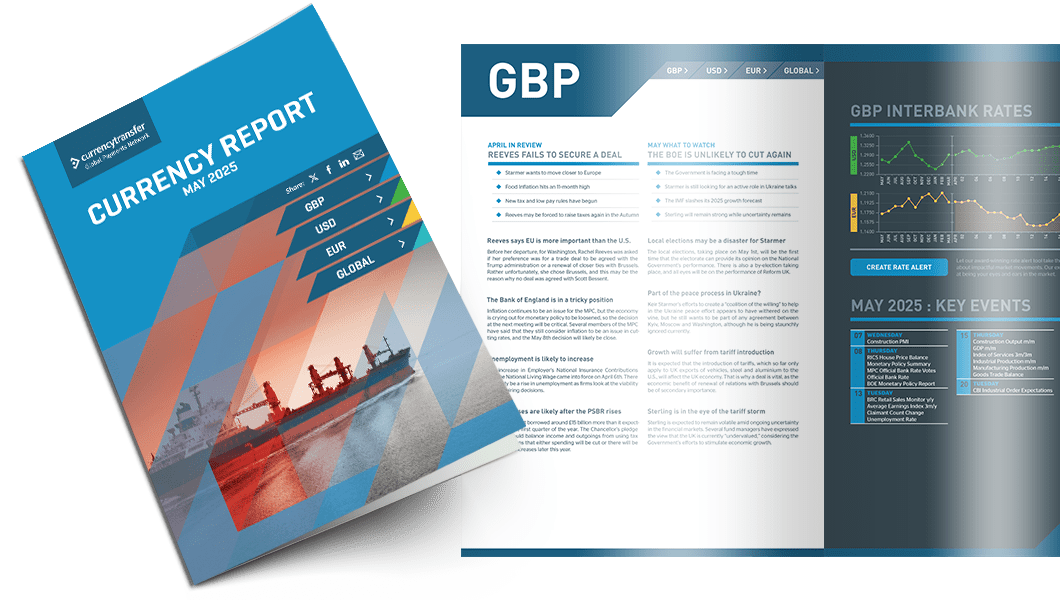
Read our latest currency report
Most impactful events planned this month and how they could impact your business
FOMC members want to continue to be patient
Following the release of the data for JOLTS job losses and new jobs in the private sector, President Trump has made fresh calls for interest rates to be cut. If the headline figure for new jobs in the non-farm payrolls numbers is in any way disappointing, Trump will leap upon the news to add further pressure on Jerome Powell to encourage the recommencement of rate cuts.
Trump has been calling for rates to be cut to support his economic and trade policies, but several FOMC members have said recently that patience is needed over a loosening of monetary policy, since the threat of tariffs has introduced increased uncertainty into the economy.
Kansas City Fed President Jeff Schmid acknowledged in a speech overnight that monetary theory may suggest “looking at a one-time price shock”, but he would be “uncomfortable staking the Fed’s reputation and credibility on theory alone.”
Despite the expected drag from tariffs, Schmid remains “optimistic” about the economy’s momentum. However, he acknowledged that both the inflationary and growth implications of tariffs are highly uncertain.
As a result, he argued that the Fed will “need to remain nimble” and be prepared to adjust its stance as needed to maintain both price stability and maximum employment.
Philadelphia Fed President Patrick Harker added his own perspective to comments from those of Schmid earlier in the day, noting that whiplash trade policies from Trump and his administration are making it difficult for Fed officials to move on rates.
The President is likely to continue “banging on the door” to call for lower interest rates, while several members of his administration back his demands, even if inflation begins to pick up again. They are either unaware of the economic realities of the relationship between growth and inflation or are choosing to ignore them.
Amid uncertainty, the Fed must wait and see on next policy steps, according to Harker. There's still no idea how shifting economic policies will affect the economy. Slow disinflation by itself justifies the Fed holding steady on interest rates. It is entirely possible that the Fed may face rising inflation and unemployment at the same time. A short-lived period of stagflation may well be the result of the President’s economic plans.
The US economy is resilient, but there are stresses in the foundation. The economy faces many different possible paths. Thus far, the job market has been mostly stable.
The current prediction is for 130k new jobs to have been created in May. This is below the 177k created in April, but still a reasonable figure given all that is happening currently, and certainly sufficient for rates to remain on hold.
The dollar index dipped to test the 98.40 level in the middle of yesterday's trading session, but quickly attracted buyers, which drove it to close at 98.74.
Rates are at 2%, and inflation is still falling
She told reporters we believe that the impact of tariffs on exports to the U.S., if and when they materialise, will predominantly impact in 2026 and will then be significantly offset by the expected investment in both military equipment and construction or infrastructure.
The ECB has lowered borrowing costs eight times, or by 200 basis points, since last June, seeking to prop up a Eurozone economy that was struggling even before erratic U.S. economic and trade policies dealt it further blows.
With inflation now just below 2%, ECB President Christine Lagarde said the Central Bank for the 20 countries that share the euro was in a "good position" with the current rate path. Investors took this to mean a break in cuts, if not an end to policy easing.
The time has come for at least a break in rate cuts since the ECB has already done the legwork in taming inflation, with the help of a strong and potentially strengthening currency and additional support was not needed for now, especially since little new data would be available by the July meeting.
Sources with direct knowledge of the discussion said there was broad agreement around the table about sitting tight in July, and a few even made the case for a longer pause, barring unexpected market turbulence.
Lagarde was less explicit but also hinted at a steady policy at the next meeting.
“We are well-positioned after that 25 basis point rate cut and with the rate path as it is," Lagarde told a press conference. "With today's cut, at the current level of interest rates, we believe we are in a good position."
Interest rates implied by markets see a pause in July and anticipate just one more cut in the deposit rate toward the end of the year, possibly in December.
"I think we are getting to the end of a monetary policy cycle that was responding to compounded shocks, including COVID, the war in Ukraine, and the energy crisis," Lagarde said.
Economists also saw her words as a clear indication of a pause, and some even bet that the ECB's most aggressive easing cycle since the global financial crisis of 2008-2009 might be at a close.
"We think the ECB is done cutting rates now, but this view is contingent on no major negative surprises surfacing and economic outlook to gradually become more robust in line with the ECB's forecasts," one bank said in a note to clients.
There is little doubt that President Trump will follow through on his threat to impose potentially damaging tariffs on Eurozone exports to the U.S. The most likely effect is for output, productivity, and growth to suffer while inflation remains on an even keel or slips a little further.
The Euro rallied to a high of 1.1491 yesterday as the rate cut and a possible pause were announced, but drifted lower to close at 1.1446 as traders became concerned about the uncertainty that remains and today’s publication of data in the U.S.
Have a great day!

Exchange rate movements:
04 Jun - 05 Jun 2025
Click on a currency pair to set up a rate alert
Alan Hill
Alan has been involved in the FX market for more than 25 years and brings a wealth of experience to his content. His knowledge has been gained while trading through some of the most volatile periods of recent history. His commentary relies on an understanding of past events and how they will affect future market performance.