Highlights
- The UK’s long-term borrowing costs hit their highest level since 1998
- Job openings fall slightly in March as hiring rebounds
- Energy is key on the Eurogroup agenda
Get bank-beating rates — zero hidden fees
Join 10,000+ clients transferring salary, property deposits and business payments globally.


It’s not the Bank of England’s job to support the Chancellor
Multiple independent analyses forecast record‑low results for Labour in the 7 May local, Scottish, and Welsh elections. The Independent reports Labour could lose 1,900 councillors, a 74% wipe‑out of the seats it is defending, the worst performance for any sitting PM in UK history.
At the same time, The Guardian similarly warns of “unprecedented losses”, with Labour’s vote share collapsing across England, Wales, and Scotland.
A governing party suffering the worst local election results ever recorded creates a political environment where a leadership challenge becomes almost inevitable.
The influx of so many new, first-time MPs who won seats in the 2024 General Election has created an atmosphere in Westminster in which holding on to constituencies has become more important than policy.
Polling and modelling indicate Labour’s national vote share has fallen from 35% in 2022 to around 20%, with Reform, the Greens, and nationalists surging. In London, traditionally Labour’s fortress, the Party is forecast to lose its top vote share in up to 14 boroughs, as the Greens and Reform erode its base.
A leader whose authority is slipping across every electoral tier faces intense pressure from MPs, unions, and activists.
Tomorrow may well turn out to be a watershed for politics in the country. The question is, will Keir Starmer survive to see it through?
The Bank of England states on its website that “We set monetary policy to achieve low and stable inflation. This is our primary monetary policy objective”. It adds that, in practice, this means “keeping inflation at two percent over the medium term”.
Looking at the broadest measure of inflation, the consumer price index, the last time it was below two percent was in September 2024, at 1.7 percent. That was the only month in the past five years when this was the case.
In April 2021, inflation was 1.5 percent. By the end of that year, it had risen to 5.4 percent. It rose throughout most of 2022, finishing the year at 10.5 percent. Since then, it has averaged 4.3 percent, more than double the Bank’s target rate.
The MPC believes the main tool for controlling inflation is the Base Rate, the interest rate the Bank pays on overnight deposits from commercial banks. Raising the rate is believed to slow economic activity, which in turn will lead to a moderation in inflation.
Given that inflation has consistently been above target, it seems curious that since August 2023, the only movement in the Base Rate has been downward, from 5.25 percent to 3.75 percent.
At the MPC meeting last week, eight members voted to leave Bank Rate unchanged, with only the Bank’s chief economist, Huw Pill, voting for a modest increase to four percent.
The Bank attempted to justify the decision by publishing three scenarios for the projected path of inflation over the next few years. The scenarios differ primarily in the price of oil. In the most pessimistic outlook, with oil at $130 a barrel for the rest of 2026, inflation peaks at six percent and remains above the two percent target even in 2028. But even in the other two scenarios, which assume lower oil prices, inflation is projected to exceed the target in both 2026 and 2027.
Inflation may be above the Bank’s target for the entirety of this Parliament.
Is there blame to be attached to this, or is the target simply impossible to meet, meaning it should be adjusted higher?
Many analysts frame persistent above-target inflation as a sign that policy settings were not tight enough or early enough.
The Bank of England reacted later than the Fed or ECB, tightening only once inflation was already well above target. Fiscal and monetary policy pulled in opposite directions, with stimulus measures (energy subsidies, tax cuts, pandemic-era support) complicating the Bank’s job.
Supply shocks were underestimated, especially in energy and food after the war in Ukraine and later disruptions in the Middle East, and communication missteps, such as repeatedly describing inflation as “transitory”, may have allowed expectations to drift.
The pound is the central transmission channel through which inflation enters the UK economy. When sterling weakens, inflation rises; when sterling strengthens, imported inflation falls.
Sterling matters because the UK is a high‑import economy. A large share of what households and firms consume, energy, food, manufactured goods, and components, is priced in foreign currencies.
The pound sterling is roughly at the same level it was at the time of the General election, so it is not contributing to inflation, particularly currently. It was 1.3050 when Labour took office and closed at 1.3570 yesterday.
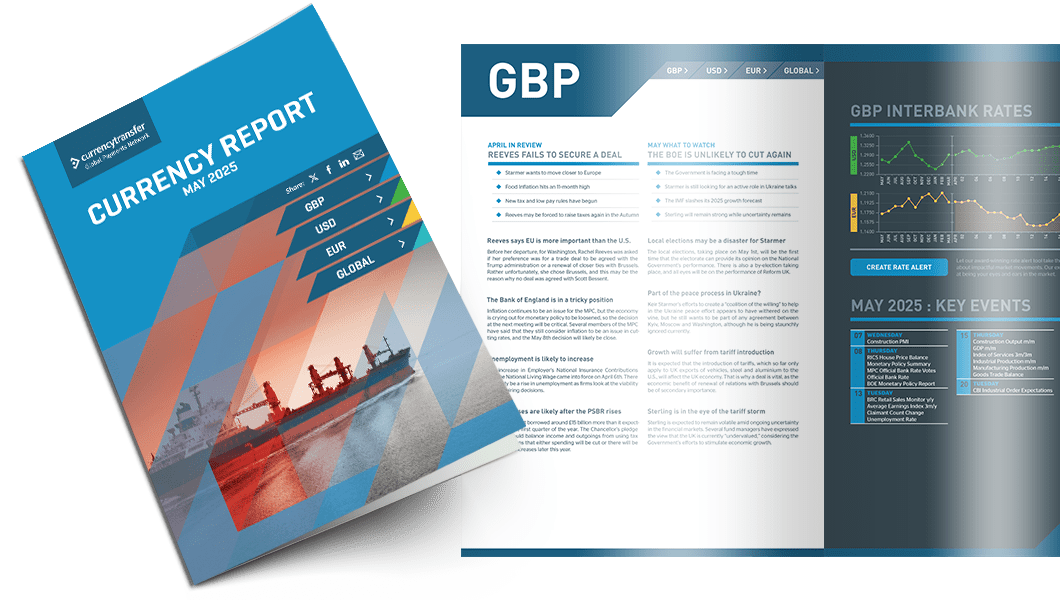
Read our latest currency report
Most impactful events planned this month and how they could impact your business
Trump posts an image of Jerome Powell falling into a skip
U.S. job openings slipped in March, but a surge in hiring suggested the labour market was regaining its footing after struggling last year.
Job openings, a measure of labour demand, fell 56,000 to 6.866 million by the last day of March, according to the Labour Department's Bureau of Labour Statistics in its Job Openings and Labour Turnover Survey (JOLTS) report. Economists polled by Reuters had forecast 6.835 million unfilled jobs.
The job openings rate eased to 4.1% from 4.2% in February.
Hiring jumped by 655,000 to 5.554 million. The hiring rate increased to 3.5% from 3.1% in February. Layoffs and discharges, however, rose by 153,000 to 1.867 million, with the rate for that category climbing to 1.2% from 1.1% in the prior month.
Economists see growing downside risks to the labour market from the U.S.-Israeli war with Iran, which has disrupted shipping through the Strait of Hormuz, boosting the prices of oil, fertiliser, aluminium and other commodities.
Labour market stability, for now, is supporting financial market expectations that the Federal Reserve will keep interest rates unchanged this year. The U.S. central bank last week left its benchmark overnight interest rate in the 3.50%-3.75% range, citing concerns about rising inflation.
Donald Trump took a fresh jab at Jerome Powell after sharing an AI-generated image of Powell falling into the skip on social media. He added a brief caption referring to the interest rates the President has consistently criticised as too high.
The post comes amid Powell’s tenure as Fed Chair, which approaches its conclusion on May 15. However, in the latest briefing, Powell revealed that he’ll remain and will not interrupt the transition process for Kevin Warsh, who will replace him as chair.
This jab comes a few days after Trump slammed Powell for not leaving his seat on the Fed’s Board of Governors. He claimed, “Jerome “Too Late” Powell wants to stay at the Fed because he can’t get a job anywhere else, nobody wants him.”
In an earlier press briefing, Powell set the record straight about why he will remain on the board despite his tenure coming to an end soon. He stated his reason, adding, “I’m literally staying because of the actions that have been taken. I had long planned to retire. The things that have happened in the last three months have left me no choice but to stay until I see them through, at least that long.”
The dollar index has remained within a narrow range as traders and investors remain uncertain about conditions in the Strait of Hormuz. Until there is either a breakthrough in peace negotiations or hostilities resume, the markets will remain in flux. Yesterday, the index rose slightly, reaching a high of 98.59 and closing at 98.48.
ECB's Villeroy: Not seeing sufficient signs yet to raise rates
At an environmental conference in Frankfurt, she said European countries currently meet around 60% of their energy needs through imports, calling the situation “clearly unsustainable.”
Lagarde emphasised that the current rise in energy prices is a reminder of the cost of that dependency.
“Alternative energy sources offer the best opportunities to achieve the goals of energy security, environmental sustainability and affordability,” she added.
Given the scale of climate and environmental risks, she noted that “responses from governments and society have been insufficient”.
Lagarde’s comments echo a speech she gave last year on Europe’s road to renewables, with other officials also frequently wading into discussions on climate and nature. However, there’s been criticism that such forays push beyond the ECB’s mandate.
In separate comments, ECB Chief Economist Philip Lane said shifting weather patterns can pose direct problems for policymakers.
“Climate change both reduces the trend level of output and increases the volatility of output and inflation, including through the increased frequency and severity of extreme weather events,” he said.
Should climate shocks become more frequent and salient, “the risk of de-anchored inflation expectations becomes more acute,” he added. “If so, always looking through climate-driven supply shocks may not be the most appropriate choice.”
Referring to the latest ECB Governing Council meeting and the prospect of a rate increase at the next one, outgoing ECB Council Member Francois Villeroy de Galhau said.
“If we see such second-round effects, we’ll act and raise rates to prevent inflation becoming broad and sustainable,” he told France 5 television yesterday. “For the moment, we don’t have sufficient signs of this propagation.”
The ECB kept borrowing costs unchanged last Thursday while signalling that a hike will be considered at the June 10-11 gathering. Since then, Bundesbank President Joachim Nagel has said such a move will be needed if there’s no significant improvement in the outlook for inflation and economic growth. In contrast, Slovakia’s Peter Kazimir has said: “It’s all but inevitable.”
Villeroy won’t participate in the next policy meeting after announcing he’d retire at the end of May, before his term was due to end next year.
In a letter to French President Emmanuel Macron this week, Villeroy said the ECB should combine caution with a readiness to act “without hesitation.”
The euro will likely react if Lagarde’s comments about reliance on imported energy continue, but for now, it remains driven by the market’s appetite for risk. Yesterday the single currency fell to a low of 1.1676 but rallied late on to close at 1.1693.
Have a great day!

Exchange rate movements:
05 May - 06 May 2026
Click on a currency pair to set up a rate alert
Alan Hill
Alan has been involved in the FX market for more than 25 years and brings a wealth of experience to his content. His knowledge has been gained while trading through some of the most volatile periods of recent history. His commentary relies on an understanding of past events and how they will affect future market performance.