
Highlights
- Rates cut to their lowest in two years
- Payroll revisions have sparked recession fears
- German Industrial Production is collapsing
Get bank-beating rates — zero hidden fees
Join 10,000+ clients transferring salary, property deposits and business payments globally.


Taylor changes his vote to avoid another pause
Many market participants were unaware of the voting system being used, which was intended to prevent a stalemate among the nine members.
The closeness of the decision surprised the market, since there was an overwhelming view that not only would rates be cut yesterday, but the cut may be the first of a succession of cuts leading to significantly lower rates.
The policy statement provided by Governor Andrew Bailey following the meeting provided a little insight into the outcome. "It was the first time MPC had two rounds of voting to reach a majority on the rate decision." The BoE forecast shows a CPI peak of 4.0% next month,
Forecasts show food price inflation peaking at around 5.5% at the end of 2025 from June's 4.5%, part of the rise due to higher minimum wage, packaging tax, national insurance, as well as higher global prices.
The BoE forecast shows CPI in a year at 2.7%, a little higher than the May forecast of 2.4%, based on market interest rates.
Bailey went on to say that in the Bank’s opinion, living standards will stagnate for a year under Labour as fears grow over looming tax rises.
The Bank believes that Rachel Reeves’s record tax raid last Autumn and rising food costs driven by government policy were exerting a renewed squeeze on working people.
It warned that the cost of the weekly shop would keep rising for the rest of the year, amid a “challenging constellation” of weaker pay growth and higher inflation.
Benefits claimants and pensioners will largely be shielded from the squeeze, with welfare payments traditionally raised in line with inflation.
However, working people will be hit in a challenge to Sir Keir Starmer’s promise to boost living standards in this parliament.
Bailey said wage growth was slowing faster than previously thought, with forecasts showing there would be zero growth in real post-tax incomes next year.
The Bank also upgraded its inflation forecasts for the next three years and warned that it would not get back to target until 2027.
The gloomy forecast came as the Bank delivered its latest assessment of the economy.
The pound rallied as the market took the Bank’s actions to mean that this may be the only cut seen this year. It reached a high of 1.3448 and closed at 1.3440.
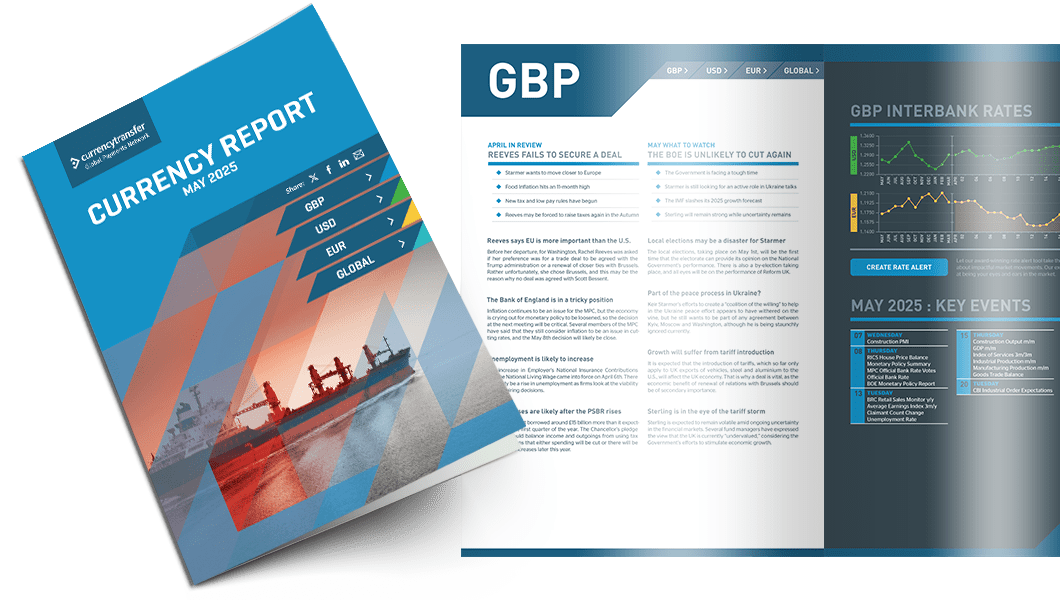
Read our latest currency report
Most impactful events planned this month and how they could impact your business
The jobs data is still reverberating
Trump advisers are impressed with Waller’s willingness to move on policy based on forecasting, rather than current data, and his deep knowledge of the Fed system as a whole. Waller has met with the president’s team about the role, but has yet to meet with Trump himself.
During the July meeting’s decision to maintain the federal funds rate between 4.30% to 4.50% Waller, along with Michelle Bowman, dissented against the rest of the Committee by seeking a 0.25% percentage point rate cut.
Despite no rate cut in July, following the weaker-than-expected July jobs number last Friday, markets are now increasingly betting that the Fed will cut in September. Traders are placing a nearly 90% chance of a 1/4 percentage point rate cut at the September 17th FOMC meeting.
Trump has relentlessly attacked Powell for his failure to get rates down, nicknaming him "Too Late." The president has argued that inflation is low, and the Fed’s European counterparts have lowered rates multiple times.
By posting large downward revisions, the latest U.S. payrolls data is sparking concerns about the underlying trajectory of the U.S. economy.
While the July employment report attracted more attention than usual, after it was followed by the firing of the head of the U.S. Bureau of Labor Statistics, whose only “crime” was, it appears, to agree that the data should be published on August 1st, not the 8th.
Concerns have been raised about the integrity of future data, while the report also raised worries about the health of the U.S. economy.
Such revisions are not totally unheard of, but they are usually associated with an inflexion point, such as a significant slowdown or even a coming recession.
The revisions to payroll numbers for May and June, a downward revision of 258,000 from previous data showing the economy added 291,000 new jobs in those two months, down to just 33,000, represent one of the largest revisions on record, apart from the pandemic period.
And the revised data stirred serious concerns about visibility into and the direction of the U.S. economy. It raised the question of what action the FOMC may have taken had it had the correct figures to hand.
The dollar index lost further ground yesterday, falling to 97.94 and closing at 98.08. Technically, it is still considered to be in a correction, but that will change if it breaks the support at 97.22.
German production has fallen to its lowest since 2020
Consumer spending continued to expand in June as retail sales rose faster at 3.1% year-on-year, surpassing the market consensus of +2.6%, and marking the highest reading since Sep-24.
Spain, as has become the norm, recorded the strongest growth among the eurozone’s largest economies, with retail sales rising by 6.4%, while Germany also outperformed the regional average with a 4.8% increase.
The monthly detail shows that trade rebounded by 0.3%month-on-month, returning to levels seen in February and March. Nonetheless, the data was slightly lower than that predicted by the market.
Sales recovered across several categories, including food, beverages and tobacco, non-food products and automotive fuel.
The tariff concerns have been balanced by increases in domestic consumption.
Preliminary data showed the economy expanded at a slightly moderated pace by +1.4%, exceeding expectations of 1.2%.
The European Central Bank projects full-year growth at +0.9%. However, rising US-EU trade friction remains a risk.
Currently, the EU faces a 15% US tariff on most goods, but it believes it has a good insurance policy thanks to a framework deal that covers most goods it exports to the US by capping tariffs at that level.
Although the EU has suspended two rounds of countermeasures for six months, tensions remain as President Trump threatens further tariff hikes of up to 35% if a USD600 billion investment pledge is unmet.
Germany’s industrial output dropped in June to its lowest level since 2020, the year when the coronavirus pandemic swept the planet, paralysing the global economy.
The decline in German production, which comes amid weak demand and slow growth abroad, coincided with a continued decrease in industrial orders. The trend has set in as the country’s export-oriented economy prepares for the impact of U.S. tariffs and stiffer competition from Chinese manufacturing.
With the monthly decline, production reached its lowest point since May 2020, at the time when the economy was shrinking under the burden of measures introduced to limit the spread of the raging COVID-19 virus.
Provisional data suggesting a 1.2% increase in May was also revised by Destatis to a negative 0.1%, compared to April, as a result of corrections in the numbers coming from Germany’s massive automotive industry.
The Market remains undecided about the fate of the Euro for the rest of 2025. There are several conflicting factors in both the Eurozone and global economies. The common currency tried to rally yesterday, reaching a high of 1.1698, but ran into strong selling interest, which saw it reverse its gains and close at 1.1665.
Have a great day!

Exchange rate movements:
07 Aug - 08 Aug 2025
Click on a currency pair to set up a rate alert
Alan Hill
Alan has been involved in the FX market for more than 25 years and brings a wealth of experience to his content. His knowledge has been gained while trading through some of the most volatile periods of recent history. His commentary relies on an understanding of past events and how they will affect future market performance.