
Highlights
- Are there any levers left for Reeves to pull?
- The time has arrived for rate cuts
- Retail sales rose more than expected
Get bank-beating rates — zero hidden fees
Join 10,000+ clients transferring salary, property deposits and business payments globally.


A new era in monetary policy begins today
While this will be the third cut that has been delivered this year, with cuts taking place in February and June, the feeling in markets is that the tone of Andrew Bailey’s comments following the decision will be more dovish than they have been recently and show the Bank’s commitment to economic growth and activity.
Almost as important as the decision itself will be the breakdown of the vote itself.
The more “traditional doves”, Swati Dhingra, Alan Taylor, and Dave Ramsden, may well be joined by the fence-sitters like Bailey himself, Sarah Breedon and Megan Greene to say the decision.
A forecast is literally just that, but some carry more weight than others and need less explanation. The one produced by the National Institute for Economic and Social Research is considered the most influential outside the Treasury itself.
Earlier this week, the NIESR stated that it believed the Chancellor would need to either significantly raise taxes or cut services “to the bone” to achieve her personal goal of balancing day-to-day payments and receipts.
While this is not a mandatory action, Rachel Reeves has confirmed several times already that it is a pledge that she will continue to keep, “come hell or high water”.
While that is an admirable sentiment, particularly in a politician, she runs the risk of digging another hole for herself, one that matches the one that already exists. Furthermore, if she decided on a mix of both tax increases and cuts to services, particularly welfare, there is no certainty that another revolt by the left of the Party will see the cuts watered down, given this Government's penchant for a U-turn.
The NIESR report points to the need to re-establish a large buffer against missing the fiscal rule. The absence of such a buffer has been called what it calls “piecemeal policy tinkering”, giving rise to greater political uncertainty. The knock-on from this is that the public is unaware of the path that the country is taking, given that it has a record of saying one thing and almost hoping for the best that the economy performs following these hopes.
The pound rallied again yesterday, reaching a high of 1.3368, although there is little certainty of its continued path higher, given the proximity of a rate cut and a possible more dovish undertone to the Bank of England’s policy statement. It eventually closed at 1.3357.
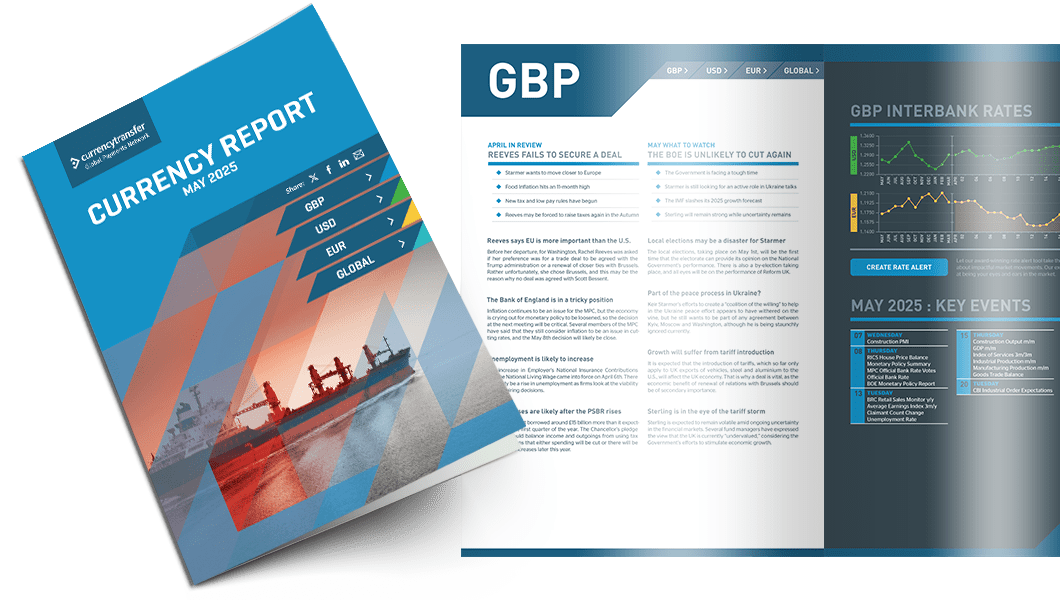
Read our latest currency report
Most impactful events planned this month and how they could impact your business
The Fed’s Daly sees rate cuts as “imminent”
He will need to “act smart” in his appointment so as not to be seen to be nominating a blatantly obvious supporter for his brand of economic policy, in order not to upset the fine balance that has been created in Congress recently, while ensuring that he can continue to undermine the performance of Fed Chairman Jerome Powell.
The decision is expected to go a long way in answering the question of who Powell’s replacement will be, whether the timing of that departure is his or Trump’s.
Several FOMC members have “emerged into the light” following their recent meeting, at which rates were left unchanged.
San Francisco Fed President Mary Daly said yesterday that she expects the Central Bank will need to cut interest rates “in the coming months,” citing a gradually cooling economy and persistent downside risks in the labour market. “I would see additional slowing as unwelcome,” Daly warned, adding that the labour market tends to “fall quickly and hard” once momentum is lost.
Daly also downplayed the inflationary impact of US tariffs, saying they pose only a short-term threat. Excluding tariff effects, she noted, inflation has been “gradually trending down,” and should continue to ease given restrictive policy and moderating demand.
Meanwhile, Boston Federal Reserve President Susan Collins and Fed Board of Governors member Lisa Cook participated in a virtual discussion yesterday, with both key policymakers cautioning that overarching uncertainty remains a key sticking point for Fed policy transmission and the Central Bank's ability to manage policy rates effectively.
Collins said it is Key to understand how uncertainty impacts the economy. Uncertainty is notable in areas where long-term investment is happening. We must look at data holistically to measure uncertainty levels. Uncertainty can even speed up some types of economic activity. Uncertainty is leading us to a wait-and-see approach to price setting.
While Cook added, We must be cautious when looking at data, since the latest jobs report is concerning and big revisions can happen at economic turning points.
The unemployment rate is still a good indicator of slack in the market, while AI technology could affect both the job and inflation sides of the Fed’s mandate.
The dollar index lost ground yesterday since the market is coming around to the idea of a rate cut next month. It fell to 98.13 and closed at 98.22
German economic activity will remain flat until Spring
“This is explained by a catch-up on delays accumulated during the quarter and the lifting of supply-chain constraints for certain companies,” Insee said in a statement on Tuesday.
Energy and water, as well as coking and refining, also contributed.
The figures reinforce an initial estimate last week that showed growth in the euro area’s second-biggest economy accelerated 0.3% in the second quarter, much stronger than anticipated. Still, the increase was solely due to inventory building that offset weak domestic demand and a drag from trade.
Boosting output will be key for the government as it tries to push through another round of unpopular belt-tightening to narrow the country’s deficit. The administration risks being toppled when parliament returns after the summer break if Prime Minister François Bayrou is unable to convince opposition lawmakers to allow his budget plans to pass.
It also reinforces the sentiment in French politics to wait-and-see rather than rush to make policy changes “on the fly,” which can often have disastrous consequences. Separate data from Spain showed a 1% increase in industrial production in June.
German figures are due later today, with economists predicting a contraction. Industrial orders unexpectedly fell in June, official data showed yesterday, as Europe's biggest economy struggles with prolonged domestic weakness and volatile US trade policy. New orders, closely watched as an indicator of future business activity, dropped 1.0% month-on-month, according to preliminary data from the federal statistics agency Destatis, after a fall of 0.8% in May.
The Eurozone seems unable to avoid a two-paced economy, which points to a revival of the adage that one size does not fit all.
The euro rallied yesterday in a market that is undecided about the path for the dollar, with other G7 currencies being caught up in the volatility. The common currency climbed to a high of 1.1669 and closed at 1.1658.
Have a great day!

Exchange rate movements:
06 Aug - 07 Aug 2025
Click on a currency pair to set up a rate alert
Alan Hill
Alan has been involved in the FX market for more than 25 years and brings a wealth of experience to his content. His knowledge has been gained while trading through some of the most volatile periods of recent history. His commentary relies on an understanding of past events and how they will affect future market performance.