
Highlights
- The UK’s economy is on an unsustainable footing
- The US trade deficit widened 42% in May as imports hit a record high
- The ECB is to remain cautious as the Eurozone outlook stays fragile
Get bank-beating rates — zero hidden fees
Join 10,000+ clients transferring salary, property deposits and business payments globally.


Bailey warns of a high risk of an equity correction
It warns that Andy Burnham faces a £100 billion challenge if he wants to put Britain’s public finances on a sustainable path.
“In nearly all of the models, debt eventually moves onto an unsustainable and ever-rising path,” the OBR said in a report.
“We stress that it is not plausible that the UK, or any other country, could remain on any of the unsustainable paths set out in these scenarios, because they imply that debt will ultimately grow explosively.”
Health spending is projected to rise from 8% of GDP in 2030/31 to 13% of GDP by 2075-76.
State pension spending is projected to rise from 5% of GDP to around 9% of GDP by 2075-76.
Education spending is expected to fall from 4.3% to 3.4% of GDP as the population ages.
The baseline scenario forecasts that spending will rise from 40% to 49% of GDP over the same period.
The OBR stressed that its scenarios should not be seen as forecasts, as it was “almost certain” that future Governments would have to take action to prevent them from happening.
But it concluded that “unsustainable fiscal outcomes that may not occur for some years are today’s challenge, not tomorrow’s”.
“The degree of tightening required to prevent debt from following an unsustainable path increases as it is delayed to future years,” the report warned.
“This would make it more costly and place a greater burden on future generations.”
A new YouGov poll has surveyed the attitudes of Labour members as the party transitions from Keir Starmer to Andy Burnham.
The most important role Andy Burnham will need to fill in his cabinet is the chancellorship. It is not simply a choice that matters to the UK; US officials have made it clear that giving the role to Ed Miliband would be a mistake’
The US administration will likely be disappointed to see that Miliband is the top contender among Labour members, with 21% saying that Andy Burnham should promote the current energy secretary to the Treasury.
This figure is closely matched by 20% who want Burnham to keep Rachel Reeves in her role. In a distant third place is Wes Streeting at just 6%, with all other contenders taking 5% or less of the vote.
With Reeves proving a top choice among party members, it is no surprise that most (66%) think she has done a good job as chancellor.
Again, Miliband’s figures closely match Reeves’s: 69% think he would do a good job if he were Chancellor.
Yvette Cooper, who was listed by only 5% of members as their first choice for the role, is also seen as likely to do a good job by 62% of party members.
However, fewer members think Reeves has done a “very good job” (10%) than anticipate that Miliband (25%) or Cooper (21%) would perform this highly.
By contrast, Labour members are equally split on whether former health secretary Wes Streeting would make a good chancellor. 39% think he would, but 43% disagree.
Bank of England Governor Andrew Bailey told the Financial Policy Committee that the risk of a sharp correction in equity markets remains high, with valuations stretched beyond optimism about AI's benefits.
Bailey said the stretch in equity valuations appears broader than AI-related enthusiasm. The FPC expressed particular concern that existing risks to financial stability could materialise simultaneously.
The Governor said risks from frontier AI represent the biggest change since December. He emphasised that firms must act on official UK guidance to strengthen cyber resilience in response to AI threats. He is also concerned about the pace of change brought about by the acceptance of AI-driven businesses.
On banking regulation, Bailey said the FPC held a detailed discussion on leverage reform, describing the topic as complex. He noted that some cleanup work is needed for leverage rules affecting major UK domestic banks.
Reform UK Leader Nigel Farage has “thrown Parliament a curveball” by resigning as an MP and then confirming he will stand as a candidate in his constituency of Clacton-on-Sea in Essex.
The other major political parties have decided that they will not be entering a candidate in the by-election since they see Farage’s actions as little more than a stunt designed for him to “get out ahead” of the intense scrutiny that he is under from the Parliamentary Ethics Committee.
Yesterday, the pound retraced its gains from Monday. It fell to a low of 1.3349 and closed at 1.3359.
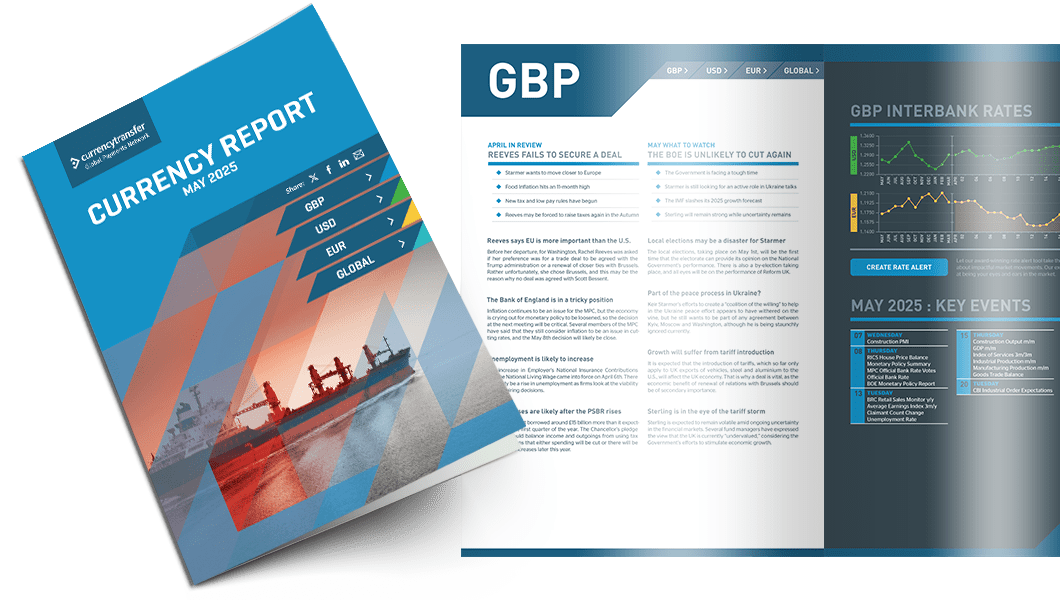
Read our latest currency report
Most impactful events planned this month and how they could impact your business
Fed policy stance remains 'well positioned,' says the NY Fed's Williams
The trade data support the deficit; the AI-specific interpretation stems from market coverage linking higher capital goods imports to data-centre and equipment demand.
The most obvious takeaway is that demand for AI infrastructure is now large enough to matter in economic data, even when exact AI attribution remains indirect.
Fed Chairman Kevin Warsh’s push for a “quieter Fed” strips away tools that have historically anchored expectations, reduced volatility, and made policy more effective. Multiple sources confirm that Warsh’s communication crackdown is not merely a shift in style; it’s a substantive reduction in one of the Fed’s most powerful policy levers.
Analysts note that clear Fed communication has historically anchored expectations and reduced market swings. Cutting guidance risks more violent moves in stocks and bonds, ultimately raising rates for consumers.
Meanwhile, decades of increased Fed communication have helped the public understand objectives, anchored inflation expectations near 2%, and made monetary policy more predictable. Scaling back communication likely worsens outcomes and reduces accountability.
Warsh wants a less predictable Central Bank, a move whose consequences could lead the Fed into troubled waters.
He has shortened statements, eliminated forward guidance, and signalled fewer press conferences, a deliberate reversal of the transparency trend since the 1990s, when the late Alan Greenspan championed a more open and communicative style.
New York Fed President John Williams, the only regional president who holds a permanent seat on the FOMC, clearly does not intend to be muzzled.
In an interview with Fox Business, he declined to say whether a rate hike is off the table. He also did not express the view that the rate will remain at 3.50%-3.75% for the rest of 2026. Williams said he'll continue to voice his views on how he sees monetary policy positioned relative to the Central Bank achieving its goals.
Williams, though, supported the decision to remove forward guidance from the Federal Open Market Committee's statement at its June meeting. "Given the uncertainties that we face in terms of inflation and the economic outlook, trying to give explicit forward guidance about where interest rates are going to be was no longer appropriate," he said. "The uncertainties are too great."
The dollar index remains in a corrective phase. There is strong selling interest around 101.80, while it is well-anchored at the 100 level. Yesterday, it reached a high of 101.12 and closed at 101.09.
Le Pen is cleared to stand in the Presidential election
A five-year ban on holding public office has been reduced and backdated to March 2025, and the court said it now considered the penalty had already been served.
However, the leader of the hard-right National Rally has been given a one-year term of wearing an electronic ankle tag under house arrest, although that would not necessarily stop her from running.
However, Le Pen has repeatedly said she would not run for President if she had to wear an electronic tag, as she would not feel "totally free" to campaign.
She is expected to announce whether she will stick with that decision and hand her candidacy to her protege, 30-year-old Jordan Bardella, at a press conference later today.
Le Pen leads the opinion polls with under 10 months to go. She has run for the Presidency three times already and has lost twice, both times to Emmanuel Macron, who cannot run again. Macron has declined to comment on the verdict.
In her last TV interview a week ago, the National Rally leader set out her conditions for running for President to both the judges and the broader public.
She would not campaign for the Presidency while wearing a tag, she told a French news channel, because "when you're a Presidential Candidate you need to have total freedom of movement. I can't rely on a judge to allow me to hold a campaign rally or go to a market".
The European Central Bank has given Eurozone banks four months to draw up plans to counter AI-enabled cyber threats, adopting a more prescriptive approach than other major Central Banks to the risks posed by advanced AI models.
The Federal Reserve and the Bank of England took a softer tone in separate comments as Central Banks grapple with the risks posed by Anthropic's Mythos and the latest generation of large language models.
The cyber capabilities of some of these systems are considered so powerful that access has been restricted, with Eurozone banks currently excluded from Mythos.
"These developments have potentially profound implications for the confidentiality, integrity and resilience of banks’ information and communication technology (ICT) systems," the ECB's Chief Supervisor, Claudia Buch, said in a letter to bank Chief Executives.
She told banks to prioritise protecting internet-facing systems and other exposed technology assets, including third-party software and open-source components, while accelerating vulnerability fixes and strengthening monitoring.
Buch also urged lenders to modernise ageing technology, improve cyber hygiene and strengthen crisis management, recovery and information-sharing arrangements.
European Central Bank Governing Council member Fabio Panetta has described a fragile Eurozone economic outlook, with upside inflation risks and downside growth risks.
He argued that recent peace talks between the U.S. and Iran could eventually ease energy prices, but warned that monetary policy should not follow a preset path.
Panetta said policymakers must keep a close watch on geopolitical developments, energy markets, supply chains, wages and inflation expectations.
The Governor of the Italian Central Bank framed the ECB’s latest rate increase as a “recalibration” after earlier oil-driven inflation pressures. He suggested that recurring supply shocks may force future policy to adapt to meet the 2% medium-term inflation target.
Germany’s manufacturing headwinds remain significant, but recent sector surveys have improved, lowering near-term downside risk for the region."
The Euro remains trapped in a narrow range as the dollar index searches for a trend. The common currency retreated to a low of 1.1408 yesterday and closed at 1.1412.
Have a great day!

Exchange rate movements:
07 Jul - 08 Jul 2026
Click on a currency pair to set up a rate alert
Alan Hill
Alan has been involved in the FX market for more than 25 years and brings a wealth of experience to his content. His knowledge has been gained while trading through some of the most volatile periods of recent history. His commentary relies on an understanding of past events and how they will affect future market performance.