
Highlights
- Burnham should devolve power to the market, not the regions
- The US Economy Lost 60k hospitality jobs, a huge blow to Trump
- Services PMI Beats Forecasts in Jun, but remains in decline
Get bank-beating rates — zero hidden fees
Join 10,000+ clients transferring salary, property deposits and business payments globally.


A rate hike could be needed to retain 'credibility' - Mann
Burnham promises a programme of council-house building, bringing the utilities under tighter public control, and restoring the high street to its former glories.
Britain has already had a 25-year experiment in devolution, with both Scotland and Wales having their own Governments and assemblies, and, in Scotland's case, even limited powers over taxation. The results have barely delivered any more growth or social advantages to either Scotland or Wales.
Scotland's growth has started to lag the rest of the UK, while spending has grown so fast that were it an independent country, its deficit would be running at an alarming 9% of GDP.
Devolved tax powers, it seems, are only ever used to raise taxes, not lower them.
As for Wales, it has been even worse, with close to 20% of the working-age population now living on benefits, traditional industries wiped out, and living standards now among the lowest in Europe.
If devolving power was so great for the local economy, there is not much sign of it so far.
Devolution will just create yet more government and more spending.
Devolution in Scotland and Wales has mainly created an extra layer of politicians, all of whom have to justify their existence by spending more money and passing more regulations. That is how Wales ended up with a 20mph speed limit in urban areas right across the principality, even if it slows down commerce by adding to the cost of every delivery.
Or how Scotland ended up with rent controls, even though they rarely ever work. It seems extraordinary that anyone could look at Britain in 2026 and decide that what it really needed was yet more government and higher levels of spending. Yet that is Andy Burnham’s only prescription.
What the British economy needs is not more power for the regions, but more power for businesses and consumers. With all his talk of ending 40 years of more of the same from centre-left and centre-right governments, it seems to have escaped Andy Burnham's notice that the Government has never been more powerful than it is now. It accounts for 45% of GDP directly and micro-manages trade and business in ways it never used to.
Far from removing red tape, Brexit has led to government bureaucracy growing.
Take the living wage. According to a recent report from the Centre for Cities, in 42 of Britain's 63 largest cities, the living wage is now above two-thirds of median earnings. In effect, what everyone earns is now decided by the government.
Or take energy prices. What you pay as a consumer is determined by the price cap from Ofgem, and the amount factories pay is decided by a complex series of green levies, and the wholesale price for wind and solar is set by a range of long-term, state-controlled agreements.
Devolve power by all means, but put the power in the hands of those who know how to use it.
Bank of England Governor Andrew Bailey has said the UK's inflation picture would look very different without the impact of wars and global geopolitical tensions. Speaking on Friday, Bailey said that, without those shocks, inflation would already be at the Bank of England’s 2% target.
His remarks come as the Bank continues its efforts to bring inflation under control while avoiding unnecessary damage to the wider economy. Bailey stressed that the Bank’s objective is not simply to reduce inflation at any cost. Instead, policymakers want to return inflation to the target level while protecting economic growth and jobs as much as possible.
The comments offer fresh insight into how the Bank of England views the country’s economic outlook after several years of elevated prices and higher interest rates.
Bailey argued that the main reason inflation stayed above target was the impact of international conflicts. Wars have disrupted global energy supplies, increased transport costs and created uncertainty across commodity markets.
Higher energy prices have filtered through to household energy bills, food prices and manufacturing costs. Those increases pushed inflation well above the Bank of England’s target and forced the Bank to raise interest rates aggressively over the past few years.
Although inflation has eased significantly from its peak, policymakers continue to watch wage growth, energy prices and global developments closely before deciding on future policy changes.
Bailey’s latest comments underline the Bank of England’s current strategy. Officials believe inflation is moving in the right direction, but they also recognise that global events can quickly change the outlook. Future interest rate decisions will therefore depend not only on domestic economic data but also on whether international pressures continue to ease.
The pound strengthened modestly last week, gaining roughly 1% vs the US dollar and 0.7% vs the euro, with broad but shallow gains across most G10 currencies.
The biggest driver was USD softness following disappointing US jobs data: the US added only 57,000 jobs, well below expectations. This weakened the dollar and mechanically lifted GBP/USD.
Risk sentiment also briefly improved on hopes of geopolitical easing, further reducing demand for the safe-haven USD.
Sterling rallied to a high of 1.3384, closing at 1.3350.
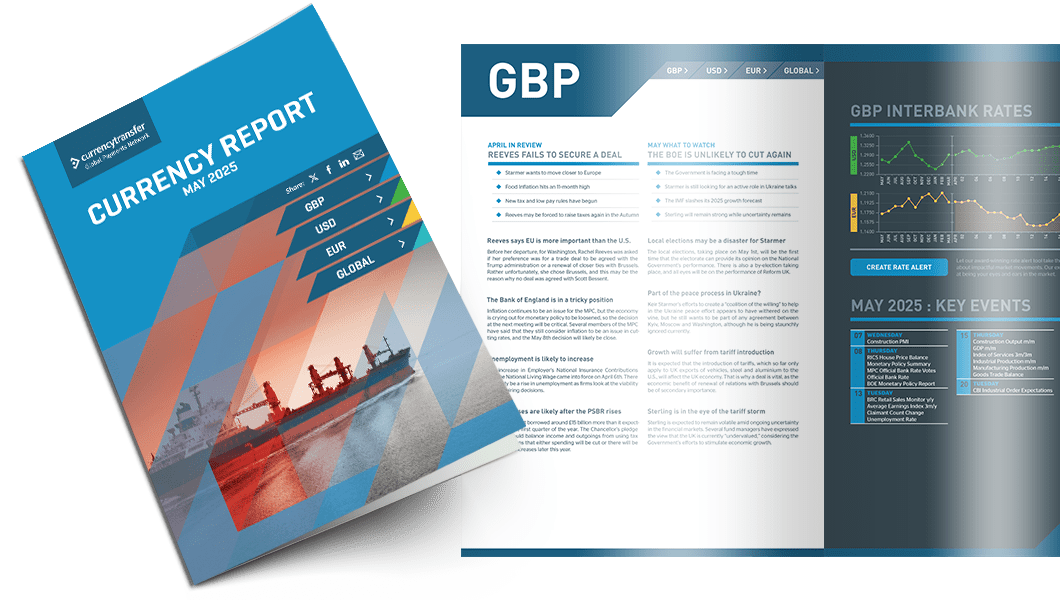
Read our latest currency report
Most impactful events planned this month and how they could impact your business
The AI spending spree is making Warsh's job harder
“He’s got a board that maybe is a little bit hostile, a board that wants to do the wrong thing,” Trump said in an interview with CNBC last week.
The comments appeared to give Warsh some leeway on interest rates, after Trump spent months hectoring his predecessor, Jerome Powell, to cut rates.
Trump’s comments came in response to a question about the June jobs report, which showed US hiring slowed sharply in June. Trump was asked whether the mixed report gave Washington more flexibility to cut rates, something the President has persistently pushed for.
“He’s a great guy and a great pro, and I know what he’d like to do, but he has barriers to climb,” Trump added, maybe giving Warsh even more leeway.
June’s jobs report curbed some of the momentum in job growth seen this year. The unemployment rate fell to 4.2% as labour force participation shrank.
Following the report, investors scaled back bets on an interest-rate increase this year. While Trump has long called for interest rate cuts, Warsh has emphasised the Central Bank’s independence in determining monetary policy.
The President also reiterated that he plans to continue seeking the removal of Fed Governor Lisa Cook, following a Supreme Court decision allowing her to remain in her post. At the same time, she challenges the administration’s efforts to oust her.
Warsh voiced optimism about artificial intelligence, describing the technology as a "paradigm shift" that would likely make the United States a "big winner in the medium-term ".
"We are in the first or second inning of this revolution," Warsh said in Sintra, Portugal, at a conference organised by the European Central Bank.
Warsh weighed in on the bullish side of an ongoing debate among policymakers, investors and the general public about the potential impact of AI on the labour market and wider economy.
The technology could create jobs and boost productivity, strengthening the economies of the U.S. and other nations, according to Warsh.
Warsh stepped into his new job with a case for lower interest rates, backed by an AI-fuelled productivity boom. What he got instead was a $700 billion AI spending blitz that's demolishing his argument for rate cuts anytime soon, with more price increases about to ripple through the U.S. economy.
As AI supporters argue, employees who adopt AI complete more tasks in a fraction of the time, and companies produce more with the same number of workers. Profits and wages then grow without stoking inflation.
The dollar index lost ground following the release of a disappointing jobs report. Its highlight was the loss of 60k jobs in the hospitality sector, which had been thriving, in part due to the “World Cup effect”
The index fell to a low of 100.56 and closed at 100.87.
OpenAI Chief Economist says AI will not replace human involvement
Although Lagarde’s term as head of the European Central Bank extends until October 2027, her recent comments to the French media have fuelled speculation. While Lagarde affirmed that her “current mission is to maintain price stability” amid global economic turmoil, which necessitated her remaining in office, she indirectly left the door open to an early resignation.
Lagarde said, “I believe a European voice must be heard in the debate surrounding the French Presidency.” She also indicated that if she saw the election discussions veering towards directions that could weaken France’s standing or isolate it from its European framework, she would feel compelled to intervene to clarify the “painful” consequences such policies would have for France and its citizens.
When asked directly whether she was considering becoming personally involved in the campaign, either by supporting a candidate or by running herself, her responses have ranged from joking to serious.
While she tried to avoid a definitive answer by saying, “I’m not joking, I don’t think it’s possible,” the mere fact that she raised the idea of “the need for a European voice” in the presidential debate is interpreted in French political circles as a calculated prelude to a move that may not be impossible.
This could happen if she felt that the “peg” represented by Le Pen or Bardella was threatening to alter France’s position within the European Union.
Far-right leader Marine Le Pen’s political fate will be decided tomorrow when a Paris appeals court rules on whether she is eligible to run in the 2027 presidential elections, a verdict with major implications for France's future. Le Pen is appealing her 2025 conviction for embezzling European Parliament funds to pay her party's employees.
The long-awaited verdict holds major implications for France's political future. After months of waiting, the Paris Court of Appeal is due to rule on Tuesday on whether France's far-right figurehead, Marine Le Pen, is eligible to run in the country's 2027 presidential elections.
OpenAI Chief Economist Ronnie Chatterji stated unequivocally at the ECB's Sintra Symposium that artificial intelligence will not replace human jobs, citing the software development industry, where predicted massive job losses have not materialised.
He drew on his father's experience of adopting a personal computer in 1985, which boosted productivity rather than eliminating his work, emphasising that new technology often complements rather than substitutes human labour.
ECB Chief Economist Philip Lane revealed that AI adoption in Europe is outpacing that of previous general-purpose technologies, expressing optimism about productivity gains and investment. At the same time, the ECB President noted that even without owning the most advanced AI models, Europe can benefit by rapidly embracing the technology. ECB research also indicates no signs of AI-driven mass layoffs to date.
"Just because a task is exposed to AI doesn't mean AI will replace it," Chatterji stressed. "We need to think more deeply about the nature of work and how it will evolve. That way, we can offer people more valuable advice about labour market trends, rather than being blindly optimistic or pessimistic."
The Euro rallied last week, as the dollar lost ground. The single currency reached a high of 1.1472 and closed at 1.1435.
Have a great day!

Exchange rate movements:
03 Jul - 06 Jul 2026
Click on a currency pair to set up a rate alert
Alan Hill
Alan has been involved in the FX market for more than 25 years and brings a wealth of experience to his content. His knowledge has been gained while trading through some of the most volatile periods of recent history. His commentary relies on an understanding of past events and how they will affect future market performance.