Highlights
- Investor confidence wanes ahead of local elections
- Risks have shifted towards higher inflation - FOMC member Musalem
- The Eurozone economy is wrestling with stagflation
Get bank-beating rates — zero hidden fees
Join 10,000+ clients transferring salary, property deposits and business payments globally.


Petrol at £2 per litre is still possible
Today, more than five million voters will go to the polls to elect a new parliament in the devolved assemblies in Wales and Scotland. At the same time, Metropolitan, County, and Town councils also hold elections.
The traditional duopoly, in which the Labour and Conservative Parties have held sway for close to one hundred years, looks set to be swept aside as “new kids on the block”, in the shape of Reform UK and the Green Party, look to make extensive gains.
These two parties are not without their issues; Green Party leader Zack Polanski has had to apologise for retweeting a message criticising the police handling of the suspect in the Golders Green stabbing, while Nigel Farage has faced a barrage of questions about a five-million-pound “gift” he received from a donor in 2021, before he became the Leader of Reform.
However, once the voting results are made public, the landscape of British politics may be forever changed.
Only one-third of UK retail investors have confidence in the country’s economy, down from 37% in the previous quarter, as pivotal local elections take place.
Over the past three months, 95% of the 1,000 retail investors surveyed about their investment intentions had maintained or increased their investment contributions, with an almost identical (94%) proportion set to do the same over the next quarter.
Eight in ten said they were confident in their investments, while seven in ten were confident in their income and living standards.
Despite this optimism, the impact of conflict in the Middle East weighed heavily on investors' minds. Almost a quarter cited the global economy or a potential recession as the most significant external risk to their holdings. In contrast, a fifth cited the UK economy or a potential recession as the largest risk.
Inflation, international conflict and rising taxes were also key concerns among retail investors.
The continual to-and-fro in the Strait of Hormuz has led larger investors to scratch their heads about the direction of oil prices, which in turn affects many major investors, particularly those with an interest in Government Bonds.
The risk to Labour’s tax and spending plans posed by the war in Iran was underlined on Tuesday, as long-term government borrowing costs hit their highest level since 1998.
Fears of higher inflation from the conflict have fuelled a sell-off across government bond markets, which City analysts say has been exacerbated in the UK by uncertainty over the future of Keir Starmer’s government.
The yield on 30-year UK government bonds, the effective interest rate, hit 5.77% on Tuesday, exceeding the 27-year high reached last September.
Mohamed El-Erian, chief economic adviser at Allianz, said he was “concerned for the health of the UK economy” after the latest market moves.
Petrol prices at the pump are falling despite the war in Iran raging on – but experts are warning: "Do not be fooled by a slight reprieve in fuel costs." The average cost of petrol is now 156.82p a litre, down from a high of 158.17p on April 13.
The price is still well above 131.71p, the level before the war began. This comes as tension remains high between the US and Iran, with the Strait of Hormuz still not flowing freely.
US President Donald Trump said today that the US is pausing its planned operation to guide stranded ships through the Strait of Hormuz. He added that the pause will last "for a short period of time" to see if a peace deal with Iran "can be finalised", while Iran says it is “studying U.S. proposals”.
The pound saw significant buying interest yesterday, as risk appetite rose amid growing optimism that the war might be over soon. Sterling rose to a high of 1.3643 but later fell back as optimism faded slightly, closing at 1.3592.
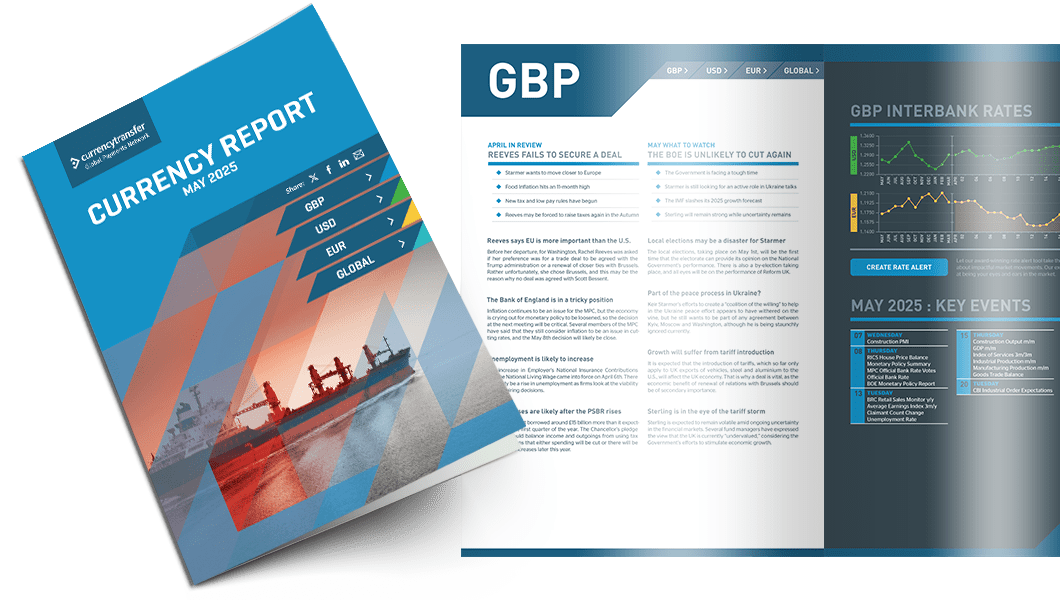
Read our latest currency report
Most impactful events planned this month and how they could impact your business
Warsh’s idea of a deal with the Treasury is causing concern
“Households had very different experiences with gasoline spending” in the wake of the war in the Middle East, which has roiled global supply chains and sent the price of gasoline surging, analysts at the New York Fed wrote in a report published yesterday.
In March, wealthier households were able to increase spending to offset higher gasoline prices while keeping their real consumption levels steady. In contrast, low-income households saw nominal spending surge while real gasoline consumption decreased, the report said.
Lower-income households may have responded to the energy price surge by moving to less costly options, “potentially by carpooling or substituting to public transit where available,” the report said.
It noted that the current experience echoes the last energy price shock, seen four years ago when Russia invaded Ukraine, but that the gap in consumption trends across income levels is now “quantitatively larger.”
American households are facing considerable pressure from surging gasoline prices, which are pushing inflation from already high levels.
The bank's findings on energy costs are part of a broader series of studies examining the divergent fates of the top and bottom ends of the American income spectrum. Last week, analysts wrote that the wealth of higher-income Americans has outpaced that of others, as lower-income households have been more heavily affected by inflation.
Fed Chair Elect Kevin Warsh is still facing questions about Central Bank independence as he prepares to be sworn in, possibly as soon as early next week.
Warsh’s nomination was approved by a 13-to-11 vote, strictly along party lines, with Republicans supporting the nomination, setting up a confirmation vote in the US Senate in the coming days.
All 13 Republicans on the panel voted in support of Warsh after Thom Tillis, a North Carolina senator, dropped his opposition following the Department of Justice’s decision on Friday to end a criminal investigation into Powell that Tillis viewed as a threat to the Fed’s political independence.
The panel’s 11 Democrats, who say they doubt Warsh’s promise to set policy without regard to the president’s wishes, voted against.
The release of transcripts of Federal Reserve rate-setting meetings, a cornerstone of its transparency for more than 30 years, undermines the debate needed to set sound monetary policy, incoming U.S. central bank chief Kevin Warsh says in an upcoming book. These remarks echo his broader desire to overhaul the Fed.
Warsh, in an interview with New York University Stern School of Business Professor Simon Bowmaker, advocated limiting taped sessions and published transcripts to a final "decision round of discussions" where officials can set out the rationale for their policy votes.
Policymakers "do not want to appear wrong with the benefit of hindsight, and so they instinctively tend to hedge their bets" when their comments are taped for release, Warsh told Bowmaker for his book, "Fed Reckoning: Conversations on America's Central Bank," to be published early next year.
Warsh, who served as a Fed governor from 2006 to 2011, went into detail about a study he conducted for the Bank of England, where "as a result of the work I did in 2014, the recording device has been turned off" for the initial round of policy meetings to allow for more free-flowing discussions, while offering more public disclosure of the actual policy votes by releasing transcripts of the day-two proceedings.
"The tape recorder, however, still looms large at the Federal Reserve. If we want that deliberation to be robust, we need a family fight. If people think the decision is 60–40 one way, I would prefer it to seem to the outside world that it was 95- 5, Warsh commented. This would allow committee members more freedom to express genuine concerns.
In the here and now, FOMC Member and St. Louis Fed President Albert Musalem told reporters yesterday that "Inflation is running meaningfully above our target. We have risks on both the employment and inflation sides. In my understanding, risks have been shifting towards more risks on the inflation side."
The situation, Musalem said, is at the point where the Fed's policy rate of interest may have to stay on hold until it is clear that inflation is returning to the central bank's 2% target. However, there are also "plausible scenarios" under which the Fed could cut rates and under which it would have to hike them.
The dollar index fell in early trade yesterday, touching its medium-term support level, as traders reacted to news that a peace deal between Washington and Tehran may be close. As those hopes faded, the index rallied to close at 98.03.
The German Economy Minister is worried about looming new US tariffs
Business analysts noted that demand conditions were hit hard, with total new business falling at the quickest pace since November 2024.
As economic conditions take a knock, we're also seeing inflation pressures creep higher in April. S&P, which compiled the data, commented. The rate of inflation accelerated further to a 40-month high, reflecting a broad-based quickening across sectors. Meanwhile, prices were subsequently raised more aggressively, marking the sharpest increase in three years.
“The prospect of interest rate hikes is also front of mind among many financial service providers, hitting real estate activity in particular. However, how the ECB responds to the sharp rise in inflation being signalled by the PMI will have a key bearing on the economic outlook well beyond real estate.
The concern is that, with business growth expectations already down sharply since the war started, higher interest rates will exacerbate this initial slump in sentiment."
Meanwhile, several senior German officials have publicly warned that looming U.S. tariffs could inflict serious economic damage on Germany’s export-driven economy: Lars Klingbeil, the finance minister and vice chancellor, has repeatedly stressed that the new U.S. tariff threats, ranging from 25% to 50% on EU goods, pose a direct risk to German industry and jobs. He argues that the tariffs would hurt both sides, raising U.S. consumer prices while undermining German exporters.
Klingbeil has also said that Germany and the EU must prepare countermeasures if Washington proceeds, though he still prefers negotiation to escalation.
The German government is particularly concerned because the U.S. is Germany’s largest non-EU export market, and the threatened tariffs target sectors already under pressure: autos, machinery, pharmaceuticals, and steel.
Several authoritative sources point to a deteriorating mix of slowing growth and rising inflation, the classic stagflation setup. The war in the Middle East has pushed oil and gas prices sharply higher, lifting inflation across Europe.
The ECB notes that this shock is already eroding purchasing power and weakening demand, while Eurozone private-sector output fell to a 10-month low, with the PMI dropping to 50.5. Economists warn that this combination of rising costs and stalling activity is “ringing stagflation alarm bells.”
Finally, the IMF has cut its 2026 Eurozone growth forecast to 1.1%, citing the energy shock and weaker investment and consumption. It explicitly warns that rising prices and weaker activity are pushing the region towards a more stagflationary environment.
The euro rose to a high of 1.1796, within a whisker of its medium-term resistance level, as it reacted to a strengthening risk appetite. The single currency encountered significant sell orders near 1.1800 and subsequently fell back to close at 1.1747. at 1.1747.
Have a great day!

Exchange rate movements:
06 May - 07 May 2026
Click on a currency pair to set up a rate alert
Alan Hill
Alan has been involved in the FX market for more than 25 years and brings a wealth of experience to his content. His knowledge has been gained while trading through some of the most volatile periods of recent history. His commentary relies on an understanding of past events and how they will affect future market performance.