Get bank-beating rates — zero hidden fees
Join 10,000+ clients transferring salary, property deposits and business payments globally.


Residency and Visa Requirements in Post-Brexit Spain
Since Brexit, UK nationals have to follow Spain's general immigration regime. UK nationals entering Spain after 1 January 2021 are considered third-country nationals and must comply with the normal Spanish immigration laws. In practice this means UK citizens can no longer move to Spain with just a passport alone. For any stay longer than 90 days (per 180-day Schengen rule) you'll need the appropriate long-term visa or permit. The UK Foreign Office similarly advises British nationals to make sure they meet the entry requirements for Spain and to check which visa or residence permit is needed to live there.
Spain offers multiple residence routes. For example, you can apply to study, retire, work (including as a digital nomad), join family, or volunteer. Each has different rules. Common paths for UK movers are:
Work and Skilled Visas
If a Spanish employer hires you (a non-EU worker), they must obtain a work permit on your behalf. Alternatively, highly-skilled professionals might apply for the EU Blue Card.
Self-employed or Business Visas
Spain has an entrepreneur visa for innovative businesses (you need a solid business plan and proof of funds) and other permits for freelancers. (Note: Spain's famous "Golden Visa" – residence for €500,000+ property investors – was abolished on 3 April 2025, so that route is no longer available for new applicants.)
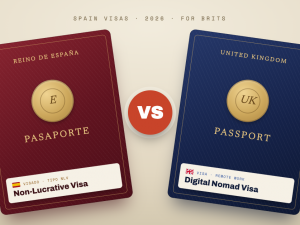
Non-Lucrative (Retirement) Visa
If you are retired or have passive income and don't plan to work in Spain, you can apply for a non-lucrative residence visa. This requires proving you have sufficient funds – based on 400% of Spain's IPREM index, currently around €28,800 per year (about €2,400/month) for one person – to support yourself without employment.

Digital Nomad Visa
For remote workers and online freelancers, Spain now offers a Digital Nomad Residence Permit. Applicants must be non‑EU nationals earning abroad. The income requirement is high – 200% of Spain's minimum wage (SMI). Following the February 2026 minimum-wage increase, this means you must demonstrate roughly €2,849 per month (≈€34,188/year) in qualifying earnings. (This rises automatically each year as the minimum wage increases.) Other conditions include having a contract or client base overseas, health insurance and a clean criminal record. Note also Spain's "Beckham Law" (a special flat 24% tax on earnings up to €600k) may apply for eligible employed digital nomads for up to six years.
Residency Status for Existing UK Expats
However, if you were residing in Spain before Brexit (until January 2021), you are protected by the withdrawal agreement — you may register yourself as a Spanish resident based on special regulations. If you fall into this category, you would likely have already obtained the green EU registration certificate or the TIE (Tarjeta de Identidad de Extranjero). The Spanish authorities advise exchanging all of your old green certificates for TIE cards which would serve as a valid proof of your residence status. With a TIE card, there is no need to register yourself with the new EU Entry/Exit System (EES). In summary, UK expatriates residing in Spain prior to Brexit must maintain their residence documents up to date (renew them upon expiration) and reside/labor in Spain according to the provisions of the Withdrawal Agreement.
The newcomers (people arriving after 2021) follow the same procedure applicable to all other non-EU citizens. In particular, one must register with Spanish authorities, obtain an NIE (Foreigner's ID number) and visa before travelling to Spain (issued by a Spanish consulate) and apply for a TIE card in Spain. New residents should register at their local town hall (padrón municipal) as well as apply for a TIE card to immigration authorities. You must also apply for any long-term visa or work permit in advance.
Reasons for Stricter Spain Migration Policy
Recently, the government of Spain has taken measures aimed at combating real estate speculation, as well as easing the shortage of housing in the country. For instance, the government canceled the Golden Visa program, allowing foreign property buyers to obtain Spanish residency on 3 April 2025. This program was openly accused of increasing the price of houses by the prime minister of Spain Pedro Sánchez, directly stating that it prevents locals from buying homes. As a result, people with a Golden Visa approved before April 2025 can maintain it and apply for renewal, but new applications will no longer be considered under this program. UK movers in 2026 would therefore be restricted to the usual visas such as the work visa, non-lucrative visa, etc.
Financial and Tax Considerations
When relocating, money matters are paramount. Spain uses the euro, so you will need to exchange pounds sterling. Using an online FX provider or specialist money transfer service can save thousands compared to bank rates. (For example, CurrencyTransfer offers mid-market rates and is tailored to large transfers like savings, property deposits or pension funds.) You will also want to open a Spanish bank account for day-to-day living, which typically requires your passport, NIE and proof of address. Major banks (Santander, BBVA, CaixaBank, etc.) all offer accounts to foreigners, though requirements can vary by branch.
Tax residence rules are crucial. Under both UK and Spanish domestic law, spending more than 183 days in a year in that country generally makes you tax resident there. In practice, if you move to Spain and spend more than half the year there, Spain will tax your worldwide income, and the UK will generally cease taxing your salary. A double-tax treaty between the UK and Spain ensures you won't pay income tax twice. Typically, your employment income is taxed only in Spain if you're resident there. (For example, if you work remotely for a UK company while living in Spain, that salary is generally taxed in Spain.) UK-source income like property rents or pensions may be taxed in the UK and relieved in Spain. It's important to notify HMRC when you leave and claim split-year tax treatment if applicable. Retirement pensions (including the UK State Pension) can be paid into a Spanish bank and will generally be subject to Spanish tax laws (the treaty allows credit for UK tax already paid on certain pension types).
Overall, the overriding principle is that you should not be taxed twice on the same income – you will simply become liable for the Spanish rates as a resident. Note that Spain's tax rates are higher than the UK's for most brackets: the top Spanish rate is 47% vs 45% in the UK. However, Spain allows certain deductions and has exemptions for pensioners over 65, etc. (Anyone planning retirement should seek expert advice on the best way to draw pensions.) Importantly, you should register as a Spanish tax resident to comply fully with Spanish tax law.
Employment, Self-Employment and Income
If you plan to work in Spain, the local job market and salary levels may differ from the UK. Spanish average wages are much lower than in Britain – around €31,600–€32,700 per year in 2025 (INE data). (By contrast, the ONS's Annual Survey of Hours and Earnings put the UK median full-time salary at £39,039 for April 2025 – roughly €45,000, not the higher figures sometimes quoted.) This reflects Spain's generally lower cost of living. Housing, groceries and dining out can be significantly less expensive than the UK – although major cities like Madrid and Barcelona are catching up to northern Europe.
If you are hired by a Spanish employer, you'll need a work permit and will enter the Spanish social security system. Salaried employees pay social security contributions (around 6% on top of income tax) and receive healthcare cover under the public system. (As a new resident you should apply for a social security number once you begin work.) Self-employed professionals must register as autónomos (with employee and self-employed social security contributions that can add up to around 30% of income) and can deduct business expenses.
Remote workers earning in pounds or dollars can benefit if they keep earnings in foreign currency and convert carefully. For example, if you transfer rental deposit or savings into euros, compare providers – banks often charge poor rates, while specialist brokers or peer-to-peer services usually give the mid-market rate plus a small fee. Platforms like CurrencyTransfer allow transfers in multiple currencies at transparent rates.
Living Costs, Accommodation and Lifestyle
Finding accommodation is a key step. Rental and purchase markets are dynamic: after a pandemic dip, prices have been rising again in many areas. Compared to the UK, housing in Spain is still relatively affordable in most regions, but major tourist regions (Costa del Sol, Balearics, Canary Islands) can be pricey. Expect to pay a sizable deposit (often 2 months' rent) plus the first month for rentals. If buying, be aware of Spanish closing costs (typically 6–10% of price in taxes and fees).
Healthcare
Healthcare is excellent but structured differently. If you qualify for a UK state pension or are a retiree, you may be able to register for Spanish public healthcare via an S1 form. Otherwise, foreigners often maintain private health insurance (required to obtain a long-stay visa such as the Non-Lucrativa or Digital Nomad visa). Insurance premiums vary by age; budget roughly €500–€1,000 per year for basic private cover. Once you're on the Spanish social security system (through work), you will gain public healthcare access.
Driving
Since a March 2023 bilateral agreement between Spain and the UK, British residents can exchange a UK driving licence for a Spanish one without taking a Spanish driving test, provided the exchange is completed within 6 months of becoming a resident. Missing that window means you'll need to sit the Spanish theory and practical tests instead – so it's worth booking your DGT appointment promptly.
Education
If you have children, note that local schools teach in Spanish; there are private international schools in big cities but they can be costly. Cultural adaptation is generally smooth – many Spaniards speak English in urban/tourist areas, and there is a large British expat community for support. Learning some Spanish will greatly improve daily life and integration.

Getting Settled in Spain
In summary, moving from the UK to Spain in 2026 is entirely feasible but requires careful planning. Start early by researching the right visa category and gathering documents (proof of income, health insurance, police clearance certificates, etc.). Use official channels (Spanish consulates or the Ministry websites) to apply.
Arrange your finances: open a Spanish bank account (you will need your passport and NIE) and plan large currency transfers through a reputable FX provider for the best rates. Register promptly once in Spain – get on the padrón (local register), apply for your TIE card and, if you're working, your social security number. Make sure to inform HMRC of your move and understand the tax implications of dual residency.
Above all, do not underestimate the paperwork: Spain's bureaucracy can move slowly, so budget extra time for processing. Despite this, the quality-of-life rewards – warm climate, good healthcare, vibrant culture – make Spain an attractive choice for UK expats. The key steps are: plan your visa, secure accommodation and healthcare, sort out your money (use mid-market currency transfers), and immerse in Spanish life. For digital workers, the CurrencyTransfer digital nomad guide has more on the visa and taxes. With preparation and the right support, settling in Spain can be a rewarding adventure.
If you’re looking for an efficient solution to transfer currencies into various countries, take a look at our platform: CurrencyTransfer offers access to a network of payment providers, live quotes and 5-star customer service. Sign-up today.
Caleb Hinton
Caleb is a writer specialising in financial copy. He has a background in copywriting, banking, digital wallets, and SEO – and enjoys writing in his spare time too, as well as language learning, chess and investing.