What is an IBAN number?
An IBAN is a standardised way to identify a bank account and used to facilitate the processing of cross-border transactions without error. IBAN stands for 'International Bank Account Number'.
What does an IBAN look like?
This is a sample format of a UK IBAN: GB 29 NABK 6016 1221 9458 18
IBAN Format
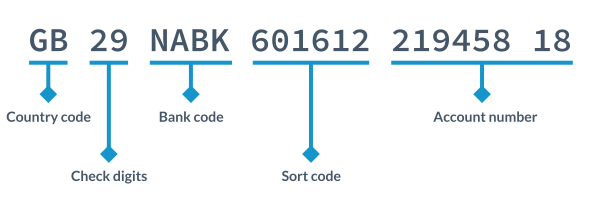 The IBAN Format – consisting of country code, check digits, bank code, sort code and the account number
The IBAN is made up of 34 characters, comprising a country code, two check digits, a bank code, a sort code and an account number. The check digits are used to enable a check of the bank account number to confirm its integrity before submitting a transaction. Each bank will have a unique bank code to identify where the transaction is coming from.
| Bank Name | IBAN Bank Code |
| Barclays | BUKB |
| HSBC | HBUK |
| Lloyds | LOYD |
| NatWest | NWBK |
| Santander | ABBY |
| Metro Bank | MBTC |
How do I find my IBAN?
Your IBAN is easy to find, but different banks will have different methods of locating it. You will likely find your IBAN:
- At the top of a bank statement
- In Online Banking under ‘Account details’
- Via an IBAN calculator
IBANs are always used together with a Bank Identifier Code (BIC) – which identifies bank and branch number. Your BIC can be found in the same way as an IBAN Be sure to have your recipient’s IBAN and BIC details when making an international payment. On your CurrencyTransfer‘s personal dashboard, you can store these details very easily by just clicking on the recipient tab.
When was the IBAN created?
The International Bank Account Number (IBAN) was created in 1997. It was adopted by the European Committee for Banking Standards (ECBS) based on the international standard ISO 13616. Before the IBAN system was created, there was a lot more confusion and eror when it came to differing national standards for bank account identification. In short, there was no standardised system for cross-border banking transactions. The creation of the IBAN allowed for a more effective standard in identifying banks and transactions when sending money abroad.
Is an IBAN your bank account number?
No. An IBAN is a longer code that includes your bank account number, but has extra numbers and letters, such as the country of origin and the bank code. Your bank account number will be part of the IBAN but not the same as the IBAN.
Do all bank accounts have an IBAN?
Not all bank accounts have an IBAN. If a bank account is not set up for international bank transfers, then it will not have an IBAN. In the UK, and the EU, most personal and business accounts for major banks will have an IBAN by default, so make sure to check your account details.
Start using CurrencyTransfer today
To avoid losing out on large sums of money due to high exchange rates, start using our international bank transfer platform. We offer better exchange rates on larger transfers with a streamlined, simple and generally improved experience for carrying out global transactions.