Highlights
- Downbeat forecasts raise the chance of an upside surprise
- The economy grew this summer thanks to business and consumer spending
- Lagarde resigns early as ECB President
Get bank-beating rates — zero hidden fees
Join 10,000+ clients transferring salary, property deposits and business payments globally.


Did the UK really need a ‘micro budget’?
The Budget has been labelled ‘steady as she goes’, but such a state of affairs is only acceptable in an economy performing at least adequately, which, according to the Institute for Fiscal Studies, Britain is not.
Chancellor John Healey said his Budget offered "breathing space", but the government could "never remove completely" cost-of-living pressures.
The UK's official forecaster said its latest economic forecast painted a "pretty grim picture".
The Office for Budget Responsibility blamed the UK's difficult financial situation on higher borrowing costs and inflation caused by the US-Iran war.
In response to rising energy prices, Healey has announced measures, including a £100 support payment, to ease pressure on household finances.
But the Resolution Foundation said that wouldn't offset the impact of higher energy bills.
"This parliament is increasingly looking like one of two halves," said the think tank's chief executive, Ruth Curtice.
"The first half has been marked by rising living standards, solid economic growth and extra funding for public services," she said.
However, the second half of the parliament would be "tough going", she said.
Opposition parties' criticism is ‘par for the course’ in the hours and days after the Budget's delivery, but one phrase from Kemi Badenoch summed up Parliament’s view. It lacked boldness and left MPs from both sides of the House wanting more, which may suit 1950s variety acts but not a Chancellor of the Exchequer.
Next week, the Bank of England is widely expected to hike the base rate, adding more to households' mortgage bills as inflation remains well above its 2% target.
A senior executive at Lloyds Banking Group has criticised a hike in bank taxes as “unhelpful” to UK economic growth, urging the Government to keep it temporary.
Chief financial officer William Chalmers responded to a planned doubling of the bank’s corporation tax surcharge announced in Wednesday’s autumn Budget.
Mr Chalmers said the bank “recognises the fiscal constraints” facing the Government, but added that it is “ultimately important that we do what we can to reduce the cost of lending for the economy to grow, and of course that travels through to the cost of borrowing”.
He said: “Additional taxes are unhelpful to achieving both of those objectives: UK growth or international competitiveness.”
“We take it for what it is, but we do sincerely hope that it is indeed limited.”
Chalmers’ pleas are likely to fall on deaf ears, as they come the day Lloyds reported a near-doubling of its third-quarter 2026 profits.
Sterling had a positive session, finishing stronger against the dollar as markets looked beyond the Fed's hawkish rhetoric and focused on the absence of an actual rate hike. The pound was one of the better-performing major currencies, supported by a softer dollar.
Use our currency tracker tool
Let us be your eyes and ears in the currency exchange market
Is AI investment sensitive to interest rates? Warsh says yes, but others disagree
The Personal Consumption Expenditures price index, the Federal Reserve's preferred inflation gauge, rose 0.5% month on month in September, the largest gain since March. Year-on-year, PCE inflation climbed to 3.6%, the highest since May. Both readings were in line with economists' expectations.
Prices for petrol and other energy goods surged 9.2% from August, as the war in Iran and restrictions on shipping through the Strait of Hormuz kept fuel costs elevated. Goods prices rose faster than in August, while services prices rose steadily.
Excluding volatile food and energy, the core PCE price index rose 0.3% month on month in September, the same pace as the revised August reading. Core PCE inflation rose 3.1% year on year, up from 3%.
Inflation has now run above the Fed's 2% target for more than five years, and September's data pushed it further from that goal.
US consumer spending rose 0.5% in September, slowing from August, the BEA said. Adjusted for inflation, spending was unchanged, as higher prices absorbed the gain.
Personal income rose 0.2%, slower than in August and below the increase in prices. With households still spending, the personal saving rate fell to 3.8%, the lowest in nearly four years.
The report came a day after the Fed left its benchmark interest rate unchanged at 3.75% to 4% and acknowledged that inflation "remains elevated." The decision followed a quarter-point rate hike in September.
Financial markets continued to expect another move this year. Traders were pricing in more than an 80% chance of a rate hike at the Fed's December meeting, according to CME's FedWatch Tool.
Meanwhile, economic growth picked up over the summer. Business investment surged, driven by the artificial-intelligence build-out, and consumers kept spending at a healthy rate despite high energy prices and other affordability concerns.
The Commerce Department said yesterday that US gross domestic product, the value of all goods and services produced across the economy, rose 3.4% in the third quarter. That figure is seasonally and inflation-adjusted.
It was the fastest pace in a year and beat analysts’ 3.1% expectations.
The report is the last major reading on the US economy before Tuesday’s midterm elections. The numbers add to evidence that, despite tariffs, an immigration crackdown and high energy prices, the US economy remains on solid footing.
Federal Reserve Chairman Kevin Warsh said he disagrees with the view that Fed rate hikes won't affect investment in artificial intelligence, given strong demand for AI and the high returns investors expect.
"I was sceptical of that view," Warsh said at a press conference on Wednesday after the central bank decided to hold benchmark rates steady. "Interest rates get in the cracks. Interest rates affect almost everything, directly or indirectly."
The issue was first raised last month, when a Wall Street fund, in a post on X, expressed its scepticism that higher rates would reduce demand and investment in AI.
"What if higher rates don't reduce demand and investment because the demand for intelligence and energy is unaffected by higher rates, because winning the race for super intelligence has a near-infinite ROI, and the demand for computers will remain incalculable," a note to investors said. "What if the old models don't apply to the current paradigm?"
The dollar's underlying fundamentals remained constructive following a hawkish Fed message. Still, in daily price action, it failed to extend its gains and generally traded softer, particularly against sterling, as markets focused on the absence of immediate and potential rate differentials.
The ECB flags December hike but sees yield rise hitting growth
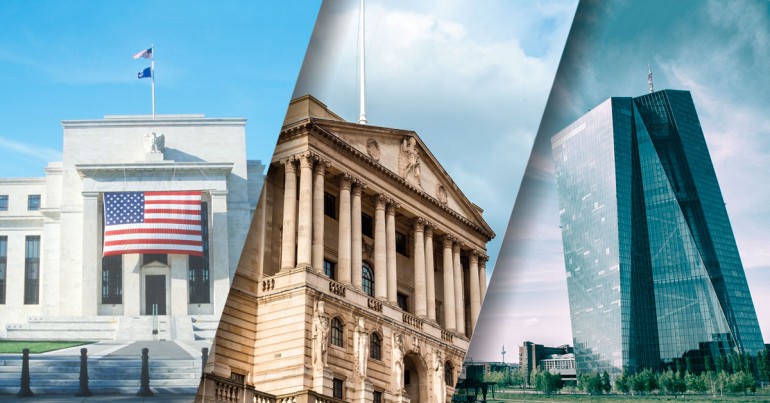
Lagarde will step down as President of the European Central Bank on 7th February 2027, ending her tenure early and prompting negotiations among European Union governments over one of the continent’s most influential economic (and political) appointments.
The ECB announced the decision yesterday, before its Governing Council left interest rates unchanged despite renewed inflationary pressure linked to rising energy prices.
Some had expected Lagarde, who has led the institution since November 2019, to remain in office until October. Her departure will therefore bring forward a succession contest that had already attracted considerable attention in European financial and political circles.
Speaking after the announcement, Lagarde said she wanted more freedom to address issues beyond monetary policy, arguing that the restrictions placed on her leadership at the central bank prevented her from contributing publicly to broader debates.
Her explanation leaves open questions about the political consequences of her departure, particularly as EU governments prepare for difficult negotiations over the institution’s future leadership.
While leaving interest rates unchanged yesterday in a well-telegraphed move, the ECB clearly hinted at another hike in December, warning that high and rising energy costs were fuelling inflation risks.
The ECB has hiked rates twice this year to prevent an Iran war-induced energy price jump from becoming entrenched, and has signalled that more may be needed, even if it was not in a hurry without evidence of dangerous second-round inflation effects.
In a decision published hours after ECB President Christine Lagarde announced she would step down early, the ECB warned that inflation risks were skewed to the upside after a recent surge in oil and gas prices.
Lagarde went further in her post-meeting press conference, saying the direction of travel for rates was clear and that policymakers debated a hike on Thursday before agreeing to wait until December to gather more data.
"The interim meeting period will be information-rich," Lagarde said. "That will actually help us determine whether the situation that we see now, which could have warranted a hike, is going to be confirmed, and in that case the sense of direction is quite clear."
A hike on December 17 is now all but certain given the surge in energy prices, but policymakers are expected to pause thereafter in light of a recent sharp rise in market-based borrowing costs.
Before Lagarde’s departure, ECB hawk Isabel Schnabel will attend her final Governing Council meeting on December 17, allowing her to leave on a suitably hawkish note.
ECB estimates circulated before Thursday's meeting showed that the latest increase in bond yields would lower economic growth by a cumulative 100 basis points and inflation by 90 basis points in 2027-28 compared to the September baseline projection.
The euro modestly outperformed yesterday, edging higher against the dollar as initial post-Fed support for the greenback faded. The single currency's gains were driven more by dollar weakness than by any significant Eurozone catalyst.
Have a great day!

Exchange rate movements:
28 Oct - 29 Oct 2026
Click on a currency pair to set up a rate alert
Alan Hill
Alan has been involved in the FX market for more than 25 years and brings a wealth of experience to his content. His knowledge has been gained while trading through some of the most volatile periods of recent history. His commentary relies on an understanding of past events and how they will affect future market performance.