
Highlights
- Manufacturing PMI shows its fastest output growth in two years
- ISM Manufacturing strengthens in October, exceeding expectations
- German retail sales decline unexpectedly
Get bank-beating rates — zero hidden fees
Join 10,000+ clients transferring salary, property deposits and business payments globally.


Burnham suffers Budget blow as voters savage Healey’s measures
The S&P Global Purchasing Managers' Index for British manufacturers rose to a five-month high of 52.8 in October, up from 51.9 in September, in line with an earlier flash estimate. The output component, sometimes seen as a better gauge of underlying conditions, rose to 53.6 from 51.5, its highest since September 2024. "Rates of growth in output and new orders both gathered pace in October, as companies responded to signs of improving demand in both domestic and overseas markets, including new work received from mainland China, the EU and the US," said Rob Dobson, a director at S&P Global Market Intelligence.
Manufacturers' input costs rose at the fastest rate since June and at one of the fastest paces since the last big surge in British inflation in 2022. Expectations for future output showed the biggest improvement since November 2025.
Growth in new orders was the strongest since July, and employment growth in the sector ground to a halt after six months of sometimes modest expansion, which firms, especially smaller manufacturers, blamed on high staff costs and the squeeze from rising input prices.
The most recent official data shows manufacturing output rose by 3.0% in the 12 months to August, the biggest increase since March 2024. S&P's data was collected from October 12-27, before finance minister John Healey's first Budget, which largely spared businesses from tax increases but announced a 3.9% rise in the minimum wage for next year.
After more than three years of holding or cutting, the Bank of England appears set to remind markets that rates can rise, with investors and most analysts expecting the Monetary Policy Committee (MPC) to lift Bank Rate by 25bps to 4% from 3.75% when it announces its decision at 12 pm this Thursday.
Governor Andrew Bailey has said the likelihood of a hike increases the longer energy prices remain elevated. At the same time, MPC member Megan Greene has openly argued for tightening, warning that the risk of the energy shock feeding into broader inflation is greater than expected.
The minutes and the Monetary Policy Report arrive at the same time, giving investors and traders plenty to digest over lunch.
The Bank’s July projections look somewhat optimistic in hindsight. UK CPI rose to 3.5% in September from 3.1% in August, its highest in 11 months, above the consensus forecast of 3.4% and the BoE’s projection of 3%, with higher petrol and diesel costs linked to the Iran conflict doing most of the damage.
There was a more awkward detail beneath the headline: services inflation climbed to 3.7% from 3.4%, core inflation rose to 2.8% from 2.6%, and factory gate prices increased 4.6% YoY, the biggest rise since April 2023, while manufacturers’ input costs jumped 8.3%, suggesting more pressure is still working its way through the pipeline.
Economists are already looking past Thursday’s meeting to decide whether and when the next hike will take place. The current consensus suggests the next hike would most likely come in February 2027, rather than immediately in December. Several research firms, including MUFG, RSM UK, UBS and JPMorgan, have pointed to a November-February hiking sequence, taking rates to around 4.25%.
Current economist forecasts suggest 4.25% would likely be the peak if the BoE hikes this week and again in February. Several forecasters explicitly expect a November hike to 4.00% followed by a final move to 4.25%, then a pause.
John Healey’s first Budget was a flop with the public, who saw it as "tinkering" and do not believe it will help with the cost of living, cut energy bills, or provide enough funding for defence. Voters also believe the Prime Minister is focusing on what is popular rather than what is right for the country.
More in Common delivered a brutal verdict on last week's Budget, the first since Burnham and Healey entered Downing Street, in a new poll. It found that 60% of voters agreed the Budget "tinkers with small things around the edges", while just 14% said it dealt with big, structural issues.
38% believed the Government was bringing down energy costs, 40% disagreed. Just 27% believed Burnham and Chancellor Healey were cutting the cost of living, with 51% disagreeing.
And 24% said the Labour Government was improving Britain's defence and security, with 42% disagreeing.
Sterling was among the best-performing major currencies in global foreign exchange markets yesterday, outperforming both the US dollar and the euro. The pound rose about 0.4% against the dollar to 1.3429, making it the strongest-performing G10 currency of the day.
The main driver was growing confidence that the Bank of England will raise interest rates this week, with money markets fully pricing in a November rate hike and expecting a further increase early next year.
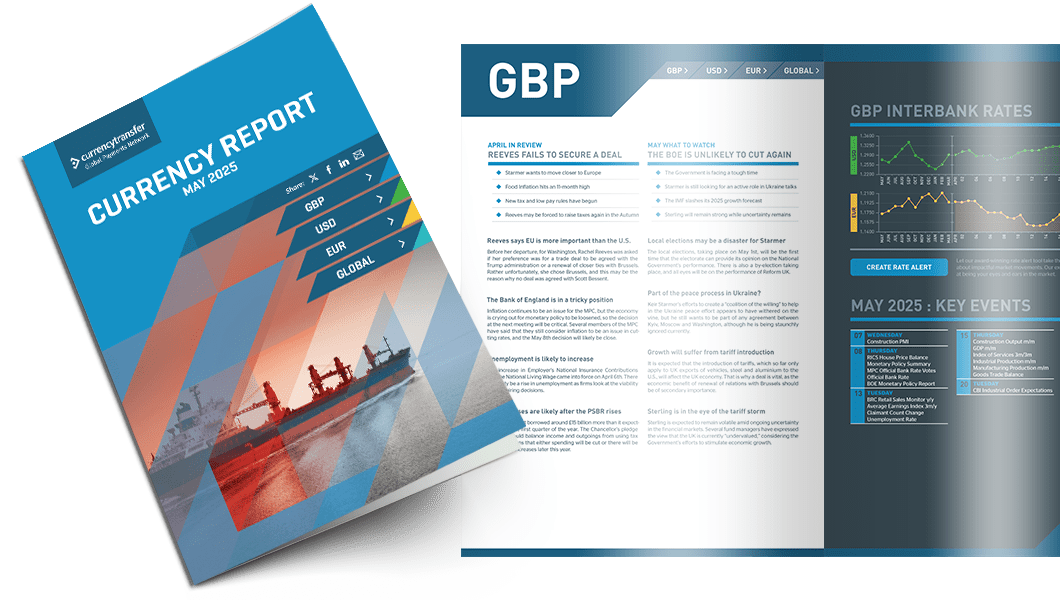
Read our latest currency report
Most impactful events planned this month and how they could impact your business
Fed plan for fewer policy meetings could bring more market whiplash
For Democrats, a strong performance would signal support for their economic agenda and could strengthen their ability to pursue fiscal priorities over the next two years. For Republicans, gains would provide a platform to challenge the administration's approach to spending, taxation and regulation ahead of the 2028 presidential race.
Beyond the political implications, financial markets will focus on what the result means for fiscal policy, government borrowing and legislative gridlock. Ultimately, the outcome may shape Washington's policy direction long after the votes are counted.
The 2026 midterms could also prove crucial to Donald Trump's political authority and his ability to govern for the remainder of his term. A strong Republican showing would likely be interpreted as voter endorsement of his economic and policy agenda, strengthening his hand in Congress and boosting confidence among supporters ahead of the next presidential contest.
Conversely, significant Democratic gains could constrain his legislative ambitions, embolden political opponents and increase scrutiny of his administration. Financial markets will focus on whether the result alters expectations for fiscal policy, taxation and government spending.
Ultimately, the midterms will be viewed as a referendum on Trump's leadership.
The Federal Reserve’s reported plans to reduce the frequency of policy meetings could increase volatility across financial markets. With fewer opportunities for policymakers to adjust interest rates or respond to unexpected economic developments, investors may be forced to wait longer for official guidance.
This could heighten uncertainty around inflation, growth and monetary policy, leading to larger market reactions when economic data are released. Bond yields, equities and the dollar could all experience sharper swings as traders attempt to anticipate Fed decisions.
Fewer meetings may simplify policymaking, but they also risk more speculation and market volatility between decisions.
The US ISM Manufacturing PMI rose to 55.5 in October from 54.5 in September, marking its 10th consecutive month of growth, according to data released by the Institute for Supply Management on Monday. The measure of manufacturing activity exceeded the 54.6 consensus.
"In October, U.S. manufacturing activity remained in expansion territory," said Susan Spence, chair of the ISM Manufacturing Business Survey Committee. "Of the five subindices that make up the PMI, four (new orders, production, supplier deliveries, and inventories) grew faster than the previous month, while employment growth slowed by 0.3%."
The US dollar was generally on the defensive yesterday as investors reduced exposure ahead of the US midterm elections and shifted focus to the potential implications for fiscal policy and government borrowing. Election uncertainty limited demand for the greenback despite relatively solid underlying economic data.
The ECB will act decisively to lower inflation if necessary
However, Makhlouf cautioned that he did not know whether it was legally possible for Mr Lane to serve another term on the ECB's executive board.
Last week, Christine Lagarde announced she would step down as ECB President in February, rather than serve her full term until October 2027.
Makhlouf said the names that had been mentioned so far "are all absolutely credible".
Speculation has focused on Dutch ex-central bank head Klaas Knot, Bank of Spain governor Pablo Hernández de Cos, and Bundesbank head Joachim Nagel as possible successors to Ms Lagarde.
Legislation underpinning the ECB says the term of executive board members "shall be eight years and shall not be renewable".
However, in a press conference last December, Ms Lagarde said the issue had come up on two occasions, and lawyers' view was that serving two terms was "not possible".
However, she added: "But I think the matter needs to be looked at again to ascertain what is possible."
Lane is increasingly seen as a potential dark horse in the race to succeed Christine Lagarde, despite the legal issues.
As the ECB's Chief Economist, Lane sits at the heart of monetary policymaking and has built a reputation as a pragmatic consensus-builder rather than a doctrinaire hawk or dove. His deep academic credentials, extensive central banking experience, and understanding of Eurozone dynamics make him a credible candidate.
However, questions remain about whether larger member states would support an Irish candidate for the ECB's top job. If policymakers prioritise continuity and expertise, Lane could emerge as a surprisingly strong contender.
The European Central Bank remains committed to restoring inflation to its target. It has repeatedly stressed that it stands ready to act decisively if price pressures prove more persistent than expected. Policymakers recognise that credibility is crucial, particularly as energy costs, wages and geopolitical developments continue to threaten the inflation outlook.
While the ECB must balance inflation concerns with fragile economic growth, its primary mandate remains price stability. As a result, officials are likely to maintain a firm policy stance and keep all options on the table if inflation shows signs of becoming entrenched across the Eurozone.
Yesterday, European Central Bank Vice President Boris Vujcic said that elevated artificial intelligence valuations are one of the prominent risks in the financial stability assessment.
Also speaking at the Central Bank of Ireland's Financial System Conference, Vujcic pointed out that the ECB currently does not see rising sovereign bond yields as "particularly dangerous," but added that movements can be non-linear and should be monitored.
"The geopolitical environment is unlikely to become any easier. But how well we absorb the shocks we face depends very much on the choices we make. Integration makes us more resilient, and resilience allows us to remain open," Vujcic concluded.
The euro delivered a mixed performance yesterday, benefiting from broad US dollar weakness but still facing headwinds from concerns about Eurozone growth and French fiscal developments. As investors reduced dollar exposure ahead of the US midterm elections, the single currency edged higher against the greenback, helping EUR/USD hold near 1.12.
However, the euro continued to underperform sterling. GBP/EUR rallied towards the upper end of recent ranges as expectations of a Bank of England rate hike contrasted with ongoing concerns about the Eurozone outlook. Market participants remained wary of French debt-market tensions and softer German economic data, both of which limited enthusiasm for the single currency.
Have a great day!

Exchange rate movements:
02 Nov - 03 Nov 2026
Click on a currency pair to set up a rate alert
Alan Hill
Alan has been involved in the FX market for more than 25 years and brings a wealth of experience to his content. His knowledge has been gained while trading through some of the most volatile periods of recent history. His commentary relies on an understanding of past events and how they will affect future market performance.


