
Highlights
- Fewer workers will go the extra mile with the growth of ‘quiet quitting’
- US factory orders rose 1.8% in September. The third rise in succession
- Eurozone countries urged to name candidates to succeed Lagarde
Get bank-beating rates — zero hidden fees
Join 10,000+ clients transferring salary, property deposits and business payments globally.


The PM insists he wants to reduce the welfare bill but will not put a number on it
Despite the name, quiet quitting does not mean leaving your job. It means doing what the job requires and nothing more: not taking on extra tasks, not checking email after hours, and putting work-life balance first, sometimes summed up as “acting your wage”.
UK productivity, the output produced per hour of work, slowed after the 2008 financial crisis and weakened again after the pandemic. The Resolution Foundation argues that less discretionary effort may help explain this. Its principal economist, Hannah Slaughter, said the trend was bad for workers and did not bode well for productivity and labour supply.
Earlier research points the same way. A 2023 London School of Economics study of more than four million data points on hours worked found that full-time workers put in 36 fewer hours a year after the pandemic than before it, with the biggest falls among Generation Z and graduates. The same researchers noted there may be no hit to productivity “if the hours are coming from unproductive activities like pointless meetings”.
The Bank of England increasingly appears set to join other G10 central banks in raising interest rates as inflationary pressures prove more persistent than expected. With wage growth firm and consumer demand resilient, policymakers worry price pressures could become embedded in the economy. Markets have steadily raised expectations for tighter monetary policy, particularly as several members of the Monetary Policy Committee have adopted a more hawkish tone in recent weeks.
A rate hike would bring the BoE closer to the stance of some global peers, who have prioritised inflation control despite concerns about slowing growth. Higher borrowing costs could weigh on household spending and business investment, but the Bank may conclude that maintaining credibility on inflation is the greater priority. For sterling, a move towards higher rates may provide support against major currencies, particularly if investors believe the BoE is committed to keeping inflation expectations firmly anchored over the medium term.
Making “brutal cuts” to welfare spending without considering the wider consequences is not the right way to address the ballooning benefits bill, the Prime Minister has said. Andy Burnham insisted he would “stick to my guns” on his approach to benefits, refusing to put a number on how much he wanted welfare costs to fall.
Chancellor John Healey found himself in the spotlight after the Budget, when he appeared to suggest that Labour would bring down the benefits bill ahead of a general election.
Treasury officials later backtracked on his remarks and refused to set a timeline for the commitment. Still, several Government figures lined up to insist Labour was serious about cutting the rising cost of welfare.
The Prime Minister faced scrutiny over reducing the benefits bill in an interview with ITN for a programme marking his first 100 days in office.
Asked how much he wanted to see the cost of welfare fall by, Mr Burnham told the broadcaster: “I come at it a different way. I want to talk about how many people I'm going to help into work. If you go at it with a number as you’ve just said, I think this is exactly what I was saying before about politics done the wrong way.
“And the changes I’m trying to bring, they’ve done that before: ‘Oh, we need to cut this amount’. And then straight away it’s into a kind of a cut agenda without really thinking through how you help people from where they are to a better position.”
He added: “If you come at it through that normal Westminster mindset of saying ‘we must cut x amount from the system’, well, it will fail again. And that’s what we’ve seen in politics in recent times.”
Sterling delivered a relatively resilient performance in global FX markets yesterday, trading in narrow ranges as investors avoided large positions ahead of both the US midterm elections and the Bank of England’s policy decision later this week. The pound was broadly unchanged against the US dollar, holding around 1.34, while edging slightly firmer against the euro and remaining close to its strongest levels in around eighteen months versus the single currency.
Support for the pound continued to come from expectations that the Bank of England is poised to raise interest rates, with markets anticipating further policy tightening over the coming months. However, uncertainty surrounding global risk sentiment, geopolitical concerns and upcoming political events limited stronger gains. Overall, sterling outperformed through stability rather than outright strength, supported by relatively hawkish BoE expectations and confidence in the UK economic outlook.
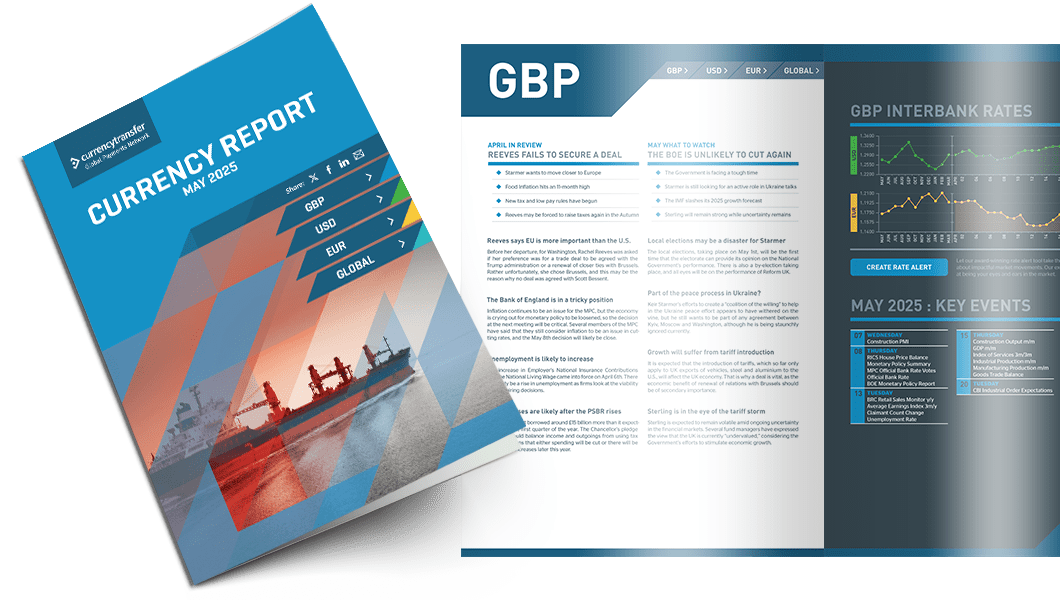
Read our latest currency report
Most impactful events planned this month and how they could impact your business
The economy is predicted to have gained 60k new jobs in October
In the Senate, results were still being finalised, but Democrats appeared well positioned after flipping several Republican-held seats, including North Carolina, South Carolina, Texas and Ohio. ABC News reported that Democrats were likely to win a Senate majority, while other outlets noted that control of the chamber had not yet been fully settled at the time of reporting.
The outcome reflects voter concerns over the economy, inflation and the broader direction of the country. Financial markets are now assessing the implications of a potentially more divided political landscape for fiscal policy, regulation and the remainder of President Trump’s term.
Trump's only comment so far has been that “I was not on the ballot, but if I had been we would have won a landslide”, posted on social media.
The economy is expected to have added around 60,000 jobs in October, a figure that would represent a marked slowdown compared with the stronger employment gains earlier in the year. While such a result would still indicate that the labour market is expanding, it would reinforce the view that higher interest rates and tighter financial conditions are beginning to weigh on hiring.
Investors will be watching the report closely because the labour market remains a key driver of Federal Reserve policy. A weaker-than-expected payrolls figure could ease concerns about inflationary pressures and reduce expectations of further monetary tightening. Conversely, evidence that wage growth remains firm could offset concerns about slower hiring.
The jobs data will also matter for financial markets, influencing Treasury yields, equity sentiment, and the US dollar. Ultimately, a gain of 60,000 jobs would suggest the economy is cooling rather than contracting, supporting hopes of a soft landing while highlighting growing signs of moderation in economic momentum.
Last Wednesday, the Federal Reserve said it was leaving rates unchanged while new information accumulated. What new information?
One obvious candidate: yesterday’s midterm election.
Politics were not at play, Chairman Kevin Warsh told reporters: “I just spent two days with my colleagues upstairs. I didn’t hear a single utterance about politics.”
But elections can influence your thinking even if you make your views clear. And a central bank can take political reality into account without being politicised.
The Fed has no rule against moving on the eve of an election, and it has occasionally done so. But if action isn’t urgent, it's better to wait until political passions have cooled.
Sensitivity is usually around presidential, not midterm, elections. But under President Trump, monetary policy has been politically sensitive 24/7. His acolytes accused then-chairman Jerome Powell of acting politically in cutting rates by half a point just before the 2024 election. The economic justification was rock solid. In office, Trump has repeatedly pressured the Fed to cut rates. He appointed Warsh expecting just that.
Does holding back on a rate increase compromise Warsh’s independence? Not after he presided over a unanimous vote to raise rates last month. True, that increase was justified by inflation and employment data. Still, if you had said a year ago that Trump’s handpicked Fed chairman would raise rates a few months into the job, you would have been called crazy. By doing so against Trump’s wishes in September, Warsh now gets the benefit of the doubt.
The US dollar traded in a relatively restrained manner across global FX markets yesterday, as investors focused on the outcome of the US midterm elections and awaited further economic data to guide the outlook for Federal Reserve policy. Political uncertainty prompted caution, limiting large moves across major currency pairs.
However, the dollar came under significant pressure overnight as investors reacted to strong Democratic gains in the US midterm elections. Markets interpreted the results as increasing the likelihood of political gridlock and constraining the administration's policy agenda. Improved risk appetite also reduced safe-haven demand, weighing heavily on the greenback.
Recent events show how much multinationals ‘depend on China’
Investors will scrutinise candidates for clues about how they might balance price stability with support for economic activity. A more hawkish candidate could strengthen expectations of tighter policy and support the euro, while a dovish contender may raise hopes of lower borrowing costs. With political and economic challenges mounting across the eurozone, the choice of the next ECB president could significantly affect financial markets and the region's economic outlook over the coming years.
A candidate with a less rigid view of monetary policy, prepared to respond to the ‘ebb and flow’ of data and global events, would be a more ‘market-friendly’ choice. Still, given the ‘players throwing their hats into the ring’, that prospect is unlikely.
Some evidence suggests that Kylian Mbappé's dispute with China will negatively affect the wider eurozone economy. So far, the reported effects have been concentrated in football, sponsorships, and media rights rather than in broader economic activity.
The controversy, which stemmed from comments about Mao Zedong, led several Chinese sponsors to end commercial relationships with Mbappé, while Chinese broadcasters and platforms restricted some football-related content. Reports also highlighted reputational damage for Real Madrid and La Liga in China.
However, the sources indicate only moderate consequences for eurozone GDP, trade, employment, or inflation. Analysts quoted in the coverage suggest the fallout is mostly a commercial and reputational issue affecting the player, associated brands, and Spanish, rather than French, access to Chinese audiences or the broader European economy. However, the Chinese are noted for their long memories.
Football’s global reach means a player’s country of residence matters more than his birthplace.
In short, the impact on the eurozone economy appears moderate, but it reminds us how dependent European brands and sporting organisations can be on access to the Chinese market.
The euro performed strongly in global FX markets yesterday, supported by a sharp decline in the US dollar following the US midterm election results. As investors reacted to significant Democratic gains and the prospect of greater political gridlock in Washington, demand for the greenback weakened, allowing the single currency to advance against its major counterparts.
The common currency also benefited from improving risk sentiment, with traders rotating away from traditional safe-haven assets. Market participants judged that a more ‘level’ US political landscape could make it harder to implement major fiscal initiatives, reducing a key pillar of recent dollar strength.
Despite ongoing concerns about eurozone growth and political developments in several member states, the euro's gains were driven primarily by dollar weakness rather than a significant improvement in the region's economic outlook. Overall, the single currency was among the better-performing major currencies during the session, as election-driven flows dominate FX trading.
Have a great day!

Exchange rate movements:
03 Nov - 04 Nov 2026
Click on a currency pair to set up a rate alert
Alan Hill
Alan has been involved in the FX market for more than 25 years and brings a wealth of experience to his content. His knowledge has been gained while trading through some of the most volatile periods of recent history. His commentary relies on an understanding of past events and how they will affect future market performance.


