
Highlights
- The City steps up opposition to a Healey bank tax raid in the budget
- Hiring slows, and unemployment ticks higher
- An AI debt glut is doing the ECB’s tightening work
Get bank-beating rates — zero hidden fees
Join 10,000+ clients transferring salary, property deposits and business payments globally.


BoE's Mann: “Markets Can't Replace Rate Hikes”
He said not everyone investing in AI would come out a winner, warning that some companies' asset prices could fall. “We could see some correction of asset prices at some point. Andrew Bailey said. “Everybody is currently priced to be a winner, but you look back at the past, that is unlikely and maybe not even possible.
“Google was not the first market leader in internet search. It was Netscape. Nobody can remember Netscape today. It does not exist.”
Bailey said AI had great potential to strengthen economic growth but also came with serious risks.
He said the Bank of England was keeping a close eye on the large sums of money flowing into AI companies.
He noted that AI chipmaker Nvidia has become the world’s most valuable listed company, with a market value of $5.5 trillion.
Bailey said that the huge sums being loaned to AI firms were pushing markets to value some of them as multi-trillion-dollar businesses.
He added that this level of investment carried risks, particularly if the big bets on AI did not pay off as investors expected.
Bailey said tech companies such as Alphabet, Meta, Microsoft and Amazon were also spending hundreds of billions of dollars on AI.
He noted that major AI companies, including Anthropic and OpenAI, were preparing to sell shares on the United States stock market.
“There is a very large amount of investment going into this sector now, and that is natural because it is a major area of growth. The next six months, as those companies ‘come to market’, will be critical for the financial as well as the AI markets”.
Some of Britain's leading business groups are mobilising to intensify their opposition to a Treasury tax raid on the banking sector in this month's budget, days before sector chiefs meet the chancellor in person for the first time.
Trade associations, including UK Finance, AFME and TheCityUK, have circulated a draft letter to John Healey, warning that increasing the tax burden on the banking sector risks driving business out of Britain without raising any additional revenue.
The CBI is said to have helped circulate the letter.
The draft version says, "While we recognise the challenging fiscal pressures facing the government, it is important to note that our industry already faces a higher tax burden than our key international competitors.
Further increasing that burden through any additional sector-specific measures would make it harder to channel finance and liquidity into businesses trying to invest and grow in the UK.
As well as criticising the Bank’s initial response to the war in Iran, MPC member Catherine Mann told a conference last week that market repricing alone cannot give markets confidence that the MPC is ‘on top’ of inflation.
“At some point, we need to follow through with base rate rises, to maintain credibility, and to avoid policy expectations repricing downwards and inflation expectations repricing further upwards,” Mann said on Thursday. “A risk-management approach to monetary policy is appropriate.”
Some BOE rate-setters have been reassured by tighter financial conditions since the US-Iran war began, with mortgage rates and broader borrowing costs rising sharply. They believe the sharp repricing in markets has bought them time, effectively weighing on demand even before the Central Bank has acted.
However, Mann remains concerned that conditions remain too loose to contain the inflationary spike caused by energy prices. She said real financial conditions are “insufficiently tight,” warning policymakers cannot let markets do the work for them.
Sterling weakened overall last week, driven primarily by broad US-dollar strength, soft UK data, and mounting fiscal concerns. Against the euro, losses were smaller, with GBP/EUR showing relative resilience. The pound fell about 1% against the USD. It hovered near multi-month lows against the EUR during the week, pressured by expectations of tighter US monetary policy, weak UK macro releases, and rising UK fiscal risk.
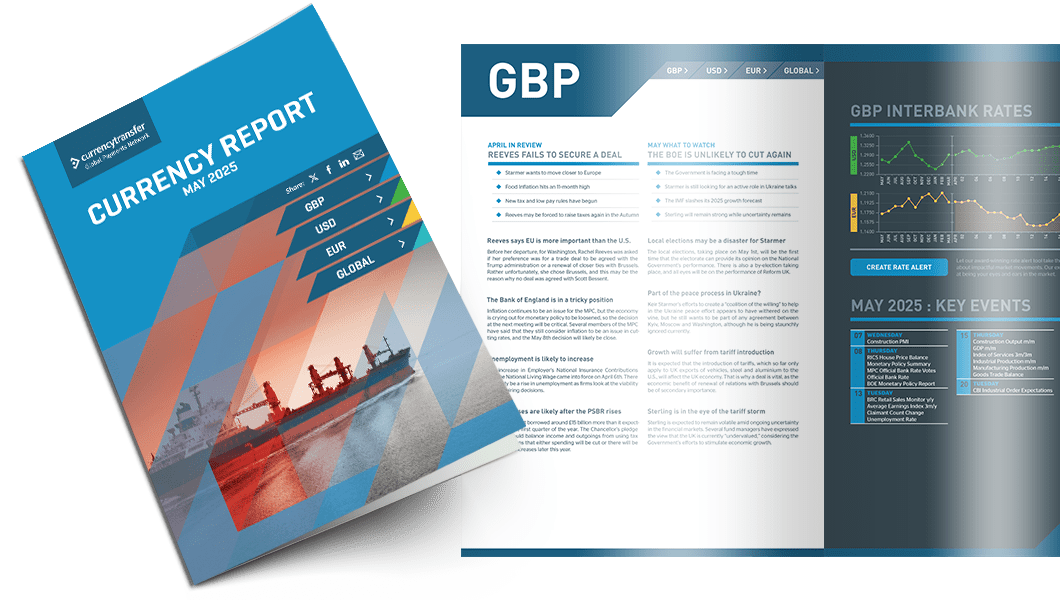
Read our latest currency report
Most impactful events planned this month and how they could impact your business
Bessent says the AI Industry must own its risks and engineer solutions
The Labour Department's closely watched employment report on Friday also showed the unemployment rate increased to 4.2% last month from 4.1% in August. The sharp moderation in job growth does not necessarily signal a sudden deterioration in labour market conditions.
Economists noted that payrolls tend to underperform when the Labour Day holiday falls late in September, as it did this year. There have been no signs of a broad increase in layoffs. First-time applications for unemployment benefits have been hovering at 57-year lows amid robust corporate profit growth and resilient domestic demand.
Economists said the report reaffirmed the labour market's "low-hire, low-fire" state and will likely have little impact on near-term monetary policy, with inflation remaining the key focus.
Weak job growth, a slightly higher unemployment rate, contained wage gains, and downward revisions to earlier payroll estimates give the Fed little reason to keep an October rate hike on the table, even if several FOMC members remain focused on inflation.
Nonfarm payrolls increased by 29,000 jobs last month after a downwardly revised rise of 133,000 in August, the Labour Department's Bureau of Labour Statistics said. Economists polled by Reuters had forecast payrolls would advance by 90,000 after a previously reported surge of 162,000 in August.
US Treasury Secretary Scott Bessent dismissed prominent artificial-intelligence figures’ warnings about the technology's existential risks as alarmist and unhelpful, urging the industry to police itself and develop solutions.
“I believe that we have to be prepared for every occurrence, but on the other hand, this alarmism without solutions by some of the AI community, that’s not leadership,” Bessent told Axios in an interview published on Saturday.
In September, Anthropic PBC Chief Executive Officer Dario Amodei, OpenAI chief Sam Altman, and XAI Corp.'s Elon Musk called for the industry to slow development of its most advanced models, citing growing risks to humanity. Microsoft co-founder Bill Gates also warned the technology is powerful enough to cause “a billion deaths” and called for government regulation.
President Donald Trump almost immediately rejected such calls, labelling the increasingly dire warnings about risk to humanity a “hoax” and insisting the US must push forward to maintain leadership over China, a sentiment that Bessent echoed in his remarks. “We cannot lose our lead to the Chinese,” he said.
In a meeting last week with top industry executives, including Musk, Microsoft CEO Satya Nadella, Meta Platforms Inc.'s Mark Zuckerberg, Palantir Technologies Inc. CEO Alex Karp, and OpenAI President Greg Brockman, Trump shot down the idea of new federal regulation.
“There’s a belief that there should be tremendous self-regulation, and we automatically have regulation with the Department of Justice, the FBI, all of that, but self-regulation is very important,” Trump told reporters at the time. He instead endorsed using outside auditors to assess AI systems’ safety in a non-binding accord with Silicon Valley leaders.
Trump displayed his usual ‘I know best’ persona, which many consider laughable given the wealth of knowledge and experience of the CEOs at the gathering.
The US dollar strengthened across most major FX pairs last week, supported by rising US Treasury yields, firm US macroeconomic data, and expectations of further Federal Reserve tightening. The USD’s broad trade-weighted indices also moved higher throughout the week. The unexpectedly weak payroll figure did little to dampen the market's continued bullishness about the greenback.
Schnabel Urges Central Banks to Go 'On-Chain'
Spaniard Pablo Hernández de Cos and the Dutchman Klaas Knot will each meet Merz to discuss their candidacies. Knot’s meeting is expected in the coming days, with de Cos set to meet the German leader within the next few weeks.
The meetings point to growing behind-the-scenes activity as European leaders consider several impending ECB vacancies.
Lagarde said last week she would not rule out leaving a few months before her term expires in October next year. Executive Board member Isabel Schnabel is due to depart in early January, and Chief Economist Philip Lane’s term ends in May.
The Greek Prime Minister suggested European leaders could seek a broader agreement covering all three positions.
Germany’s position is regarded as important in negotiations over the ECB leadership. French President Emmanuel Macron has not yet met Knot or de Cos, though senior French officials have discussed both candidates in recent months.
The planned meetings also indicate that Berlin is no longer considering Bundesbank President Joachim Nagel for the ECB presidency, confirming the informal agreement that no German will hold the position, given Germany’s strong influence over ECB policy.
De Cos, a former Bank of Spain governor, is currently General Manager of the Bank for International Settlements. Knot previously headed the Dutch Central Bank. Both received public backing from their respective national leaders last week.
European Central Bank Executive Board member Isabel Schnabel outlined three options for integrating central bank money with distributed ledger technology (DLT) and advocated issuing tokenised reserves directly. She presented these options at the Bank of England's Future of Money conference in London.
The focus is not on a Retail Digital Euro, but on wholesale settlement, specifically the funds that commercial banks hold in ECB accounts for interbank payments.
Although Schnabel will leave the Bank’s employment at the end of the year, she clearly believes that ‘tokenisation’ could form part of her legacy.
The same wave of AI infrastructure debt crowding sovereign bonds out of global capital markets has pushed Eurozone borrowing costs to their highest level since 2009. A senior European Central Bank official argued on Friday that this bond-market selloff is already doing part of the work the ECB would otherwise need to do by raising rates again.
Olli Rehn, Governor of the Bank of Finland and First Vice-Chair of the European Systemic Risk Board (ESRB), made the case at an ESRB conference in Frankfurt, adopting a notably two-sided tone less than a month before the ECB's next scheduled rate decision.
Energy prices, he said, were pushing inflation dangerously close to the ECB's worst-case scenario, but rising long-term interest rates were simultaneously acting as a brake that could prevent that energy shock from spiralling into the broader economy.
"Higher energy prices bring us closer to the ECB's adverse scenario in terms of inflation," Rehn told conference attendees on Friday. But he immediately pointed to an offsetting force: "The rise in long-term interest rates will slow growth and reduce the pass-through of the energy shock to other prices and wages."
The Euro weakened steadily last week, broadly underperforming across global FX markets. The move was gradual but consistent, driven by softer Eurozone data, widening US yield differentials, and a mild risk-off tone that favoured the USD over the EUR.
The single currency softened against the USD and JPY. The week was characterised by persistent EUR selling, with no single sharp catalyst; rather, a steady drip of weaker inflation momentum, cautious ECB communication, and stronger foreign-currency drivers.
Have a great day!

Exchange rate movements:
02 Oct - 05 Oct 2026
Click on a currency pair to set up a rate alert
Alan Hill
Alan has been involved in the FX market for more than 25 years and brings a wealth of experience to his content. His knowledge has been gained while trading through some of the most volatile periods of recent history. His commentary relies on an understanding of past events and how they will affect future market performance.