
Highlights
- Is it time to end the Bank of England’s independence?
- Economic Sentiment Sinks Again to New All-Time Low
- Fears of crisis contagion hit the Eurozone
Get bank-beating rates — zero hidden fees
Join 10,000+ clients transferring salary, property deposits and business payments globally.


A Former BoE economist warns on gilts as the Budget tests UK mortgage rates
Kemi Badenoch may well have asserted her sole control of the Party, but it will take much more than promises of tax and welfare cuts to convince voters that she and her Party can be trusted.
Jumping on the ‘bandwagon’ of ‘reform-bashing’ may earn her standing ovations from the Party faithful, but since Labour have left the middle ground unpopulated by veering to the left, attracting defectors to Nigel Farage’s Party will be tough, especially as the small boats keep arriving and Farage still holds the initiative on the right.
The by-election in Sir Keir Starmer’s Holborn and St Pancras seat is most likely to be a straight fight between the Greens and Labour. It remains to be seen how much self-inflicted damage the Greens have done following their Annual Conference last week.
A Labour loss today would be a major blow to Andy Burnham and could mark a turning point after two and a half years of unchallenged rule.
The UK’s mortgage market is heading into the 28 October Autumn Budget under significant pressure.
The 30-year gilt yield breached 6% on 1 October 2026, a level not seen since 1998. Former Bank of England chief economist Andy Haldane has warned the government must act to appease financial markets—failure to do so, he said, risks cracking the country’s fiscal foundations.
Haldane served on the Bank’s Monetary Policy Committee until 2021. “The truth is we are skating on pretty thin ice in fiscal terms, and nothing would be worse both economically and politically than if the ice were to crack beneath our feet,” he said.
Haldane also said the Burnham government needs to demonstrate it will bring public spending under control. The private sector, he argued, already feels the tax burden is too heavy. Additional levies risk undermining the investment needed to drive growth.
Fixed mortgage pricing is anchored to swap rates, which track gilt yields closely. When long-dated gilt yields rise, lenders’ hedging costs increase and fixed products reprice, often within days.
There was a time when Bank of England interest rate announcements passed entirely unnoticed—a small rise here; a minor dip there. Until May 2022, rates hadn’t climbed above 1% for 13 years.
No longer. With rates currently at 3.75% and predicted to rise in the coming months, the Bank’s decisions are closely watched. Not just by the City, but by jobseekers and mortgage holders, both present and aspiring, facing higher repayments.
The Bank’s Monetary Policy Committee reviews rates eight times a year. Yet despite the consequences, its nine unelected members are independent and unaccountable to the government. Now Parliament’s influential Treasury Committee has launched an inquiry into this relationship.
The Bank promotes monetary and financial stability. The government sets an inflation target (currently 2%), and the Bank sets interest rates it hopes will help achieve it. Since 2009, the Bank has also managed quantitative easing (QE) and tightening (QT).
The case for Bank of England independence was appealing: limit the influence of ignorant, self-serving MPs and leave inflation to the experts. This remains integral to conventional economic wisdom.
Several centre-left figures see the Bank as serving a different master: the once pinstriped suit-wearing grandees of the City, while giving insufficient attention to either its mandate or the working class. Voters see the Bank as responsible for rising inflation, having a newfound, if limited, grasp of the economy fed to them by often biased journalists on TV.
Questions are being raised about the suitability of the MPC's current makeup. The four independent members are often seen as treating the economy like an experiment, which makes them out of touch with reality.
Furthermore, the current Treasury Select Committee cannot understand why it does not include a Treasury representative and possibly one of their number.
Change may be in the wind for both the BoE and its grasp on interest rates.
Yesterday, Sterling softened modestly against the U.S. dollar but strengthened against the Euro, extending its recent outperformance against European currencies.
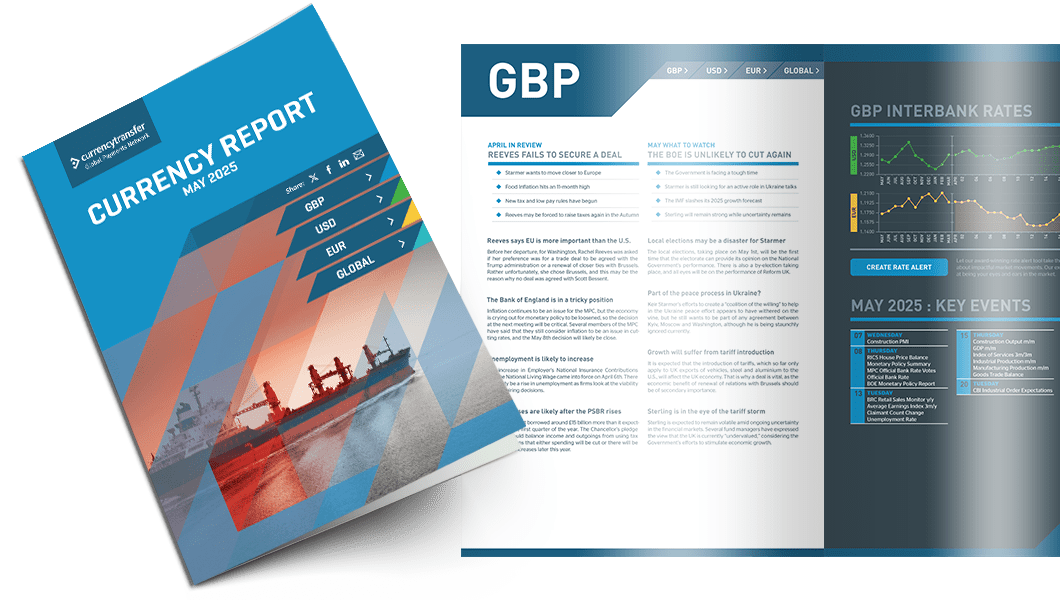
Read our latest currency report
Most impactful events planned this month and how they could impact your business
Half a billion dollars in GOP spending does little to move polls
The average 30-year fixed-rate mortgage surged 19 basis points to 7.49% in the week just ended, the Mortgage Bankers Association said yesterday. It was last higher in November 2023.
Mortgage rates are closely tied to yields on US 10-year Treasury notes, which earlier this week hit a 24-year high, driven by worries over inflationary pressures from soaring oil prices and data showing stronger US economic growth.
The cost of living is the top issue on Americans' minds as they decide how they will vote on Nov. 3, a Reuters/Ipsos poll completed on Monday showed, and is one reason why Trump's approval rating is at a record low of 32%.
Home borrowing rates are up about 1.4% since joint US-Israeli strikes against Iran began in late February, tracking a similar rise in the 10-year Treasury yield, which topped 5.3% on Monday.
Inflation is also rising, registering 3.4% in August, while the Federal Reserve targets 2%.
Fed policymakers have signalled they expect to follow their September interest-rate increase with another rate hike by year's end. However, markets are for now betting they will not move at their upcoming policy meeting at the end of October.
Mortgage loan applications fell 4.2% last week from the previous week, the MBA said on Wednesday, with refinancing applications dropping sharply.
"Very few homeowners have an incentive to refinance at these rates, and the jump in borrowing costs has caused many potential borrowers to step back from the housing market," said Joel Kan, the MBA’s deputy chief economist.
Economic sentiment continued to weaken as the latest biweekly reading of the Economic Sentiment Index (ESI) fell 0.2 points to 27.8, its fourth straight biweekly decline and a new record low.
Affordability pressures extended beyond housing, as inflation remained elevated in August. The Bureau of Economic Analysis (BEA) reported that the August Personal Consumption Expenditures (PCE) price index increased 0.3% during the month and 3.4% YoY, remaining above the Federal Reserve's 2.0%target. Core PCE, which excludes volatile food and energy prices, increased 3.0% annually.
Nevertheless, consumer spending remained resilient despite elevated prices, with personal consumption expenditures increasing 0.9% in August. Looking back to earlier in the year, GDP estimates for the second quarter showed stronger growth than previously estimated. BEA reported that real GDP increased at an annual rate of 2.2%, up from its previous estimate of 1.5%. The revision primarily reflected stronger investment, consumer spending, and government spending than previously estimated. First-quarter growth was also revised up to 2.5% from 2.1%.
The midterm elections may be remembered as the year the wealthy dominated in political spending for congressional and state elections, with questionable results.
The elections are on track to break spending records, reports the Brennan Centre for Justice, a nonprofit that advocates reducing money's influence in politics. And some of the richest Americans and corporations are dominating the spending.
However, the massive cash injection has done little. If anything, it has done little to ‘change the needle’ on voting intentions.
The US dollar weakened yesterday across most major FX pairs, driven by easing Treasury yields and a risk‑on tone in equities, though pockets of strength remained.
The IMF warns France to ‘get its house in order’
The Governor of the French Central Bank, Emmanuel Moulin, told the Financial Times that his country risks being “strangled by interest rates”.
The best solution, he made clear, was for the French government to cut costs and reduce the deficit, which, in an unchanged scenario, could reach more than six percent next year. With students rioting across France for the past two weeks over a lack of investment in the education system, pressure is mounting on Macron’s government, which faces no easy fix for the economy's problems.
Last week, the French minority government proposed €43bn in cuts for 2027. But pushing them through parliament is a tall order in a divided country.
Meanwhile, investors are dumping French bonds, pushing up French government borrowing costs relative to German benchmark Bunds. This is already immensely costly for French society.
“In three weeks, we’ve lost the equivalent of €15bn a year in higher debt-servicing costs over a 10-year horizon, or almost €100bn cumulatively over 10 years!”, French economist Shahin Vallée said on social media last week.
The spread between French and German bond yields, historically around 50 basis points, was 109 basis points yesterday morning. It ended the day up another 30 points.
Spreads are a key indicator of financial stability because they show how nervous investors are. The bigger the spread, the higher the perceived risk. France's spread is already bringing back unwelcome memories of the Eurozone crisis in November 2011, when it reached 200 basis points.
IMF Managing Director Kristalina Georgieva has told France to bring its finances under control, warning that political instability, repeated borrowing shocks, and rising debt costs are driving investors to demand sharply higher yields on French government bonds.
Georgieva commented that France has faced “borrowing shock after shock after shock, climbing a staircase that does not lead to heaven.” The political environment is making it harder to chart a credible path to fiscal tightening, even as there is a “very clear recognition” that France must bring its deficit below 5% and move toward EU targets.
Meanwhile, industrial production in Germany recovered more sharply than expected in August, as manufacturers continued to adapt to a volatile energy environment.
Output rose 2.0% on the month, after a 1.2% fall in July, according to Germany’s statistics body, Destatis, on Wednesday. That marked the strongest rise since March 2025. Economists had predicted a 0.5% rise.
Production in the eurozone’s largest economy has mostly picked up since April, as companies stockpiled inventory amid concerns over the war in the Middle East. Some German producers also gained an advantage as disruptions to raw-material supplies from the Gulf hit chemical companies based in Asia. Overall production was up 2.3% compared with August 2025.
A particularly strong rise in construction output led growth, and mechanical equipment manufacturing also increased. However, car production fell on the month, partly due to Asian competition and factory holidays.
Germany’s economy expanded solidly in the first half of the year, driven by unexpectedly strong demand for its goods exports. The government’s fiscal stimulus package continues to feed through into the economy.
The jump in construction could be linked to the build-out of artificial-intelligence data centres. However, it will probably also involve renewing Germany’s public infrastructure, said Sebastian Wanke, an economist at KfW Research.
Growth in mechanical engineering and digitisation, including data-processing equipment and lasers needed to manufacture semiconductors, shows that the global boom in AI and data centres has nevertheless taken hold in Germany, he said.
“Against this backdrop, production is set to rise and, hopefully, the joy of growth will soon return to this country,” Wanke added.
The euro fell sharply across global FX markets yesterday, recording broad losses against all G10 currencies as rising French fiscal stress, higher sovereign yields and elevated oil prices triggered risk aversion.
Have a great day!

Exchange rate movements:
07 Oct - 08 Oct 2026
Click on a currency pair to set up a rate alert
Alan Hill
Alan has been involved in the FX market for more than 25 years and brings a wealth of experience to his content. His knowledge has been gained while trading through some of the most volatile periods of recent history. His commentary relies on an understanding of past events and how they will affect future market performance.